


A rug pull is a crypto scam where developers create a token or project, generate hype to attract investors, then disappear with the funds. The term comes from the expression “pulling the rug out from under someone”—one moment you’re standing on solid ground, the next you’re watching your investment drop to zero.
According to blockchain security firm Chainalysis, rug pulls accounted for 37% of all cryptocurrency scam revenue in 2021, totaling approximately $2.8 billion in stolen funds. This guide covers how rug pulls work, the warning signs to watch for, and the due diligence steps that can help protect your capital.
Your capital is at risk. This article is for informational purposes only and does not constitute financial advice.
What is a rug pull in crypto
A rug pull is a crypto scam where developers hype up a project, attract investor money, then vanish with the funds. The name comes from the expression “pulling the rug out from under someone.” One moment you’re standing on solid ground, the next you’re flat on your back wondering what happened.
In practice, rug pulls happen most often in DeFi protocols, new token launches, and NFT collections. The decentralized nature of crypto means anyone can create a token or project without verification. That openness creates opportunity for legitimate builders and scammers alike.
DeFi protocols: Scammers create fake lending or trading platforms, collect deposits, then drain the funds
Token launches: Developers mint a new coin, pump the price through marketing, then sell everything at once
NFT projects: Creators promise future utility or rewards, collect mint revenue, then abandon the project
The aftermath looks the same across all three. Investors hold worthless assets, the developers are gone, and recovery is nearly impossible.
How do crypto rug pulls work

The playbook follows a consistent pattern, even though the details vary from scam to scam. First, someone creates a token or NFT project. The website looks professional. The roadmap promises revolutionary features. Everything appears legitimate on the surface.
Then comes the marketing blitz. Developers flood Twitter, Discord, and Telegram with hype. They might pay influencers to promote the project, announce fake partnerships with established companies, or use bot networks to simulate community excitement. The goal at this stage is simple: convince as many people as possible to buy in.
Once enough money flows into the project, the exit happens. Developers might drain the liquidity pool, dump their token holdings all at once, or simply disable the project entirely. The whole process can take weeks of buildup and minutes of execution.
| Stage | What Happens | Typical Timeline |
|---|---|---|
| Creation | Token or NFT project launches with professional appearance | Days to weeks |
| Hype | Aggressive social media marketing, influencer promotions | Weeks to months |
| Accumulation | Investors buy tokens and add liquidity to trading pools | Ongoing |
| Exit | Developers drain funds and disappear | Minutes |
The speed of that final stage catches most victims off guard. By the time anyone realizes what’s happening, the money is already gone.
Types of crypto rug pulls
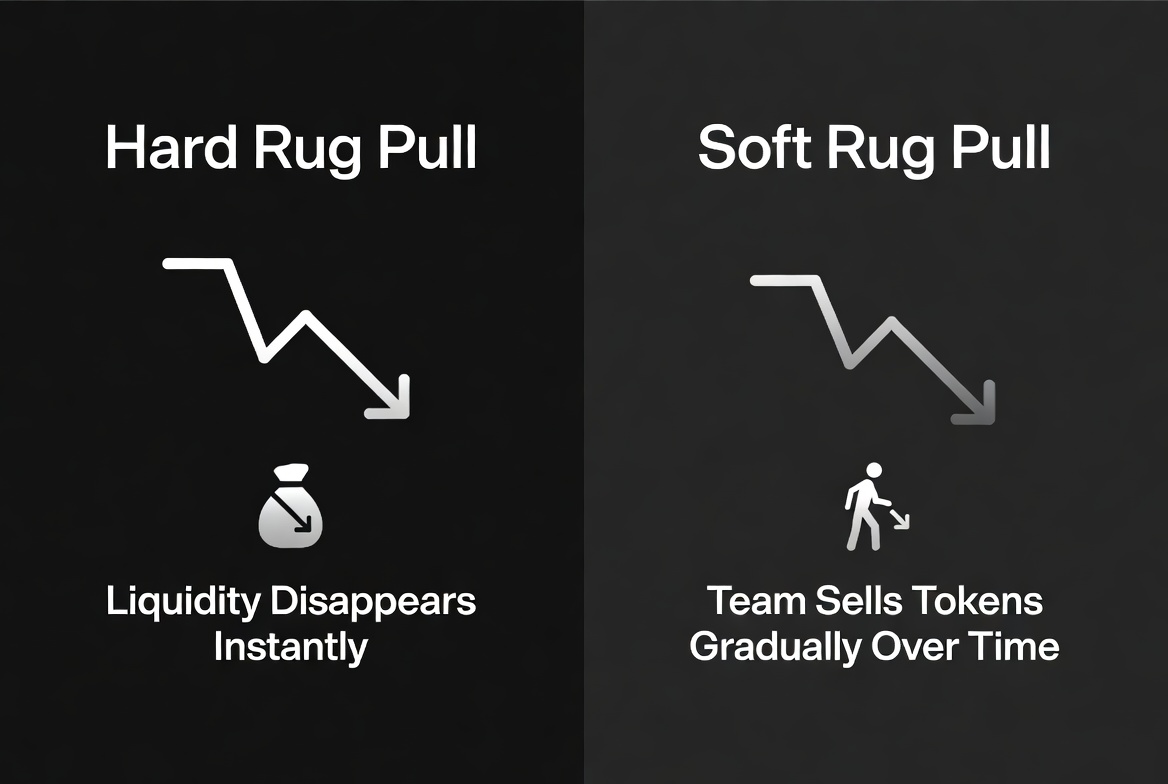
Rug pulls fall into two broad categories based on how quickly the scam unfolds.
Hard rug pulls
A hard rug pull happens all at once. Developers remove every dollar from a liquidity pool in a single transaction, or they’ve written code into the smart contract that prevents anyone except themselves from selling. The token price drops to zero instantly.
Hard rug pulls are often planned from the beginning. The malicious code exists in the contract from day one, waiting for the right moment. Investors have no warning and no time to react.
Soft rug pulls
Soft rug pulls unfold gradually over weeks or months. Developers slowly sell their token holdings while reducing communication with the community. Updates become less frequent. Questions go unanswered. By the time investors recognize the pattern, significant damage has already occurred.
This slower approach resembles traditional pump-and-dump schemes. The project appears to function normally during the early stages, which makes soft rug pulls harder to identify before it’s too late.
Common rug pull methods
Beyond the speed distinction, scammers use specific technical tactics to execute their exits.
Liquidity theft
DeFi trading relies on liquidity pools. A liquidity pool holds paired assets that enable swapping one token for another. When you trade on a decentralized exchange, you’re swapping with the pool rather than with another person.
Scammers exploit this system by creating a pool, waiting for investors to deposit funds, then withdrawing all the liquidity at once. The token becomes untradeable overnight because there’s nothing left in the pool to swap against.
This is why “locked liquidity” matters. When liquidity is locked, the funds sit in a time-locked smart contract that prevents withdrawal for a set period. Unlocked liquidity means developers can drain everything whenever they choose.
Token dumping
Some rug pulls don’t involve any technical tricks at all. Developers simply hold a large percentage of the token supply from the start. After hyping the project and inflating the price, they sell their entire position in one move.
The sudden flood of tokens crashes the price before other holders can exit. Everyone else is left holding coins worth a fraction of what they paid.
Limiting sell orders
The most deceptive method involves coding the smart contract to block sales. Investors can buy tokens freely, but when they try to sell, the transaction fails. Only wallets controlled by the developers can execute sales.
The Squid Game token used this exact mechanism in 2021. The price rose dramatically as buyers piled in, then collapsed when investors discovered they couldn’t sell. Only the developers could cash out.
Exit scams and rug pulling
Exit scams and rug pulls overlap significantly, though the terms aren’t quite identical. An exit scam is the broader category covering any fraud where operators build trust and then disappear with funds. Rug pulls are exit scams specific to crypto.
Traditional exit scams have existed for decades across many industries. What makes crypto rug pulls particularly damaging is the combination of anonymity, speed, and irreversibility that blockchain technology enables. Scammers can operate without revealing their identities, move funds instantly across borders, and exploit the fact that blockchain transactions cannot be reversed.
Rug pull red flags and warning signs
Spotting potential rug pulls before investing can prevent significant losses. No single indicator guarantees a scam, but multiple warning signs appearing together warrant serious caution.
Anonymous or unverified development team
Legitimate projects typically have founders with verifiable identities and track records. Anonymous teams aren’t automatically running scams, but anonymity does remove accountability. When something goes wrong, there’s no one to hold responsible.
Look for LinkedIn profiles, past project history, and public engagement with the community. Developers who hide their identities while asking for your money present obvious risk.
No smart contract audit
A smart contract audit is a third-party review of the code that powers a crypto project. Auditors check for vulnerabilities, bugs, and malicious functions that could harm users. Reputable firms like CertiK, Hacken, and Trail of Bits publish their findings publicly.
Unaudited contracts may contain hidden exploits or sell-blocking mechanisms. The absence of an audit doesn’t confirm a scam, but it does mean no independent expert has verified the code is safe.
Unlocked or unverified liquidity
Locked liquidity sits in a time-locked smart contract that prevents developers from withdrawing funds for a specified period. Unlocked liquidity means developers can drain the trading pool at any moment.
Blockchain explorers and DeFi tools can verify whether liquidity is locked and for how long. Short lock periods or no lock at all represent elevated risk.
Unrealistic return promises
Guaranteed high returns or “100x potential” marketing echoes classic investment fraud. Legitimate projects don’t promise specific returns because market outcomes are unpredictable. Anyone guaranteeing profits is either lying or doesn’t understand how markets work.
Concentrated token holdings
When a small number of wallets hold most of the token supply, those holders can crash the price by selling. Blockchain explorers like Etherscan reveal token distribution publicly. If the top ten wallets control 80% of supply, a coordinated dump could devastate the price.
How to avoid rug pulls in crypto
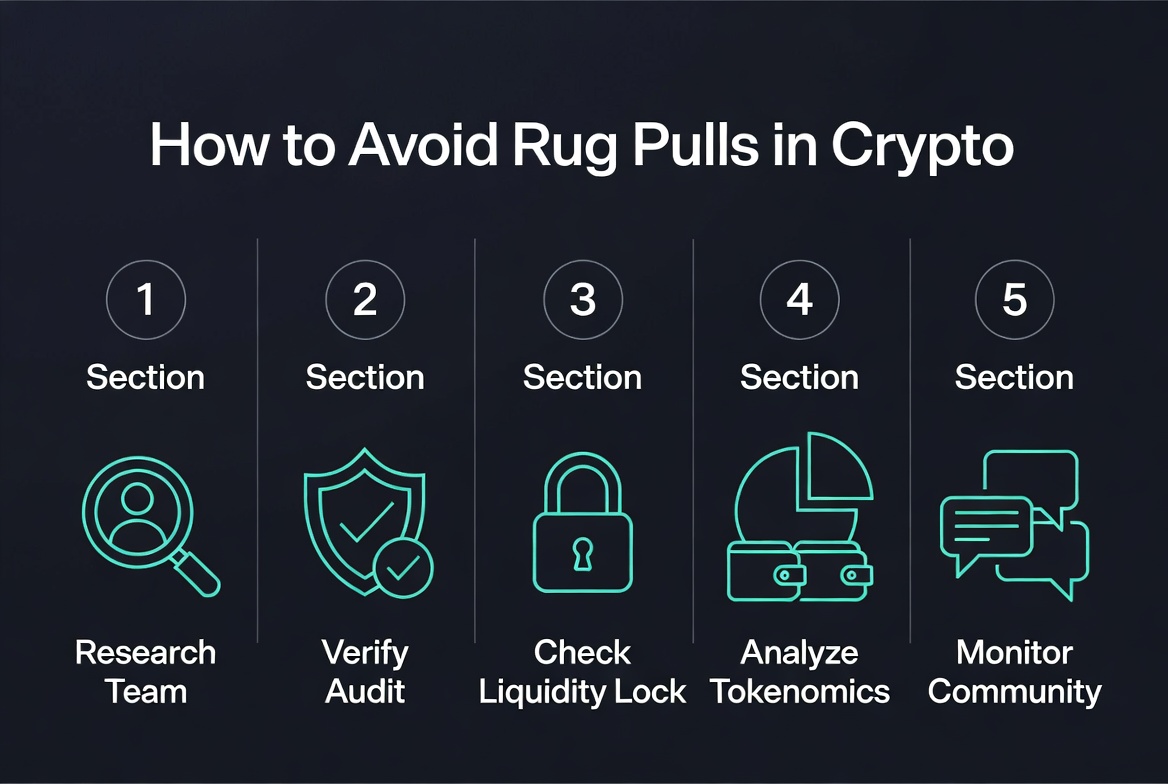
Due diligence takes time, but it remains the primary defense against rug pulls.
1. Research the development team
Verify identities through LinkedIn, Twitter, and past project involvement. Developers with established reputations have more to lose by running scams. Anonymous founders require extra scrutiny.
2. Verify smart contract audits
Check if a reputable firm has reviewed the contract code. Look for the audit report on the project’s website or through the auditing firm directly. Be aware that some scammers fabricate audit claims or use unknown auditors.
3. Check liquidity lock status
Use blockchain explorers or tools like DEXTools to verify whether liquidity is locked. Longer lock periods generally indicate lower rug pull risk, though locks can be circumvented through other methods.
4. Analyze tokenomics and distribution
Review how tokens are allocated across wallets. What percentage does the team hold? Are there vesting schedules that prevent immediate dumping? Concentrated holdings in few wallets present clear risk.
5. Monitor community signals
Organic community growth looks different from bot-driven activity. Engaged communities ask critical questions and tolerate skepticism. Echo chambers where any doubt gets banned often indicate problems.
Tip: Token scanning tools like TokenSniffer and RugDoc analyze smart contracts automatically and flag common red flags. They provide useful first-pass assessments, though they’re not foolproof.
Are rug pulls illegal
Rug pulls constitute fraud under existing laws in most jurisdictions. The challenge lies in enforcement rather than legality.
Scammers often operate anonymously, across multiple countries, through platforms that don’t require identity verification. Traditional law enforcement approaches struggle with this combination. Identifying perpetrators is difficult. Prosecuting across borders is complicated. Recovering funds is nearly impossible.
Some cases have resulted in charges. In 2022, US authorities charged the creators of the Frosties NFT project with wire fraud and money laundering conspiracy. Turkish authorities issued an Interpol red notice for Thodex exchange’s CEO. As regulatory frameworks mature, prosecutions may become more common, though most rug pull operators currently face no consequences.
Famous crypto rug pull examples
Past crypto scams illustrate how rug pulls operate in practice and the scale of damage they can cause.
Thodex exchange
Turkish crypto exchange Thodex collapsed in 2021 when CEO Faruk Fatih Özer allegedly fled the country with user funds. The exchange had over 400,000 active users at the time. This case represents one of the largest exchange-based exit scams in crypto history.
AnubisDAO
This DeFi project raised approximately $60 million in ETH, then saw its liquidity drained within 20 hours of launch. The speed demonstrated how quickly hard rug pulls can occur when malicious intent exists from the start.
Squid Game token
Capitalizing on the Netflix show’s popularity, this meme coin employed a sell-limiting mechanism in its smart contract. The price surged as investors bought in, then collapsed when they discovered only developers could sell. The scam gained widespread media attention due to its connection to the popular show.
Frosties NFT
This NFT project promised rewards and community benefits to holders. After selling out the collection, developers abandoned the project and deleted all social media accounts. US authorities later charged the creators, making Frosties one of the first NFT rug pulls to result in federal prosecution.
Rug pull vs pump and dump
Rug pulls and pump-and-dump schemes share similarities but differ in execution and outcome.
Both involve artificial price inflation through coordinated hype. The key difference lies in what happens afterward. Pump-and-dump schemes involve selling after inflating prices, but the underlying asset may continue trading. Rug pulls typically destroy the project entirely through liquidity removal or contract manipulation.
| Aspect | Rug Pull | Pump and Dump |
|---|---|---|
| Primary method | Liquidity removal or project abandonment | Coordinated selling after price inflation |
| Project survival | Project typically dies completely | Asset may continue trading |
| Technical manipulation | Often involves smart contract exploits | Usually just market manipulation |
| Common in | DeFi, NFTs, new token launches | Stocks, crypto, any tradeable asset |
Pump-and-dump schemes are illegal in regulated securities markets. In crypto, enforcement remains inconsistent, and both tactics continue to harm investors.
Protecting your capital in crypto markets
Rug pulls represent one of many risks in cryptocurrency investing. The decentralized nature of crypto creates both opportunity and vulnerability.
Diversification: Spreading investments across multiple projects limits exposure to any single scam
Established platforms: Trading on exchanges with security track records reduces counterparty risk
Ongoing research: Following reputable crypto news helps identify emerging scams and market developments
Skepticism: Offers that seem too good to be true usually are
For ongoing cryptocurrency market coverage and project updates, AtoZ Markets’ Cryptocurrency News section provides daily reporting on market developments and industry alerts.
FAQs about crypto rug pulls
Can investors recover funds after a crypto rug pull?
Recovery is extremely rare. Blockchain transactions are irreversible, and scammers typically use mixing services or multiple wallet transfers to obscure fund movements. Some victims have pursued legal action, but most funds are never recovered. The decentralized nature of crypto that enables innovation also enables theft without recourse.
What blockchain tools help detect potential rug pulls?
Token scanners like TokenSniffer and RugDoc analyze smart contracts automatically and flag common red flags. Blockchain explorers like Etherscan reveal token distribution, holder counts, and transaction history. DEXTools provides real-time trading data and liquidity analysis. None of these tools guarantee safety, but they provide useful information for due diligence.
Have any rug pull perpetrators been criminally prosecuted?
Yes, though prosecutions remain relatively uncommon. The Frosties NFT creators faced US federal charges in 2022. Turkish authorities issued an Interpol red notice for Thodex’s CEO. South Korean authorities have pursued several cases related to crypto fraud. As regulatory frameworks develop and law enforcement gains expertise, prosecutions may increase.
How can investors verify if a crypto project has locked liquidity?
Blockchain explorers show whether liquidity tokens have been sent to a time-lock contract address. Third-party services like Team Finance and Unicrypt provide liquidity lock verification and display lock duration publicly. The lock contract address and duration are typically visible on-chain, allowing independent verification.