

In an era where markets never sleep and opportunity exists across every continent, the trading platform you choose can be the difference between thriving and merely surviving as an investor. Whether you’re a first-time investor dipping your toes into the stock market or a seasoned professional executing high-frequency forex trades, your platform is your gateway — and not all gateways are created equal.
The global trading landscape has evolved dramatically over the past decade. Retail investors now have access to tools, markets, and asset classes that were once reserved for institutional players. Cryptocurrency markets run 24/7. Fractional shares make blue-chip stocks accessible to anyone. Copy trading lets beginners mirror the strategies of professionals in real time. The barrier to entry has never been lower — but so has the barrier to making a costly mistake by choosing the wrong broker.
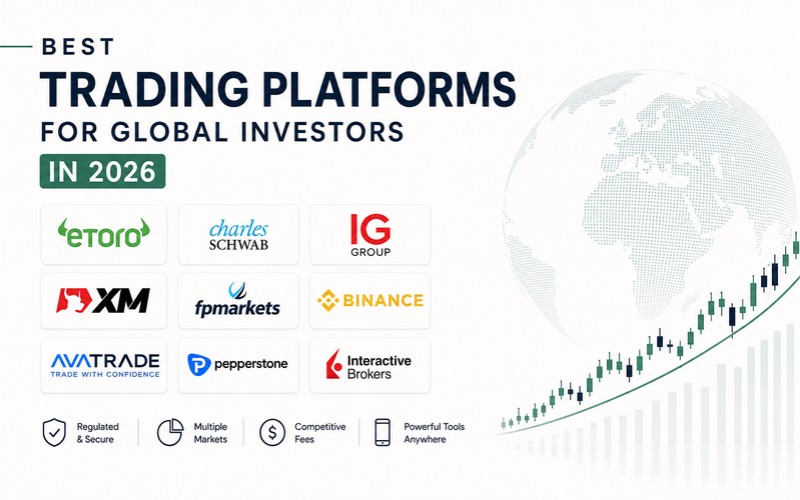
This article is your definitive guide to the best trading platforms for global investors in 2026. We’ve evaluated the most widely used platforms across key metrics — regulation, fees, asset variety, usability, and customer support — to bring you a comprehensive breakdown of the top nine. Whether you’re based in New York, London, Singapore, Lagos, or Dubai, there’s a platform on this list suited to your needs.
What to Look for in a Global Trading Platform
Before diving into specific platforms, it’s worth establishing the criteria that separate great trading platforms from mediocre ones. Here’s what every global investor should evaluate:
1. Regulation and Licensing
A regulated broker operates under oversight from a recognized financial authority — ensuring your funds are protected, trades are executed fairly, and the company is held to legal standards. Look for regulation from bodies such as the FCA (UK), SEC/FINRA (USA), ASIC (Australia), CySEC (Cyprus/EU), or MAS (Singapore). Unregulated platforms should be avoided at all costs.
2. Asset Variety
Top global platforms offer access to multiple asset classes: stocks and ETFs, forex, commodities (gold, oil), indices, bonds, cryptocurrencies, and derivatives. The broader the offering, the more flexibility you have to diversify your portfolio.
3. Fee Structure
Fees come in many forms — trading commissions, spreads, overnight financing charges, inactivity fees, and withdrawal fees. Low costs don’t always mean the best value; transparency and clarity of fees matter just as much.
4. Platform Usability
A clean, intuitive interface reduces errors and speeds up decision-making. Look for platforms with robust charting tools, research features, real-time data, and seamless order execution — both on desktop and mobile.
5. Customer Support
When something goes wrong — and occasionally it will — responsive support is critical. Evaluate availability (24/5 vs. 24/7), channels (live chat, phone, email), and language support.
6. Deposit and Withdrawal Options
Check which payment methods are supported (bank transfer, credit/debit cards, e-wallets), processing times, minimum deposits, and any associated fees.
7. Mobile Experience
In 2026, most active traders execute at least some trades on mobile. A well-designed app with full functionality is no longer a luxury — it’s a baseline requirement.
Top 9 Best Trading Platforms Globally 2026
1. eToro
Overview: Launched in 2007 and headquartered in Cyprus, eToro revolutionized retail investing with its pioneering social trading and copy trading ecosystem. With over 35 million registered users across more than 140 countries, it remains one of the most recognizable trading brands in the world. eToro’s mission has always been to democratize investing — and in large part, it has succeeded.
Supported Markets & Assets: Stocks, ETFs, cryptocurrencies (75+), commodities, indices, and forex. Offers fractional share investing and a proprietary CopyTrader feature that allows users to automatically mirror the portfolios of top-performing investors.
Fee Structure: – Zero commission on stocks and ETFs (spreads apply) – Spreads on forex and crypto (variable; e.g., 1 pip on EUR/USD) – $5 withdrawal fee – $10/month inactivity fee after 12 months of no login – Minimum deposit: $50–$200 (varies by country)
Regulation & Safety: Regulated by FCA (UK), CySEC (EU), and ASIC (Australia). eToro USA LLC is registered with FinCEN. Client funds are held in top-tier banks in segregated accounts.
Pros: – Industry-leading CopyTrader and social trading features – Beginner-friendly interface with intuitive navigation – Wide geographic availability (140+ countries) – Free virtual portfolio ($100,000 demo) for practice – Strong crypto offering with real asset ownership
Cons: – Wide spreads make it less competitive for active day traders – Limited advanced charting and technical analysis tools – Withdrawal and inactivity fees add up for casual users – Not available to US residents for full stock trading
Best Suited For: Beginner investors, social and copy traders, long-term passive investors, and crypto enthusiasts.
Read Also: eToro Full Review
2. Charles Schwab
Overview: Charles Schwab is the largest retail brokerage in the United States by assets under management, with over $9 trillion in client assets. Following its landmark acquisition of TD Ameritrade, Schwab now combines its own powerful platform with the legendary thinkorswim trading suite — making it a dominant force for North American investors. It has also been expanding its international presence in recent years.
Supported Markets & Assets: US and international stocks, ETFs, mutual funds, options, futures, forex, bonds, CDs, and retirement accounts (IRAs, 401k rollovers).
Fee Structure: – $0 commissions on US-listed stocks and ETFs – Options: $0.65 per contract (no base fee) – No account minimums for standard accounts – No inactivity fees – Forex: spread-based pricing
Regulation & Safety: Regulated by the SEC and FINRA. SIPC-insured up to $500,000 (with excess coverage through Lloyd’s of London). One of the most financially sound and transparent brokers in existence.
Pros: – thinkorswim is among the most powerful retail trading platforms in the world – Exceptional educational content and research tools – Zero commissions on stocks and ETFs – Superb retirement account options – Publicly listed with outstanding financial stability
Cons: – Primarily US-centric; limited access for non-US residents – International stock selection narrower than global-first brokers – Currency conversion fees apply for non-USD transactions – Interface can feel complex for absolute beginners
Best Suited For: US-based investors, options traders, retirement-focused investors, and experienced traders who want institutional-quality tools.
Read Also: Charles Schwab Full Review
3. IG Group
Overview: Founded in London in 1974, IG Group is one of the oldest and most respected trading platforms in the world. Listed on the London Stock Exchange (LSE: IGG), IG offers access to over 17,000 markets and is particularly renowned for its CFD trading, spread betting (UK/Ireland), and share dealing services. It has a strong presence across Europe, Asia-Pacific, and Africa.
Supported Markets & Assets: Shares, indices, forex, commodities, cryptocurrencies, ETFs, bonds, options, and interest rates — primarily via CFDs and spread betting. Direct share dealing available in the UK/Ireland.
Fee Structure: – Spread-based pricing on most instruments (no commissions on CFDs) – Share dealing (UK): From £3 per trade (free if 3+ trades in previous month) – No inactivity fee for the first 2 years; £12/month thereafter – Competitive overnight funding rates
Regulation & Safety: Regulated by FCA (UK), ASIC (Australia), MAS (Singapore), FSCA (South Africa), DFSA (Dubai), and others. As a listed company with 50 years of history, IG’s financial transparency is exceptional.
Pros: – Massive range of 17,000+ tradable instruments – Industry-leading web and mobile trading platform – Excellent IG Academy with free educational courses – Strong research and market commentary – Available in most regions globally (excl. US)
Cons: – CFD trading carries high risk; most retail clients lose money – Not available to US residents – Inactivity fee kicks in after 2 years – Spread costs can be higher than ECN brokers for active forex traders
Best Suited For: European and Asia-Pacific traders, CFD traders, spread bettors (UK/Ireland), and investors seeking a wide market range.
Read Also: IG Full Review
4. XM Group
Overview: Founded in 2009 and operating under Trading Point of Financial Instruments, XM has grown into one of the world’s largest forex and CFD brokers, serving over 10 million clients in 190+ countries. XM is particularly popular in emerging markets due to its very low minimum deposit, multilingual support (30+ languages), and generous bonus programs. It is a staple choice for retail forex traders worldwide.
Supported Markets & Assets: 1,400+ instruments including forex (55+ pairs), stocks (as CFDs), commodities, indices, precious metals, energies, and cryptocurrencies.
Fee Structure: – Standard Account: No commission; spreads from 1 pip (EUR/USD) – Ultra Low Account: Spreads from 0.6 pip; no commission – XM Zero Account: Spreads from 0 pip + $3.50 commission per lot – Minimum deposit: $5 (one of the lowest globally) – $15 inactivity fee after 90 days of inactivity
Regulation & Safety: Regulated by CySEC (EU), ASIC (Australia), IFSC (Belize), and DFSA (Dubai). EU clients receive negative balance protection and fund segregation.
Pros: – Extremely low $5 minimum deposit — accessible to all – Supports MT4 and MT5 with a wide range of tools – 30+ language support; strong emerging market presence – Generous welcome bonuses and loyalty rewards – 24/5 multilingual customer support
Cons: – Bonus programs have complex terms and conditions – IFSC (Belize) entity used for some clients offers weaker protection – Not available in the US or some other restricted jurisdictions – Inactivity fee starts after only 90 days
Best Suited For: Beginner-to-intermediate forex traders, traders in emerging markets (Asia, Africa, Middle East, Latin America), and those with limited starting capital.
Read Also: XM Full Review
5. FP Markets
Overview: Founded in 2005 in Sydney, FP Markets (First Prudential Markets) is an ASIC-regulated broker that has quietly built a formidable reputation among serious forex and CFD traders. It is particularly well-regarded for its RAW spread accounts, fast execution speeds, and support for third-party trading tools including TradingView, Autochartist, and IRESS (for direct market access to ASX stocks).
Supported Markets & Assets: Forex (70+ pairs), shares (CFDs and DMA), indices, commodities, metals, cryptocurrencies, bonds, and ETFs. Notably, FP Markets offers real share trading via IRESS — rare among CFD brokers.
Fee Structure: – Standard Account: No commission; spreads from 1.0 pip – Raw Account: Spreads from 0.0 pip + $3 commission per lot (round turn) — among the most competitive globally – Minimum deposit: $100 – No inactivity fee
Regulation & Safety: Regulated by ASIC (Australia) and CySEC (Cyprus). Also holds licenses in St. Vincent & the Grenadines and Kenya (CMA). Client funds segregated in top-tier Australian banks.
Pros: – RAW spread accounts with extremely tight spreads – Supports MT4, MT5, cTrader, TradingView, and IRESS – Direct market access to real stocks via IRESS platform – Strong execution speed with minimal slippage – No inactivity fees
Cons: – Less well-known globally compared to larger brands – IRESS platform requires a higher minimum deposit – Limited educational resources for beginners – Customer support can be slower during off-peak hours
Best Suited For: Intermediate-to-advanced forex traders, scalpers and algorithmic traders, and Australian investors wanting direct market access to ASX stocks.
Read Also: FP Markets Full Review
6. Binance
Overview: Founded in 2017 by Changpeng Zhao (CZ), Binance rapidly became the world’s largest cryptocurrency exchange by trading volume. Despite a turbulent period of regulatory scrutiny globally — including a landmark $4.3 billion DOJ settlement in 2023 — Binance remains the dominant force in crypto trading in 2026, serving hundreds of millions of users worldwide. It has since strengthened its compliance framework significantly.
Supported Markets & Assets: 350+ cryptocurrencies for spot trading, futures, options, margin trading, staking, savings, NFTs, and launchpad (new token listings). Also offers Binance Pay and peer-to-peer trading.
Fee Structure: – Spot trading: 0.10% per trade (discounted with BNB token usage) – Futures: 0.02% maker / 0.05% taker – VIP tiers for high-volume traders with significantly reduced fees – Withdrawals: Variable by network (typically low) – No inactivity fees
Regulation & Safety: Regulated in France (AMF), Abu Dhabi (FSRA), Bahrain, El Salvador, and others. Binance.US operates under US state money transmitter licenses. Note: regulatory landscape varies significantly by country — always verify availability in your jurisdiction.
Pros: – Widest selection of cryptocurrencies globally (350+) – Extremely competitive trading fees, especially with BNB discounts – Advanced trading tools including futures, options, and margin – High liquidity across virtually all major crypto pairs – Earn products: staking, savings, and yield farming
Cons: – Complex regulatory situation in several countries (including restricted/banned in some) – Not suitable for non-crypto investing – Interface can overwhelm beginners given the sheer range of products – Past regulatory controversies may concern risk-averse investors – Not available to US residents via the global platform (Binance.US is a separate, limited entity)
Best Suited For: Crypto-focused traders, DeFi participants, advanced crypto investors, and those seeking the widest possible selection of digital assets.
Read Also: Binance Full Review
7. AvaTrade
Overview: Founded in Dublin in 2006, AvaTrade is a globally regulated forex and CFD broker serving over 400,000 active clients in more than 150 countries. It is particularly well-regarded for the breadth of its regulatory licences — holding approvals across six continents — and for its support of automated trading through MetaTrader platforms, ZuluTrade, and its proprietary AvaOptions platform for vanilla options trading.
Supported Markets & Assets: Forex (55+ pairs), stocks (as CFDs), indices, commodities, cryptocurrencies, bonds, ETFs, and vanilla options via AvaOptions. Over 1,250 instruments in total.
Fee Structure: – No commissions; spread-based pricing – EUR/USD spread: From 0.9 pip (competitive for a no-commission model) – $50 inactivity fee after 3 months; $100 dormant account fee after 12 months – Minimum deposit: $100 – No deposit or withdrawal fees
Regulation & Safety: Regulated by the Central Bank of Ireland (EU), ASIC (Australia), FSA (Japan), FSCA (South Africa), ADGM/FSRA (Abu Dhabi), and ISA (Israel). One of the most broadly regulated brokers in the world — a significant trust indicator.
Pros: – Regulated on six continents — exceptional global credibility – Supports MT4, MT5, AvaTradeGO (mobile), ZuluTrade, and DupliTrade – AvaOptions is a unique and powerful platform for options traders – No deposit or withdrawal fees – Strong customer support in multiple languages
Cons: – High inactivity fees ($50 after just 3 months — among the worst in the industry) – Spreads slightly wider than ECN/RAW brokers like Pepperstone or FP Markets – No real stock ownership (CFD only) – Not available to US residents
Best Suited For: Forex and CFD traders seeking a globally regulated broker, options traders using AvaOptions, and algorithmic traders using ZuluTrade or DupliTrade.
Read Also: AvaTrade Full Review
8. Pepperstone
Overview: Founded in Melbourne in 2010, Pepperstone has established itself as one of the premier forex and CFD brokers in the world, built on a foundation of ultra-tight spreads, lightning-fast execution, and robust multi-platform support. Originally serving the Australian market, Pepperstone has expanded aggressively and now holds regulatory licences across five jurisdictions, serving clients in 160+ countries.
Supported Markets & Assets: Forex (90+ pairs), indices, commodities, shares (as CFDs), ETFs, and cryptocurrencies — all traded as CFDs. Over 1,200 instruments available.
Fee Structure: – Standard Account: No commission; spreads from 1.0 pip (EUR/USD) – Razor Account: Spreads from 0.0 pip + $3.50 commission per lot (round turn) — among the tightest in the market – No inactivity fees – No deposit or withdrawal fees (third-party charges may apply) – Minimum deposit: $0 (no formal minimum)
Regulation & Safety: Regulated by ASIC (Australia), FCA (UK), DFSA (Dubai), CMA (Kenya), SCB (Bahamas), and BaFin (Germany). Client funds held in segregated accounts at Tier-1 banks.
Pros: – Consistently among the tightest spreads globally for major forex pairs – Supports MT4, MT5, cTrader, and TradingView natively – Blazing-fast execution with minimal requotes — ideal for scalping and HFT – No inactivity fees and no minimum deposit – Excellent multilingual 24/5 customer support
Cons: – CFD-only platform; no real stock or physical asset ownership – Not available to US residents – Lighter on research and educational content vs. larger platforms – Limited proprietary platform (relies on third-party tools)
Best Suited For: Active forex traders, scalpers, algorithmic and automated traders, and any trader who prioritizes execution quality and low costs above all else.
Read Also: Pepperstone Full Review
9. Interactive Brokers (IBKR) — Strong Contender
Overview: Founded in 1978 and publicly listed on NASDAQ (IBKR), Interactive Brokers is the gold standard for professional and institutional-grade retail trading. No other platform on this list matches its global market access — 150+ markets in 33 countries and 27 currencies — or its sheer breadth of asset classes. While not the most beginner-friendly platform, it is unambiguously the most powerful, and in 2026 it remains the first choice for serious global investors.
Supported Markets & Assets: Stocks, ETFs, options, futures, forex, bonds, mutual funds, cryptocurrencies, structured products, and hedge funds — across North America, Europe, Asia-Pacific, Latin America, and the Middle East.
Fee Structure: – IBKR Lite: $0 commissions on US stocks and ETFs – IBKR Pro: From $0.0005 per share (US stocks); tiered pricing across all asset classes – Margin rates: Among the lowest in the industry (from ~5.8% for USD) – No inactivity fees – Very low forex commissions (0.08–0.20 basis points of trade value)
Regulation & Safety: Regulated by SEC, FINRA, FCA, ASIC, MAS, IIROC (Canada), and many others. Client funds protected by SIPC up to $500,000 for US clients, with additional excess SIPC coverage.
Pros: – Unmatched global market access across 150+ markets – The most competitive margin rates available to retail traders – Trader Workstation (TWS): incredibly powerful professional platform – Strong API access for algorithmic and quantitative traders – Best-in-class research, portfolio analytics, and risk management tools
Cons: – Steep learning curve; TWS interface is notoriously complex for beginners – Customer support can be slow and inconsistent – The sheer range of features can be overwhelming – IBKR Lite (commission-free) available only in the US
Best Suited For: Professional traders, active investors, algorithmic traders, and anyone requiring the deepest global market access available to a retail investor.
Read Also: Interactive Brokers Full Review
Platform Comparison Table
| Platform | Best For | Min. Deposit | Commission | Forex | Crypto | Key Regulation |
|---|---|---|---|---|---|---|
| eToro | Beginners / Copy Trading | $50–$200* | $0 stocks (spreads) | Yes | Yes | FCA, CySEC, ASIC |
| Charles Schwab | US Investors / Retirement | $0 | $0 stocks | Yes | No | SEC, FINRA |
| IG Group | CFD / Wide Market Range | $0 | Spread-based | Yes | Yes | FCA, ASIC, MAS |
| XM | Emerging Markets / Forex | $5 | $0 (Std) / $3.50/lot (Zero) | Yes | Yes | CySEC, ASIC |
| FP Markets | Scalping / RAW Spreads | $100 | $0 (Std) / $3/lot (Raw) | Yes | Yes | ASIC, CySEC |
| Binance | Crypto / DeFi | $0 | 0.10% spot | No | Yes | AMF, FSRA |
| AvaTrade | Global Regulated / Options | $100 | Spread-based | Yes | Yes | CBI, ASIC, FSCA |
| Pepperstone | Forex / Execution Speed | $0 | $0 (Std) / $3.50/lot (Razor) | Yes | Yes | ASIC, FCA, DFSA |
| Interactive Brokers | Professionals / Global Access | $0 | From $0 | Yes | Yes | SEC, FCA, ASIC |
*eToro minimum deposit varies by country
Best Platforms by Category
🏆 Best for Beginners
eToro — Social trading, copy trading, and a clean interface make it the ideal entry point for new investors. The $100,000 virtual demo portfolio lets you practice risk-free before committing real money.
📈 Best for Forex Trading
Pepperstone — Ultra-tight spreads on the Razor account, multi-platform support (MT4, MT5, cTrader, TradingView), and best-in-class execution make it the top choice for dedicated forex traders globally.
🏦 Best for Stock Trading
Charles Schwab — For US investors, Schwab’s zero-commission structure and the power of thinkorswim make it the premier equity trading platform. For global stock access, Interactive Brokers is unbeaten.
💰 Best for Low Fees
FP Markets (RAW Account) — Spreads from 0.0 pip with only $3 commission per lot round-turn makes FP Markets one of the most cost-effective platforms for active traders globally.
🪙 Best for Crypto
Binance — With 350+ cryptocurrencies, the deepest liquidity, the lowest trading fees, and the widest range of crypto products (spot, futures, staking, savings), Binance is the undisputed leader for crypto traders.
🎓 Best for Professionals
Interactive Brokers — Unmatched market access, institutional-grade tools, the lowest margin rates in retail, and a full API for algorithmic trading make IBKR the professional’s platform of choice.
🌍 Best for Emerging Market Traders
XM — A $5 minimum deposit, 30+ language support, and availability in 190+ countries make XM the most accessible platform for traders in Asia, Africa, Latin America, and the Middle East.
⚙️ Best for Automated / Algorithmic Trading
Pepperstone / FP Markets — Both support MT4/MT5 Expert Advisors, cTrader cBots, and have the fast execution infrastructure needed for algorithmic strategies.
📱 Best Mobile Experience
eToro / AvaTrade (AvaTradeGO) — Both offer polished, feature-rich mobile apps that provide a complete trading experience on the go.
How Global Regulations Affect Your Choice
Regulation is not just a formality — it is your primary safety net as a retail investor. Here’s a quick overview of the key regulators and what they mean for you:
FCA (Financial Conduct Authority) — United Kingdom One of the world’s most respected regulators. FCA-regulated brokers must maintain client money in segregated accounts, provide clear risk disclosures, and adhere to strict conduct rules. Offers strong investor protection including negative balance protection for retail clients.
SEC & FINRA — United States The SEC oversees securities markets; FINRA regulates broker-dealers. US regulation is among the most stringent globally. SIPC protection covers up to $500,000 in the event of broker insolvency. Note: most international forex/CFD brokers cannot legally serve US residents.
ASIC (Australian Securities and Investments Commission) — Australia ASIC is a highly respected regulator with strong client protection rules, especially around CFD leverage limits, negative balance protection, and clear product disclosure requirements.
CySEC (Cyprus Securities and Exchange Commission) — European Union CySEC is the most common regulator for EU-based forex and CFD brokers. Brokers regulated by CySEC can passport services across the EU under MiFID II, offering EU-wide investor protections.
MAS (Monetary Authority of Singapore) — Singapore / Asia MAS is the gold standard regulator in Asia-Pacific. Brokers licensed by MAS are considered highly trustworthy and are popular among Southeast Asian and broader Asian investors.
DFSA (Dubai Financial Services Authority) — Middle East The DFSA regulates brokers operating in the DIFC (Dubai International Financial Centre) and is considered one of the strongest regulators in the Middle East.
Key Takeaway: Always verify a broker’s regulatory status on the official regulator’s website. Never take a broker’s word for it alone.
Tips for Choosing the Right Platform for Your Region
North America
US residents should prioritize SEC/FINRA-regulated platforms. Charles Schwab and Interactive Brokers lead the pack. Most forex and CFD brokers on this list (IG, XM, AvaTrade, Pepperstone) cannot legally serve US retail clients. Binance.US is a separate and more limited entity for US crypto traders.
Europe
eToro, IG, AvaTrade, XM, Pepperstone, and FP Markets all hold CySEC or FCA regulation and can serve European clients. Look for MiFID II compliance and negative balance protection. Post-Brexit UK investors should confirm FCA regulation specifically.
Asia-Pacific
Pepperstone and FP Markets are Australian-headquartered with ASIC regulation — ideal for Australian traders. Interactive Brokers and IG offer strong coverage of Asian markets. MAS-regulated entities from IG and Pepperstone serve Singapore-based investors.
Middle East
IG, Pepperstone, and AvaTrade all hold DFSA (Dubai) or ADGM licences and actively serve the UAE, Saudi Arabia, and wider Gulf region. XM also has a strong presence in the Middle East.
Africa
AvaTrade (FSCA), Pepperstone (CMA Kenya), and XM serve African markets. South African traders should look for FSCA regulation. eToro and Binance also serve many African nations, though local payment support varies.
Common Mistakes to Avoid When Picking a Trading Platform
- Choosing an Unregulated Broker This is the single most dangerous mistake you can make. Unregulated brokers operate with no oversight, and your funds have no legal protection. If they disappear, so does your money. Always verify regulation independently.
- Ignoring the Total Fee Structure A “zero commission” platform isn’t necessarily free. Wide spreads, overnight financing charges, currency conversion costs, inactivity fees, and withdrawal fees can silently erode your returns. Always calculate the all-in cost of trading.
- Overlooking Geographic Restrictions Many platforms don’t accept clients from all countries — or offer a different (sometimes weaker) regulatory entity to certain regions. Always verify that the platform is available and fully regulated in your jurisdiction.
- Falling for Bonus Traps Some brokers offer large deposit bonuses with complex withdrawal conditions. These bonuses are designed to retain your capital, not reward you. Always read the terms carefully before accepting any bonus.
- Not Testing the Platform First Most reputable brokers on this list offer demo accounts. Use them. Practice with virtual funds before committing real capital. This lets you evaluate execution speed, interface quality, and tool availability without risk.
- Choosing Based on Advertising Alone Heavy marketing, influencer promotions, and celebrity endorsements are not indicators of quality or regulatory safety. Research independently, read verified third-party reviews, and confirm regulation directly with the relevant authority.
- Neglecting Customer Support Test support before you deposit. Send a pre-sales query and evaluate response time and quality. Discovering poor support when you’re in the middle of a trade problem is far too late.
Conclusion
The best trading platform in 2026 is not a single universal answer — it depends entirely on who you are, where you live, and how you trade.
- If you’re a beginner looking for simplicity and social features, eToro is your best starting point.
- If you’re a US-based investor seeking professional tools and zero commissions, Charles Schwab is unrivalled.
- If you’re a dedicated forex or CFD trader who demands the tightest spreads and fastest execution, Pepperstone or FP Markets will serve you best.
- If you’re a crypto-focused investor who needs the widest asset selection and lowest fees, Binance remains the dominant platform.
- If you’re a globally regulated broker — available across multiple continents with a strong compliance record, AvaTrade earns its reputation.
- If you’re in an emerging market with limited capital, XM’s $5 minimum deposit and multi-language support makes it the most accessible choice.
- If you’re a professional or institutional-grade trader requiring access to every major market on earth, Interactive Brokers stands in a class of its own.
Whatever you choose, prioritize regulation above all else. In a world where new platforms constantly launch and disappear, the protection of a robust regulatory framework is your single most important safeguard.
Do your due diligence, use demo accounts, start small, and scale up as your confidence and expertise grow. The global markets are open — the right platform is your key to accessing them.
Disclaimer: This article is for informational purposes only and does not constitute financial advice. Trading involves significant risk, including the possible loss of your entire invested capital. CFD trading is particularly high risk. Always conduct your own research and consider seeking advice from an independent financial advisor before investing.