

The Middle East and North Africa (MENA) region has rapidly emerged as one of the most dynamic and fastest-growing forex trading markets in the world. From the gleaming financial towers of Dubai’s DIFC and Abu Dhabi’s ADGM to the bustling trading communities in Riyadh, Cairo, Doha, and Amman, millions of traders across MENA are actively seeking reliable, regulated, and Sharia-compliant forex brokers to participate in the world’s largest financial market.
What sets the MENA region apart from other global trading hubs is a unique combination of factors: a robust and evolving regulatory environment, a predominantly Muslim population that demands Islamic (swap-free) trading accounts, rapidly growing economies fueled by oil revenues and diversification initiatives, and a young, tech-savvy trader base hungry for investment opportunities.
In this comprehensive guide, we have researched and reviewed the best forex brokers operating in the MENA region for 2026, drawing on insights from leading industry sources. Whether you are a beginner trader in Cairo, a seasoned scalper in Dubai, or an institutional investor in Riyadh, this guide is designed to help you make an informed decision.
Risk Disclaimer: Forex and CFD trading involves significant risk of loss and is not suitable for all investors. Leverage can work against you. Between 51% and 89% of retail investor accounts lose money when trading CFDs. Please ensure you fully understand the risks involved before trading.
Why Is the MENA Region a Major Forex Trading Hub?
1. Strategic Geographic Location
Sitting at the crossroads of Europe, Asia, and Africa, the MENA region benefits from overlapping trading sessions with multiple global financial markets. Traders in the UAE, for instance, can actively participate in both Asian and European sessions within a single trading day — a rare advantage that maximises trading opportunities.
2. Thriving Financial Centres
Dubai (home to the DIFC), Abu Dhabi (ADGM), Bahrain, and Riyadh have all invested heavily in building world-class financial infrastructure. The UAE in particular has become a magnet for global brokers seeking a regulated, tax-efficient base in the region.
3. Robust Regulatory Framework
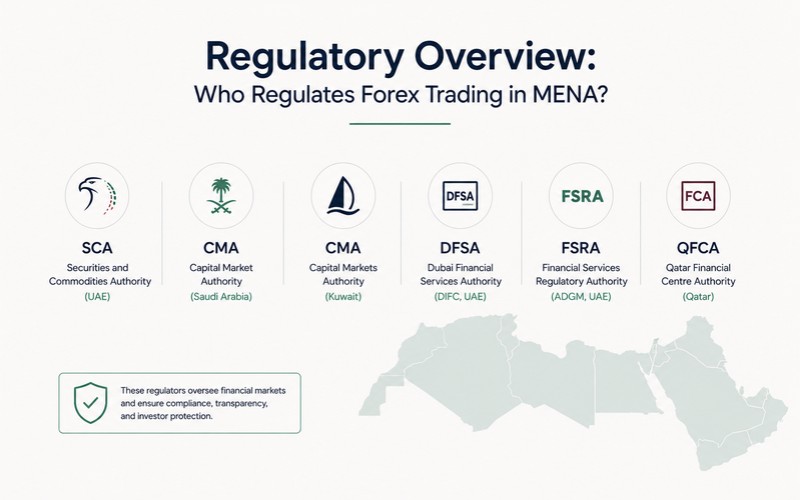
The MENA regulatory landscape is well-developed, with several authoritative bodies overseeing forex trading activities:
– UAE Securities and Commodities Authority (SCA/CMA): The primary federal regulator overseeing forex and CFD brokers operating on the UAE mainland.
– Dubai Financial Services Authority (DFSA): Regulates financial services firms operating within the Dubai International Financial Centre (DIFC), considered one of the most prestigious regulatory designations globally.
– Financial Services Regulatory Authority (FSRA): Governs financial activities within Abu Dhabi’s ADGM financial free zone.
– Saudi Capital Market Authority (CMA): Oversees financial markets in Saudi Arabia.
– Financial Regulatory Authority (FRA): Egypt’s primary financial markets regulator.
– Central Bank of Jordan: Oversees financial institutions including forex brokers in Jordan.
These regulators enforce strict standards around client fund segregation, fair pricing, operational transparency, and dispute resolution mechanisms, making the MENA region one of the safest environments for retail forex trading.
4. Islamic Finance Compatibility
A significant factor that shapes the MENA trading landscape is the demand for Sharia-compliant trading accounts. The majority of MENA traders are Muslim and require forex accounts that eliminate riba (interest), including overnight swap fees charged for holding positions beyond market close. Leading brokers have responded by offering fully compliant Islamic (swap-free) accounts that remove these charges, making forex trading accessible and ethical for Muslim traders across the region.
5. Growing Retail Participation
Rising smartphone penetration, increased financial literacy, and the proliferation of Arabic-language trading platforms and educational content have fuelled a surge in retail forex trading across MENA. Countries like Saudi Arabia, the UAE, Egypt, and Kuwait are now among the most active emerging-market trading nations globally.
Key Criteria for Selecting a Forex Broker in MENA
When evaluating forex brokers for the MENA region, traders should prioritise the following factors:
Regulation and Safety: Always choose a broker licensed by a recognised authority — ideally by the DFSA, SCA/CMA, or FSRA for local coverage, or by top-tier global regulators such as the FCA (UK), ASIC (Australia), or CySEC (Cyprus).
Islamic (Swap-Free) Accounts: Verify that the broker offers genuine, Sharia-compliant swap-free accounts without hidden replacement fees or artificial administrative charges that effectively replicate interest.
Trading Costs: Assess the total cost of trading — this includes spreads, commissions, overnight financing fees (for non-Islamic accounts), and deposit/withdrawal fees.
Platform Quality: MetaTrader 4 (MT4) and MetaTrader 5 (MT5) remain the most popular platforms across the MENA region. However, proprietary platforms with Arabic-language interfaces are increasingly valued.
Arabic Language Support: Brokers offering Arabic-language websites, platforms, customer service, and educational content are far better positioned to serve MENA traders effectively.
Local Payment Methods: The ability to deposit and withdraw in local currencies — AED, SAR, EGP, JOD, QAR — using local bank transfers or regional payment systems is a critical convenience factor.
Customer Support: 24/5 or 24/7 multilingual support, with Arabic-speaking agents, is essential for MENA traders.
Educational Resources: Quality educational content, especially in Arabic, is highly valued by the growing base of new traders in the region.
The Best Forex Brokers in the MENA Region (2026)
Based on extensive research from FXStreet’s broker analysis, BrokerChooser’s expert evaluations, and multiple independent reviews, here are the top forex brokers serving the MENA region in 2026.
1. XM — Best for Beginners and Educational Resources
Headquarters: Cyprus (regulated in UAE via DFSA)
Founded: 2009
Regulation: DFSA (UAE), ASIC (Australia), CySEC (Cyprus), FSC
Minimum Deposit: $5
Spreads: From 0.0 pips (Ultra Low Account)
Platforms: MetaTrader 4, MetaTrader 5, XM WebTrader, XM App
Islamic Account: Available on all account types
XM has established itself as arguably the most popular retail forex broker among MENA traders, and for very good reason. With a minimum deposit of just $5, genuine Islamic accounts available across all account tiers, a fully Arabic-language platform, and a comprehensive educational ecosystem — including Arabic webinars, tutorials, and daily market analysis in Arabic — XM caters specifically to the needs of the MENA trading community.
XM holds a DFSA licence for its MENA-facing entity (Trading Point MENA Limited), providing direct regulatory coverage within the Dubai International Financial Centre. It also holds licences from ASIC and CySEC, adding further layers of security and credibility.
The broker offers ultra-tight spreads from 0.0 pips on its Ultra Low Account and provides access to over 1,000 trading instruments across forex, stocks, commodities, and indices. XM’s execution quality is fast with no requotes — a critical feature for active traders.
Pros:
– Very low $5 minimum deposit — highly accessible for new traders
– DFSA-regulated for MENA clients
– Islamic accounts available on all account types with no hidden fees
– Extensive Arabic-language education platform including live webinars
– Fast execution with no requotes
– Daily Arabic market analysis and research
Cons:
– Non-trading fees (inactivity fee after 90 days of inactivity)
– Relatively higher spreads on standard account types
– Withdrawal methods can be limited in some MENA countries
2. Exness — Best for Low-Cost and High-Volume Traders
Headquarters: Cyprus/Seychelles
Founded: 2008
Regulation: FCA (UK), CySEC (Cyprus), FSCA (South Africa), FSA (Seychelles), CMA (Kenya)
Minimum Deposit: $10
Spreads: From 0.0 pips (Raw Spread and Zero Accounts)
Platforms: MetaTrader 4, MetaTrader 5, Exness Terminal, Exness Trade App
Islamic Account: Available on all account types
Exness has earned a reputation as one of the most cost-competitive and volume-dominant forex brokers serving the MENA market. Consistently ranked among the highest-volume brokers in the Middle East, Exness has distinguished itself through near-zero spreads on major pairs, instant withdrawals (a feature that resonates strongly with regional traders), and an extremely favourable fee structure for both retail and high-volume traders.
Its Islamic accounts are genuine and automatic — the platform recognises a MENA user’s location and immediately offers the swap-free option during registration, without complex paperwork or administrative hurdles. Exness supports deposits and withdrawals in local currencies including AED, SAR, and EGP, and offers multiple regional payment methods.
For scalpers, day traders, and those trading large volumes, Exness’s Raw Spread accounts offer spreads starting from 0.0 pips with competitive commissions. Leverage options are among the highest in the industry, though traders should use leverage responsibly.
Pros:
– Industry-leading spreads from 0.0 pips
– Instant withdrawals — funds available immediately upon request
– Islamic accounts automatically offered to MENA region clients
– Supports local MENA currencies and regional payment methods
– Extremely high liquidity and trade execution speeds
– Available in Arabic across platforms and customer support
Cons:
– Does not hold a DFSA or SCA licence — relies on international regulation (FCA, CySEC)
– Very high leverage ratios may increase risk exposure
– Fewer educational resources compared to XM
3. Pepperstone — Best for Advanced Traders and MetaTrader Users
Headquarters: Melbourne, Australia (MENA office in Dubai)
Founded: 2010
Regulation: DFSA (Dubai), ASIC (Australia), FCA (UK), CySEC (Cyprus), SCB, FSCA, BaFin
Minimum Deposit: $0 (no minimum)
Spreads: From 0.0 pips (Razor Account)
Platforms: MetaTrader 4, MetaTrader 5, cTrader, TradingView, Pepperstone App
Islamic Account: Available upon request
Pepperstone is widely regarded as one of the finest brokers for technically advanced traders, algorithmic traders, and those relying on Expert Advisors (EAs). The broker holds a DFSA licence for its Dubai operations, making it a trusted and locally-regulated choice for UAE-based traders seeking the highest execution quality.
Its Razor Account offers raw spreads from 0.0 pips with low commission rates, making it ideal for scalpers and high-frequency traders operating across the MENA region. Pepperstone supports an impressive range of platforms including MT4, MT5, cTrader, and TradingView — providing traders with flexibility in their chosen trading environment.
Pepperstone has no minimum deposit requirement, making it accessible to traders of all capital levels. It also supports Arabic-language customer service and offers swap-free accounts for Muslim traders upon request.
Pros:
– DFSA-regulated — fully licensed to operate in Dubai
– No minimum deposit — highly accessible
– Raw spreads from 0.0 pips on Razor Account
– Exceptional platform variety: MT4, MT5, cTrader, TradingView
– Outstanding execution speed — ideal for EAs and algorithmic trading
– Multiple top-tier global regulatory licences
Cons:
– Swap-free account requires manual request — not automatic
– Educational resources are less comprehensive than XM
– No proprietary platform for users seeking an alternative to MT4/MT5
4. AvaTrade — Best for Regulated, Beginner-Friendly Trading
Headquarters: Dublin, Ireland (regulated in UAE)
Founded: 2006
Regulation: DFSA (UAE), ASIC, FSA (Japan), CBI (Ireland), FSA (South Africa), FSCA, ADGM
Minimum Deposit: $100
Spreads: From 0.9 pips (standard account)
Platforms: MetaTrader 4, MetaTrader 5, AvaTradeGO, AvaOptions, DupliTrade
Islamic Account: Available
AvaTrade is one of the most established and trusted forex brokers serving the MENA region, with a significant operational presence across UAE, Saudi Arabia, and the wider GCC. Founded in 2006, AvaTrade has built a reputation for safety, regulatory compliance, and a beginner-friendly trading environment that caters well to traders entering the forex market for the first time.
The broker holds a DFSA licence for its UAE operations and is additionally regulated by ASIC, the Central Bank of Ireland, and multiple other tier-1 authorities — making it one of the most comprehensively regulated brokers available to MENA traders. AvaTrade’s proprietary AvaTradeGO app offers an intuitive mobile trading experience that is well-suited for on-the-go traders.
For copy trading enthusiasts, AvaTrade’s integration with DupliTrade allows MENA traders to automatically mirror the positions of successful traders — an increasingly popular feature in the region.
Pros:
– DFSA-regulated — strong local regulatory credibility in the UAE
– Comprehensive suite of platforms including AvaTradeGO and AvaOptions
– Strong regulatory standing across multiple jurisdictions
– Excellent educational resources and tools for beginners
– DupliTrade integration for copy trading
– Available in Arabic
Cons:
– Spreads start from 0.9 pips — not the tightest in the industry
– $100 minimum deposit is higher than some competitors
– Inactivity fee applied after 3 months of inactivity
5. IC Markets — Best for ECN/Raw Spread Trading
Headquarters: Sydney, Australia
Founded: 2007
Regulation: ASIC (Australia), CySEC (Cyprus), FSA (Seychelles), SCB (Bahamas)
Minimum Deposit: $200
Spreads: From 0.0 pips (Raw Spread Accounts)
Platforms: MetaTrader 4, MetaTrader 5, cTrader, TradingView
Islamic Account: Available upon request
IC Markets has firmly established itself as one of the premier choices for MENA traders who prioritise tightest possible spreads and direct ECN market access. Consistently recognised for offering some of the lowest trading costs in the industry, IC Markets operates as a true ECN broker — connecting traders directly to a pool of liquidity providers including major banks, hedge funds, and financial institutions.
For high-volume traders in MENA seeking institutional-grade conditions at retail level, IC Markets delivers with raw spreads starting from 0.0 pips across both its MT4/MT5 and cTrader environments. Its liquidity infrastructure supports fast execution with minimal slippage, making it particularly suited to scalping, day trading, and algorithmic trading strategies.
IC Markets provides Islamic accounts upon request and supports deposits in multiple currencies. While it does not hold a DFSA or SCA licence, its ASIC and CySEC regulatory licences are among the most respected globally.
Pros:
– True ECN broker with direct market access
– Raw spreads from 0.0 pips — among the lowest in the industry
– Multiple platform choices: MT4, MT5, cTrader, TradingView
– Excellent execution speeds with deep liquidity
– Suitable for scalpers, algorithmic traders, and high-volume traders
– Islamic accounts available
Cons:
– No DFSA or SCA local licence — relies on international regulators
– $200 minimum deposit higher than some competitors
– Limited educational content for beginner traders
– No proprietary platform
6. Tickmill — Best for Low-Commission Professional Trading
Headquarters: London, UK
Founded: 2014
Regulation: FCA (UK), CySEC (Cyprus), FSCA (South Africa), FSA (Seychelles), Labuan FSA
Minimum Deposit: $100
Spreads: From 0.0 pips (Raw Account)
Platforms: MetaTrader 4, MetaTrader 5, Tickmill Trader (Web & Mobile)
Islamic Account: Available
Tickmill has carved out a strong reputation in the MENA trading community by offering highly competitive trading conditions across a well-regulated, professional environment. With raw spreads starting at 0.0 pips and low commission rates on its Raw account, Tickmill provides a cost-efficient trading environment that appeals to both retail and professional traders across the Middle East.
Regulated by the FCA in the UK and CySEC in Cyprus — two of the world’s most stringent regulatory frameworks — Tickmill provides a high degree of trust and financial security. The broker maintains an office in Dubai, and its Arabic-language support and swap-free Islamic account options further tailor its offering to the MENA market.
Tickmill provides access to CFDs on over 60 currency pairs, as well as indices, commodities, stocks, cryptocurrencies, and bonds — providing meaningful diversification potential. Its addition of the proprietary Tickmill Trader app provides added mobile accessibility.
Pros:
– FCA and CySEC regulated — top-tier global oversight
– Ultra-tight spreads from 0.0 pips with competitive commissions
– Dubai office with Arabic-language customer support
– Swap-free Islamic accounts available
– Access to MT4, MT5, and proprietary Tickmill Trader platform
– Access to CFDs on bonds — a rare offering among retail brokers
Cons:
– Educational resources are less comprehensive compared to XM or AvaTrade
– Product range outside Forex and equities could be broader
– No local DFSA or SCA licence — relies on FCA/CySEC regulation
7. FP Markets — Best for ECN Trading and Platform Variety
Headquarters: Sydney, Australia
Founded: 2005
Regulation: ASIC (Australia), CySEC (Cyprus), FSCA (South Africa), FSA (Seychelles)
Minimum Deposit: $100
Spreads: From 0.0 pips (Raw Account)
Platforms: MetaTrader 4, MetaTrader 5, cTrader, TradingView, Iress
Islamic Account: Available (Sharia-compliant, 100% swap-free)
FP Markets is a well-regarded ECN broker offering institutional-grade trading conditions to retail traders across the MENA region. With raw spreads starting from 0.0 pips and the ability to trade over 70 currency pairs, FP Markets combines competitive pricing with a truly impressive selection of trading platforms — including MT4, MT5, cTrader, TradingView, and the premium Iress platform for equities.
Particularly noteworthy for MENA traders is FP Markets’ 100% swap-free Islamic account offering, which is Sharia-compliant and available upon documentation request. The broker also offers access to a wide range of regional currency pairs relevant to UAE, Saudi Arabia, and Kuwait traders.
FP Markets is regulated by both ASIC and CySEC — two of the world’s most rigorous regulatory bodies — and consistently receives strong reviews from independent research platforms including BrokerChooser, which ranks it among the top choices for UAE traders.
Pros:
– True ECN pricing with raw spreads from 0.0 pips
– Outstanding platform variety: MT4, MT5, cTrader, TradingView, Iress
– 100% swap-free Islamic accounts (Sharia-compliant)
– 70+ currency pairs including regional exotic pairs
– Regulated by ASIC and CySEC — strong international oversight
– Strong liquidity and fast execution speeds
Cons:
– No DFSA or SCA local licence — international regulation only
– Iress platform involves an additional monthly platform fee
– Customer support response times can vary during peak periods
Understanding Islamic Forex Accounts in MENA
Given the importance of Islamic accounts to the MENA trading community, it is worth taking a closer look at what genuinely constitutes a Sharia-compliant trading account and what to watch out for.
What Makes a Forex Account Sharia-Compliant?
Under Islamic finance principles, earning or paying riba (interest) is prohibited. In standard forex trading, holding a position overnight generates a swap charge — a form of interest. An Islamic account eliminates these swap charges, ensuring positions can be held overnight without interest-based costs.
Hidden Fees — What to Watch Out For
Unfortunately, not all “Islamic accounts” are truly fee-free. Some brokers replace swap fees with administrative charges, wider spreads, or commission markups that effectively replicate the interest that the Islamic account is supposed to avoid. When evaluating an Islamic account, ask:
– Are there any “administrative fees” replacing swaps?
– Are spreads wider on the Islamic account compared to the standard account?
– Is there a time limit on the swap-free feature?
Brokers like Exness, XM, and ADSS have earned strong reputations for offering genuine, transparent Islamic accounts without hidden charges.
Regulatory Overview: Who Regulates Forex Trading in MENA?
UAE (United Arab Emirates)
The UAE has the most developed forex regulatory framework in the region. Three regulators govern broker activity:
– SCA (Securities and Commodities Authority / Capital Market Authority): Federal regulator for mainland UAE operations.
– DFSA (Dubai Financial Services Authority): Regulator for the DIFC financial free zone — a globally prestigious designation.
– FSRA (Financial Services Regulatory Authority): Regulator for the ADGM financial free zone in Abu Dhabi.
Saudi Arabia
The Capital Market Authority (CMA) regulates investment products and financial services in the Kingdom, though retail forex trading directly via CFD brokers remains in a regulatory grey area for Saudi residents who typically access internationally regulated brokers.
Egypt
Egypt’s Financial Regulatory Authority (FRA) oversees non-banking financial services including forex. CFI Financial holds an FRA licence, making it one of the few internationally recognised brokers with direct Egyptian regulatory authorisation.
Other MENA Markets
In Jordan, Qatar, Bahrain, Kuwait, and Oman, the regulatory landscape is evolving. Most retail traders in these markets access forex through internationally regulated brokers (FCA, ASIC, CySEC), as local forex-specific regulations are less developed.
Tips for Forex Traders in the MENA Region
Start with a Demo Account: All brokers listed in this guide offer free demo accounts loaded with virtual funds. Use these to test your trading strategy and familiarise yourself with the platform before risking real capital.
Understand Leverage Risks: Leverage can amplify both gains and losses dramatically. In the UAE, the DFSA imposes maximum retail leverage caps — understand these limits and use leverage responsibly.
Choose the Right Account Type: If you are a Muslim trader, always opt for a verified Islamic (swap-free) account. Read the terms carefully to ensure no hidden fees replace the swap charges.
Monitor Economic Events: The MENA region is heavily influenced by oil prices, geopolitical events, and US dollar movements. Stay informed via economic calendars and keep an eye on OPEC meetings, Federal Reserve decisions, and regional geopolitical developments.
Prioritise Regulation: Only trade with brokers licensed by credible regulators — DFSA, SCA, FCA, ASIC, or CySEC. Avoid unregulated offshore brokers, no matter how attractive their offers appear.
Use Risk Management Tools: Always use stop-loss and take-profit orders to manage your risk on every trade. Never risk more than 1–2% of your trading capital on a single position.
Frequently Asked Questions (FAQ)
Is forex trading legal in the UAE?
Yes, forex trading is fully legal in the UAE. It is regulated by three main authorities: the SCA (mainland), the DFSA (DIFC), and the FSRA (ADGM). Traders must use brokers licensed by one of these bodies or internationally recognised regulators.
Is forex trading halal?
Forex trading is a complex topic in Islamic finance. Traditional forex trading involving overnight swap fees (interest) is generally considered *haram* (prohibited). However, many scholars and traders consider forex trading permissible when conducted through an Islamic (swap-free) account that eliminates interest-based charges. Traders are advised to consult with a qualified Islamic scholar for a personal ruling.
What is the best forex broker for beginners in MENA?
Based on our research, XM is the best choice for beginners in the MENA region. With a $5 minimum deposit, extensive Arabic-language educational content, genuinely free Islamic accounts, and DFSA regulation, XM provides an unmatched package for new traders.
Which broker offers the tightest spreads for MENA traders?
Exness and IC Markets consistently offer the tightest spreads in the market — with raw spreads starting from 0.0 pips on major pairs like EUR/USD. Both are well-suited for scalpers and high-frequency traders.
Can I trade forex in Saudi Arabia?
Saudi residents can access international forex brokers regulated by FCA, ASIC, or CySEC. The Saudi CMA oversees domestic capital markets, but the direct regulation of retail CFD forex trading in Saudi Arabia is still developing. Always verify the broker’s terms for Saudi clients before opening an account.
What is the minimum deposit for forex brokers in MENA?
Minimum deposits vary by broker — from $0 (Pepperstone) and $5 (XM and Exness) at the lower end, to $100–$200 for brokers like AvaTrade, Tickmill, and IC Markets.
Do brokers in MENA support the Arabic language?
Yes — all brokers on our list offer at least some Arabic-language support. XM, FP Markets, and Exness offer the most comprehensive Arabic-language experiences, including platforms, websites, customer service, and educational materials.
Conclusion
The MENA region stands as one of the most promising and dynamic forex trading landscapes in 2026, driven by strong regulatory frameworks, widespread demand for Sharia-compliant accounts, advanced financial infrastructure, and a rapidly expanding community of traders.
Whether you are a beginner in Cairo looking for education and low entry barriers, a scalper in Dubai seeking the tightest spreads and fastest execution, or a professional trader in Riyadh prioritizing ECN conditions and platform flexibility, the brokers featured in this guide — XM, Exness, Pepperstone, AvaTrade, IC Markets, Tickmill, and FP Markets — represent the strongest options currently available to MENA traders.
Key Takeaway:
There is no single “best” broker for everyone. The ideal choice depends on your trading style, capital, priorities (such as lowest spreads, education, regulation, or instant withdrawals), and specific needs. Always prioritize regulation (especially DFSA, SCA, or top-tier international licences), genuine Islamic swap-free accounts, competitive trading costs, and reliable customer support in Arabic.
Before opening any live account, take full advantage of demo accounts, thoroughly review the broker’s terms, and ensure you understand both the opportunities and substantial risks involved in forex and CFD trading.