


Market data in this article is as of early June 2026. Prices move fast in crypto, so figures may be out of date by the time you read this.
Solana had a remarkable run in 2025. It climbed to an all-time high of $293 in January that year, drew serious institutional money through a spot ETF that now holds over $1 billion in assets, and then gave most of it back. As of early June 2026, SOL trades around $64, sitting roughly 78% below that peak. For anyone watching from the sidelines, that raises an obvious question: is this a buying opportunity, or is there more pain ahead?
This article looks at that question from three angles: fundamentals, technicals, and market sentiment. We cover each one in plain language, so you do not need a finance background or any prior knowledge of crypto to follow along. By the end, you will have a clear, honest picture of where Solana stands today and what could realistically happen to its price by December 2026.
A quick note before we start. This is analysis, not financial advice. Nobody knows exactly where any crypto price goes next, and this article will not pretend otherwise. What it will do is lay out the evidence clearly so you can form your own view.
What Is Solana and What Does It Do?
Solana is a blockchain — a decentralised, publicly accessible digital ledger that records transactions without needing a bank or central authority to verify them. You may already know Bitcoin and Ethereum, the two biggest names in crypto. Solana is different from both, and understanding how will help you make sense of everything that follows.
Bitcoin was built to do one thing well: act as digital money. It is slow by design, processing somewhere between 15 and 30 transactions per second, with each transaction taking around ten minutes to confirm. That deliberate slowness is part of what makes it secure and trusted. But it is not built to run applications.
Ethereum took the next step. It introduced the idea of smart contracts — programmes that run automatically on the blockchain without anyone controlling them. This made it possible to build financial apps, digital collectibles, and decentralised exchanges directly on-chain. The problem is that Ethereum’s base layer is still relatively slow, handling roughly the same 15 to 30 transactions per second, which means fees spike sharply during busy periods.
Solana was designed to solve the speed and cost problem at the base layer itself. Rather than adding extra layers on top to handle traffic, Solana built a single, fast, unified chain. Under ideal conditions it can theoretically process up to 65,000 transactions per second. In real-world usage during 2026, it sustains around 2,000 to 5,500 transactions per second during normal operation, spiking well above 100,000 in stress tests. For context, Visa’s global payment network averages around 1,700 transactions per second day to day. Solana is already at that level and has significant headroom above it.
Fees are the other headline number. A transaction on Solana typically costs around $0.00025 — less than a fraction of a cent. Running the same transaction on Ethereum’s base layer during a congested period could cost several dollars. That gap in cost is not a minor detail, it is one of the main reasons developers building apps that require fast, frequent, cheap transactions keep choosing Solana.
The technology behind this speed is called Proof of History. Think of it as a built-in clock for the blockchain. Instead of validators having to agree on the order of transactions in real time, which is slow, Solana timestamps every transaction before it gets processed, so validators already know the sequence. This lets the network run many transactions in parallel rather than one at a time, which is the core reason for its speed.
The native token of the Solana network is called SOL. It has three main uses. You spend small amounts of SOL to pay for transactions on the network, the same way you might pay a small fee to send a wire transfer. You can also stake SOL, which means locking it up to help secure the network in exchange for earning rewards. And SOL holders can participate in governance, voting on proposals that shape how the network evolves. One recent example: the Alpenglow upgrade — a major speed improvement coming later in 2026 — passed a validator vote with 98.27% approval.
Where Does Solana Stand Today?
As of early June 2026, Solana is trading around $62 to $65 depending on the exchange. That might sound like a reasonable price until you put it in context. Solana hit an all-time high of $293 on January 19, 2025. From that peak, it has fallen roughly 78%. The past week alone has been brutal, with SOL down about 25% in seven days.
The story of how it got here matters. Solana actually started 2026 on reasonably solid footing, opening the year near $125 and briefly pushing as high as $148 in January. But it could not hold those levels. The token retreated through February and March, eventually bottoming out in the low $60s. It staged a partial recovery into spring, trading in a range between $80 and $97 for much of April and May, before sliding back to current levels in early June. That recent drop from $82 to $62 in just one week tells you how quickly sentiment can shift in this market.
There are a few reasons for the June selloff. A token unlock of over 620,000 SOL hit the market on June 7, adding fresh supply at a time when buyers were already pulling back. Broader crypto market fear has been building too. The Crypto Fear and Greed Index sits firmly in extreme fear territory right now, which means most participants are in sell-or-avoid mode rather than buy mode.
On the institutional side, the picture is more encouraging. Spot Solana ETFs launched in the United States in October 2025, making SOL only the third cryptocurrency to get that regulatory green light after Bitcoin and Ethereum. As of May 2026, those ETFs have pulled in cumulative inflows of over $1.1 billion, led by Bitwise and VanEck. Even through the recent weeks of heavy outflows from Bitcoin and Ethereum ETFs, Solana’s ETF products held up comparatively well, recording their best month of 2026 in May with roughly $80 million in net inflows.
So that is the contradiction at the heart of Solana’s current position. The price is near its lowest level of the year, down heavily from its 2025 peak, and short-term sentiment is in the red. But institutional money has been quietly accumulating through regulated products at the same time. Whether the price or the institutional flow is telling the truer story about Solana’s direction is exactly what the rest of this article tries to work out.
Fundamental Analysis — Is the Business Behind SOL Strong?
Price and fundamentals do not always move together in crypto, and Solana right now is a good example of that. The price is near its lowest point of the year and has just closed eight consecutive red monthly candles, the longest losing streak in the token’s history. But underneath that, the network itself is doing some of the best numbers it has ever posted.
Start with on-chain activity. In Q1 2026, average daily non-vote transactions on Solana hit a new all-time high of 112.6 million, up 50% compared to the previous quarter. As of June 1, the network was still processing around 75 million daily transactions. More transactions mean more fee revenue and more demand for SOL to pay those fees. Solana ranked second among all blockchain networks in revenue earned in Q1 2026, behind only Hyperliquid. For a network that has been in a price downtrend for eight months straight, that is a genuinely strong result.
DeFi total value locked, which measures how much money is sitting inside Solana-based financial apps, currently sits at around $5.4 billion. That sounds like a lot until you compare it to the peak of $11.5 billion reached in Q3 2025. The decline is real and reflects both the drop in SOL’s price and the pullback in retail activity, particularly in meme coins, which drove significant fee revenue in 2024 and early 2025. That said, SOL-denominated TVL actually hit all-time highs in Q1 2026, meaning users were deploying more SOL into the network even as the dollar value fell. That distinction matters because it shows the decline reflects price more than user departure.
Real-world asset tokenization is a newer story on Solana but a meaningful one. By Q1 2026, the total value of tokenized real-world assets on the network had grown 43% in one quarter to reach $2.01 billion. Mastercard expanded stablecoin settlement to Solana earlier this year. These are not speculative developments; they are large institutions choosing Solana as infrastructure for actual financial transactions.
On the technology side, two upgrades are the main events for the rest of 2026. The first is Firedancer, a completely new validator client built by Jump Crypto. Unlike most software updates, Firedancer rewrites Solana’s core code from scratch in a different programming language, which makes the network more resilient because it no longer depends on a single codebase. In testing, Firedancer has demonstrated the ability to process over one million transactions per second. As of early June 2026, it is running on around 207 validators on mainnet, with rollout continuing. The second upgrade is Alpenglow, and this one is potentially even more significant. It targets a reduction in transaction finality from the current 12 to 13 seconds down to around 150 milliseconds. Alpenglow went live on a test cluster on May 11, 2026, and Solana co-founder Anatoly Yakovenko said at Consensus Miami in May that mainnet activation could come as early as Q3 2026 if testing continues smoothly, with most timelines pointing to late 2026.
To put the Alpenglow improvement in plain terms, the current wait of 12 seconds for a transaction to be fully confirmed limits what kinds of apps can be built on Solana. At 150 milliseconds, that limitation largely disappears, and Solana becomes fast enough to compete with traditional payment infrastructure for real-time financial applications.
The institutional signal is also worth noting. Goldman Sachs has disclosed over $108 million in Solana ETF exposure. That is a firm not typically associated with speculative crypto bets, and it speaks to how the investment case for SOL has shifted since the commodity classification in March.
The risk side of the fundamental picture is real too. Daily active users have dropped from a peak of 6.4 million to around 2.8 million in recent months. Meme coin activity, which powered much of Solana’s fee revenue surge in 2024, has not recovered. And competition from newer high-speed chains like Sui and Aptos is growing. The fundamental case for Solana rests on whether the institutional and developer layer can replace the retail speculative activity that has faded. Based on Q1 data, there are signs that it can, but it has not fully happened yet.
Technical Analysis — What Is the Chart Saying?
Technical analysis looks at price patterns and momentum indicators to read where a market might go next. For Solana right now, most of those indicators are pointing in the same direction: down, or at best, sideways for a while before any meaningful recovery.
The first thing to understand is where SOL sits relative to its moving averages. Moving averages smooth out the day-to-day noise and show the broader trend. Right now, Solana is trading below every major moving average that analysts watch. The 20-day, 50-day, 100-day, and 200-day exponential moving averages all sit above the current price, meaning each one is acting as a ceiling rather than a floor. The 50-day average sits around $84 to $86, and the 200-day is up around $106. For the price to start a genuine recovery, it would need to close above these levels consistently, not just touch them briefly on a good day.
There is also a pattern called a death cross on the chart, which happens when the shorter-term 50-day moving average drops below the longer-term 200-day moving average. It is a bearish signal that tells you short-term momentum has turned negative relative to the longer-term trend. Solana has that cross in place right now, which is one reason many technical traders are staying cautious.
The RSI, or Relative Strength Index, is the other key number to understand. It runs from 0 to 100 and measures whether buying or selling has been excessive. A reading below 30 is generally considered oversold, meaning sellers may have pushed too hard and a bounce becomes more likely. Solana’s daily RSI is currently sitting between 26 and 32 depending on the timeframe and the source. The weekly RSI is around 29. Those are low numbers. In plain terms, the market has been selling SOL very hard for a long time, and the momentum indicators are starting to look stretched to the downside.
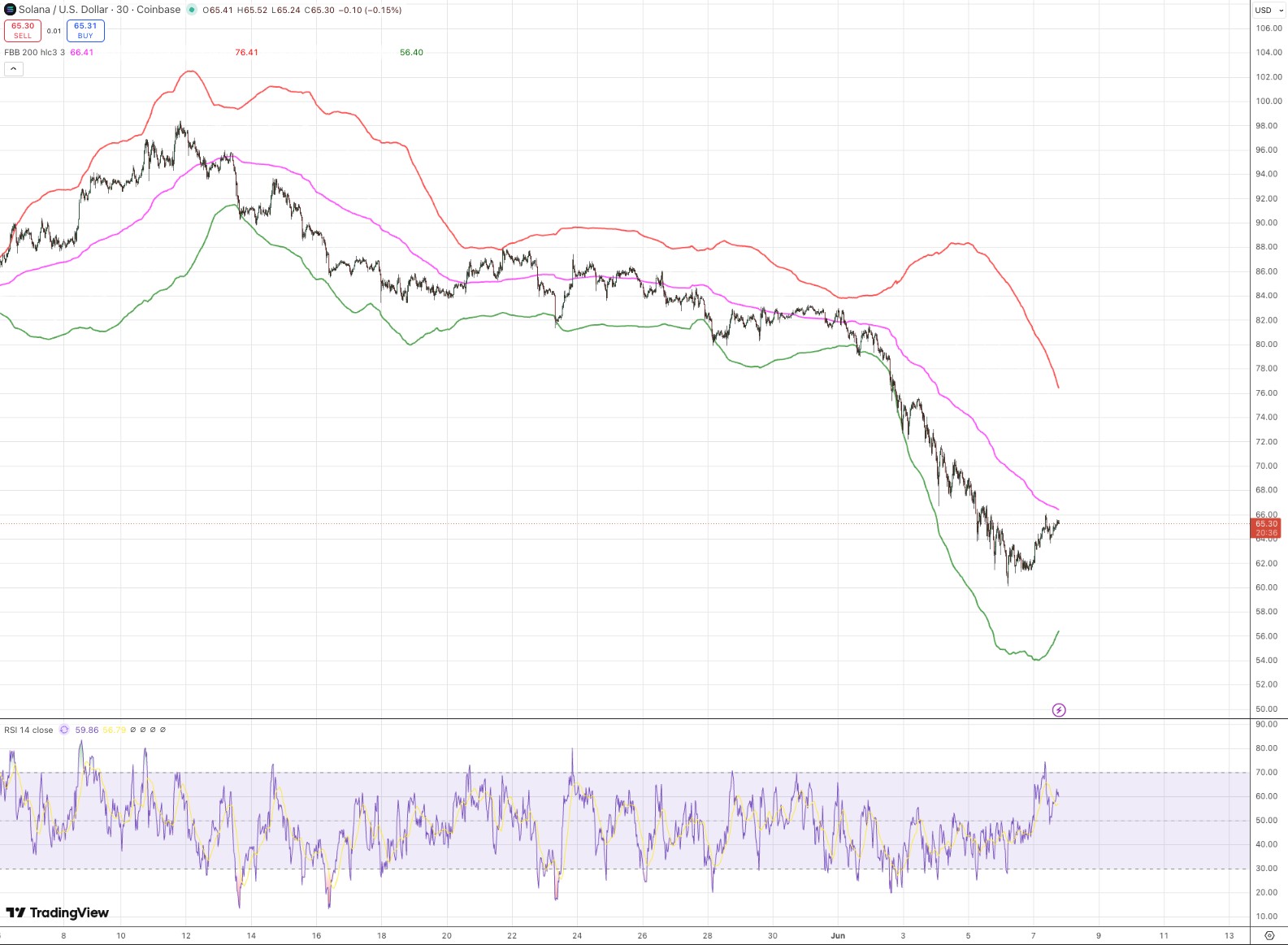
Here is the nuance a beginner should understand. Oversold does not mean the price will immediately go up. It means the selling pressure may start to ease, and that a bounce becomes increasingly possible the longer the RSI stays this low. The RSI can stay in oversold territory for weeks during a strong downtrend, as Solana’s eight consecutive red monthly candles demonstrate. But it also means the risk-reward for new sellers is getting worse at these levels, while the setup for patient buyers becomes more interesting.
On support and resistance, the levels to watch are fairly clear. On the downside, the $60 to $62 zone is where the price is sitting right now and where buyers have been stepping in. If that level breaks convincingly, the next meaningful support is around $50, and below that, some analysts are watching the $43 zone as a deeper floor. On the upside, the first real hurdle is $75 to $77, which has been a resistance ceiling over recent weeks. Above that, the $83 to $86 EMA cluster is the bigger test, and only a sustained close above $96 would start to signal a genuine trend reversal rather than a short-term bounce.
One near-term factor making the chart messier is the token unlock. Over 620,000 SOL tokens unlocked on June 7, adding fresh supply to a market that was already under selling pressure. When large amounts of tokens unlock, holders who received them at lower prices may choose to sell, which creates an additional headwind for the price in the short term. Watch whether the current $60 to $62 support holds over the next few weeks. If it does, that is a sign buyers are absorbing the supply. If it breaks, the next stop could be the $50 zone.
Sentiment Analysis — How Does the Market Feel About SOL?
Sentiment is the mood of the market. It is not about whether a project is good or bad on paper. It is about how investors are feeling right now, because in crypto, feelings move prices just as much as fundamentals do, sometimes more.
Right now, the overall mood around Solana is fearful. The Crypto Fear and Greed Index, which measures market sentiment on a scale of 0 to 100, is sitting between 12 and 20 depending on the day. That puts it firmly in extreme fear territory. For context, a reading of 0 means everyone is panic-selling. A reading of 100 means everyone is buying recklessly. Somewhere in the middle is where healthy markets tend to live.
For a beginner, the useful thing to know about extreme fear readings is what they have historically signalled. The last time SOL entered daily extreme fear was February 6, 2026, which turned out to be close to the bottom of that particular selloff. That does not mean a bottom is guaranteed now. But historically, extreme fear has tended to precede recoveries more often than it has preceded continued crashes. The risk-reward for selling into extreme fear tends to be poor. That is why experienced investors often treat these readings as a prompt to pay closer attention rather than a signal to panic.
The broader crypto market is also in risk-off mode. Bitcoin dominance, which measures how much of the total crypto market cap is held in Bitcoin alone, currently sits at around 59%. When Bitcoin dominance is high, it typically means investors are retreating into the relative safety of Bitcoin and pulling money out of altcoins like Solana. Historically, altcoin seasons — the periods when coins like SOL surge — tend to begin only after Bitcoin dominance starts falling. That rotation has not started yet. It is the main reason the timing of any Solana recovery is hard to call even if the direction seems reasonable.
The ETF flow picture splits into two very different stories depending on whether you look at the short term or the slightly longer term. In the short term, BTC, ETH, SOL and XRP ETFs collectively bled $4.4 billion over 13 trading sessions through early June. That is a significant institutional withdrawal from crypto broadly, driven partly by a stronger-than-expected US jobs report in early June that reduced hopes for Federal Reserve rate cuts, pulling money out of riskier assets. But zoom out slightly, and Solana’s ETF story looks considerably more constructive. May 2026 was the best month of the year for Solana ETFs, with $80 million in net inflows led by Bitwise even as Bitcoin and Ethereum ETFs were in heavy outflow.
The regulatory picture is the most structurally important sentiment shift of 2026. On March 17, 2026, the SEC and CFTC jointly published a 68-page binding interpretive rule, signed by both agency chairs, that classified Solana and 15 other major crypto assets as digital commodities rather than securities. This matters enormously. Before that ruling, the SEC had actively sued exchanges for listing Solana. Institutional compliance teams at pension funds, wealth managers and large banks were legally restricted from holding SOL because its regulatory status was unresolved. That restriction is now gone. Corporate treasury teams that previously limited themselves to Bitcoin can now hold SOL under the same legal framework. The ruling does not guarantee institutional buying, but it removes the single biggest legal barrier that was standing in the way.
On June 5, Morgan Stanley went a step further, opening a pathway for clients to convert SOL holdings directly into ETF shares without triggering a taxable sale. That is a meaningful product innovation that makes it easier for wealthy investors to gain or maintain Solana exposure through regulated channels.
There is a negative in the sentiment picture worth being honest about. A $1 billion exploit on the Drift protocol in April 2026 raised fresh concerns about security on the Solana ecosystem. Security incidents damage trust, and trust is a large part of what drives institutional allocations. It has not derailed institutional interest, as the ETF flows show, but it is a reminder that the ecosystem is still maturing.
Solana Price Prediction for End of 2026
Before giving you a number, it is worth being straight about what price predictions in crypto actually are. They are educated guesses, built from the evidence available today, and they get things wrong regularly. The range of published year-end forecasts for SOL right now runs from around $89 on the conservative end to $250 from Standard Chartered, one of the largest banks in the world. That gap tells you something important: even the people who spend their careers analysing this stuff disagree sharply on what SOL is worth.
With that said, here is where the evidence points when you weigh it honestly.
The case for a meaningful recovery by year-end is built on three things that are already in place, not things that might happen. The first is Firedancer. It is already live on mainnet, running on over 200 validators, and solving a problem that dogged Solana for years: dependence on a single codebase. The rollout continues through the second half of the year. The second is Alpenglow. It went live on a test cluster on May 11, 2026. Solana co-founder Anatoly Yakovenko said at Consensus Miami in May that mainnet activation could come as early as Q3 if testing holds up, with most realistic timelines pointing to late 2026. If it lands on schedule, it cuts transaction finality from 12 seconds to around 150 milliseconds, a structural improvement that opens up entirely new categories of financial applications on Solana. The third is the SEC and CFTC commodity classification from March 17. That ruling removed the legal barrier that was keeping large institutional allocators away from SOL. Corporate treasury teams, pension funds and wealth managers can now hold SOL under the same legal framework as Bitcoin. That does not guarantee buying, but it removes the reason not to.
On top of those three tailwinds, Solana’s ETF structure has a unique feature that Bitcoin and Ethereum ETFs do not. The staking yield passes through to ETF shareholders, giving institutional holders a return on their position while they wait. That makes Solana’s ETF a genuinely different product from a portfolio management perspective, and it is likely part of why Solana ETFs pulled $80 million in inflows during May even as Bitcoin and Ethereum ETFs were bleeding.
What do the published forecasts actually say? Standard Chartered’s head of digital assets trimmed his year-end 2026 target to $250 from $310, citing the commodity ruling as the primary catalyst. InvestingHaven forecasts a range of $75 to $150, with a breakout beyond $150 possible if institutional adoption accelerates. Changelly’s algorithmic model clusters around $88 to $100 for the second half of the year. The Polymarket prediction market, where participants stake real money on outcomes, puts a 19.5% probability on SOL reaching $160 by end of 2026. That is not a forecast, but it is a crowd-sourced read on probability worth noting.
Taking all of that together, a realistic year-end target range of $120 to $200 reflects what the weight of evidence supports. Getting there from the current $62 to $65 requires two things to go reasonably right. Bitcoin dominance needs to start falling, triggering the capital rotation into altcoins that historically precedes SOL’s strongest rallies. And Alpenglow needs to hit mainnet on schedule, because a successful launch would be the clearest signal yet that Solana is closing the gap with institutional-grade infrastructure.
The $250 target from Standard Chartered is not impossible. It would require both of the above to happen faster and with more force than the base case assumes, plus a broader crypto bull market to accelerate through the second half of the year. Think of it as the scenario where everything goes right rather than most things going right.
The main risk that could derail all of this sits outside Solana’s control entirely. Bitcoin has been in a period of dominance, and altcoins historically do not have sustained rallies while that dominance is rising. If Bitcoin stays above 55 to 60% market dominance through Q3 and Q4, the window for a meaningful SOL rally before December narrows significantly. No amount of good fundamentals or successful upgrades can fully overcome a market structure that is rotating away from altcoins.
Conclusion
Solana is going through a rough patch right now. The price is down a lot, most people are nervous, and it has been falling for eight months in a row. That is not fun if you own SOL.
But here is the thing. The network itself is actually doing well. More people are using it than ever before. Big banks and institutions are putting money in through regulated funds. And two major upgrades are either already running or close to launch, which could make Solana faster and more useful than it has ever been.
None of that means the price will definitely go up. Crypto does not work that way. But it does mean Solana is not a broken project. It is a working network going through a tough market period, and those two things are very different.
If the broader crypto market turns around in the second half of 2026, Solana is well placed to benefit. If it does not, waiting is the smarter move over chasing.
Either way, now you have the information to make that call yourself.