

A stablecoin is a cryptocurrency designed to maintain a fixed value, typically pegged 1:1 to the U.S. dollar or another reserve asset. Unlike Bitcoin or Ethereum, which can swing 10% in a day, stablecoins aim to stay at exactly $1.
That stability makes them useful for trading, payments, and parking funds during volatile markets. This guide covers how stablecoins maintain their peg, the different types available, the risks involved, and how traders use them in practice.
Your capital is at risk. This article is for informational purposes only and does not constitute financial advice.
What Is a Stablecoin in Crypto
A stablecoin is a type of cryptocurrency designed to hold a steady value by pegging its price to a reserve asset, most often the U.S. dollar. While Bitcoin and Ethereum swing up or down by double digits in a week, stablecoins aim to stay fixed at a 1:1 ratio with their underlying asset. So 1 USDT or 1 USDC equals $1 USD, at least in theory.
JPMorgan Asset Management defines a stablecoin as “a cryptocurrency that is designed to have a stable value” and is “typically pegged to a fiat currency.” That stability makes stablecoins practical for everyday payments, quick transfers between exchanges, and parking funds during volatile stretches in the crypto market.
The backing behind each stablecoin varies. Some issuers hold cash and Treasury bills in bank accounts. Others use cryptocurrency as collateral or rely on algorithms to manage supply. The type of backing matters because it determines how reliable that $1 peg actually is.
How Do Stablecoins Maintain a Stable Value
Stablecoin issuers keep the peg intact through reserve management and supply control. When someone deposits $100 into a fiat-backed stablecoin, the issuer mints 100 new tokens. When someone redeems tokens for dollars, the issuer burns them. This minting and burning keeps the token supply matched to actual reserves.
- Reserve backing: The issuer holds cash, Treasury bills, or other assets equal to the tokens in circulation
- Minting and burning: New tokens are created when users deposit fiat; tokens are destroyed when users redeem
- Arbitrage incentives: If a stablecoin trades at $0.98, traders can buy it cheap and redeem it for $1 worth of reserves, pocketing the difference while pushing the price back up
Arbitrage is the invisible hand here. Whenever the market price drifts from $1, traders have a financial incentive to correct it. This mechanism works well when reserves are transparent and redemptions are reliable.
Types of Stablecoins Explained
Stablecoins fall into four categories based on what backs them. Each type carries different risks and trade-offs.
Fiat-Backed Stablecoins
Fiat-backed stablecoins are the most straightforward. The issuer holds traditional currency, usually USD, in bank accounts or short-term government securities. USDT and USDC both work this way. The catch is that holders have to trust the issuer actually has the reserves it claims.
Cryptocurrency-Backed Stablecoins
Crypto-backed stablecoins use other cryptocurrencies as collateral instead of dollars. Because crypto prices fluctuate, these stablecoins require over-collateralization. To mint $100 worth of Dai, for example, a user might deposit $150 worth of Ethereum. MakerDAO governs Dai through smart contracts rather than a central company.
Commodity-Backed Stablecoins
Commodity-backed stablecoins are pegged to physical assets like gold. Paxos Gold (PAXG) represents ownership of actual gold bars stored in vaults. Holders get digital exposure to gold without dealing with storage or shipping.
Algorithmic Stablecoins
Algorithmic stablecoins use code instead of collateral. Smart contracts automatically expand or contract the token supply based on market demand. When the price rises above $1, the algorithm mints more tokens. When it falls below, the algorithm reduces supply. This approach carries higher risk because the mechanism can fail under extreme market pressure, as several past de-pegging events have shown.
| Type | Backing | Example | Primary Risk |
|---|---|---|---|
| Fiat-backed | Cash and Treasury reserves | USDC, USDT | Issuer transparency |
| Crypto-backed | Over-collateralized crypto | DAI | Collateral volatility |
| Commodity-backed | Physical assets like gold | PAXG | Custody and auditing |
| Algorithmic | Smart contract supply control | FRAX | De-pegging failure |
Why Are Stablecoins Important for Traders
Stablecoins solve a practical problem for crypto traders. Moving money between a bank account and an exchange takes time, sometimes days. Stablecoins let traders hold a dollar-equivalent asset on-chain, ready to deploy instantly.
- Price stability: Traders can park funds in a stable asset without converting back to fiat
- Fast settlement: Moving stablecoins between wallets or exchanges takes minutes, not days
- Trading pairs: Most exchanges use stablecoins as base pairs, making them essential for active trading
- Market downturns: Stablecoins act as a “digital dollar” when traders want to exit volatile positions quickly
Read Also: Stablecoin and Altcoin Allocation: Building a Balanced Portfolio for 2026
How Are Stablecoins Used in Practice
Beyond trading, stablecoins have found real-world applications that extend well past speculation.
Trading and Portfolio Management
Traders use stablecoins to lock in profits after a winning trade or to wait on the sidelines for the next opportunity. Since most exchanges list stablecoin pairs, moving between positions is quick. There’s no need to withdraw to a bank account and wait for the funds to clear.
Cross-Border Payments and Remittances
Sending stablecoins internationally can be faster and cheaper than a wire transfer. Settlement happens in minutes regardless of destination, and there’s no need for a correspondent bank in the middle. For people sending money to family abroad, stablecoins offer a practical alternative.
Hedging Against Local Currency Volatility
In countries with unstable currencies or high inflation, stablecoins pegged to the USD provide a store of value. Residents can hold digital dollars without opening a U.S. bank account or dealing with capital controls.
Decentralized Finance and Yield Strategies
Stablecoins are foundational assets in DeFi, short for decentralized finance. DeFi refers to financial services built on blockchain networks that operate without traditional intermediaries. Users can lend stablecoins, provide liquidity to trading pools, or participate in yield-generating protocols, all through smart contracts.
Top Stablecoins by Market Capitalization
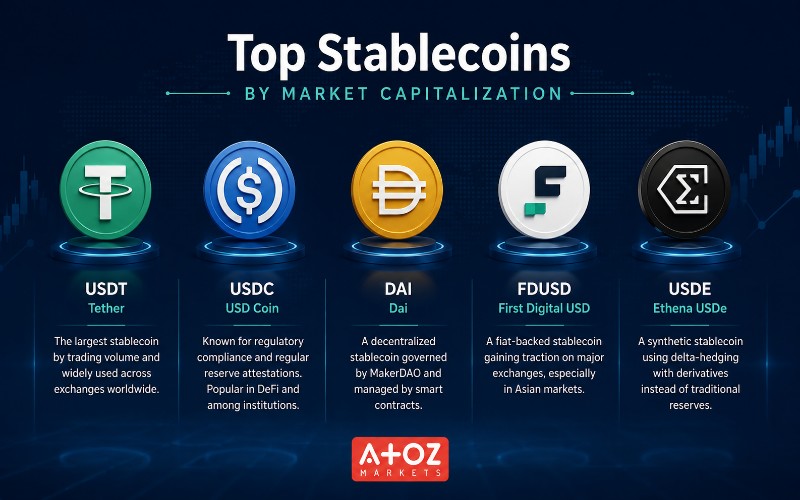
A handful of stablecoins dominate the market, each with distinct characteristics.
Tether (USDT)
USDT is the largest stablecoin by trading volume and adoption. Tether Limited issues it, and the token is available on nearly every major exchange. Its widespread use makes it highly liquid, though questions about reserve transparency have followed the project for years.
USD Coin (USDC)
Circle issues USDC and has built a reputation for regulatory compliance and regular reserve attestations. USDC is popular in DeFi applications and among institutional users who prioritize transparency.
Dai (DAI)
Dai is a decentralized stablecoin governed by MakerDAO. Unlike USDT or USDC, no central company controls it. Smart contracts manage collateral and maintain the peg, making Dai appealing to users who prefer decentralization.
First Digital USD (FDUSD)
FDUSD is a newer fiat-backed stablecoin that has gained traction on major exchanges, particularly in Asian markets. It competes with USDT and USDC for trading volume.
Ethena USDe (USDE)
USDe is a synthetic stablecoin, meaning it uses delta-hedging strategies with derivatives rather than holding traditional reserves. This approach is more complex and carries different risks than collateral-backed alternatives.
What Are the Risks of Holding Stablecoins
Stablecoins are designed for stability, but they’re not risk-free.
De-Pegging and Price Volatility
A stablecoin can trade above or below $1 if market confidence wavers. De-pegging events are rare for major stablecoins, but they have happened. When they do, holders can face sudden losses.
Counterparty and Issuer Default
Fiat-backed stablecoins depend on the issuing company. If that company mismanages reserves or goes bankrupt, token holders may not recover full value. The stablecoin is only as reliable as the entity behind it.
Reserve Transparency and Audit Concerns
Not all issuers publish verified, third-party audits of their reserves. Without transparency, it’s difficult to assess whether a stablecoin is fully backed. Some issuers provide attestations, which are less rigorous than full audits.
Regulatory and Legal Uncertainty
Governments are still figuring out how to regulate stablecoins. Rule changes could affect availability, redemption processes, or operational requirements. A stablecoin that operates freely today might face restrictions tomorrow.
How Are Stablecoins Regulated Around the World
Stablecoin regulation varies by jurisdiction and continues to evolve.
In the United States, federal stablecoin legislation remains pending, though state-level rules apply to some issuers. The European Union has implemented the MiCA framework, which establishes requirements for stablecoin issuers operating in EU markets.
The Bank of England has proposed rules aimed at ensuring “stablecoins always maintain a stable value” and that “people can pay using stablecoins with confidence.” In Asia, regulatory approaches range from supportive frameworks to outright restrictions depending on the country.
Stablecoins vs Bitcoin and Other Cryptocurrencies
Stablecoins and Bitcoin serve different purposes. Bitcoin is a decentralized asset with a market-driven price that fluctuates based on supply and demand. Stablecoins are designed to hold a fixed value.
| Feature | Stablecoins | Bitcoin and Altcoins |
|---|---|---|
| Price stability | Yes, pegged to an asset | No, market-driven volatility |
| Primary use | Payments, trading, DeFi | Store of value, speculation |
| Backing | Reserves or algorithms | Decentralized network value |
Traders often use both. Bitcoin offers potential appreciation over time, while stablecoins provide liquidity and a stable place to park funds between trades.
Can You Invest in Stablecoins and Earn Yield
Stablecoins don’t appreciate in value on their own. That’s the point. However, holders can earn yield, meaning interest or returns, by lending or deploying their stablecoins.
Centralized Exchange Earn Programs
Major exchanges offer savings or “earn” products where users deposit stablecoins and receive interest. Rates vary by platform and market conditions. Before depositing, reviewing the terms and understanding the risks is worthwhile.
DeFi Lending and Yield Farming
Decentralized protocols allow users to lend stablecoins or provide liquidity to trading pools. Yield farming involves moving assets between protocols to maximize returns. Potential yields can exceed traditional savings rates, but smart contract bugs and platform failures are real risks.
How Stablecoins Fit Into a Crypto Trading Strategy
Stablecoins offer flexibility for managing risk and positioning in volatile markets. Many traders keep a stablecoin allocation ready for quick entry when opportunities appear. Rather than waiting for a bank transfer, they can move instantly.
Regulatory standing also matters when choosing which stablecoin to hold. A stablecoin with transparent reserves and clear regulatory compliance may carry less risk than alternatives with opaque backing.
For timely updates on stablecoin developments and crypto market news, follow AtoZ Markets’ Cryptocurrency News coverage.
Frequently Asked Questions About Stablecoins
Is Bitcoin a stablecoin?
No. Bitcoin is a decentralized cryptocurrency with a price that fluctuates based on market demand. Stablecoins are designed to maintain a fixed value pegged to an asset like the U.S. dollar.
Is XRP going to become a stablecoin?
No. XRP is the native token of the XRP Ledger and has its own market-driven price. It was not designed to be pegged to a stable asset.
Can stablecoins completely lose their peg?
Yes, though it’s uncommon for major stablecoins. De-pegging events have occurred when reserve adequacy was questioned or when algorithmic mechanisms failed under market stress.
How do I buy stablecoins?
Stablecoins are available on most cryptocurrency exchanges. Users can deposit fiat currency or trade other crypto assets for stablecoins. Decentralized exchanges also offer stablecoin trading pairs.
Are stablecoins taxable?
Tax treatment varies by jurisdiction. In many countries, converting stablecoins to fiat or other cryptocurrencies may trigger a taxable event. Consulting a tax professional familiar with crypto is advisable.
Who controls the supply of stablecoins?
For fiat-backed stablecoins, the issuing company controls minting and redemption. For decentralized stablecoins like Dai, smart contracts and community governance manage supply rather than a central authority.