

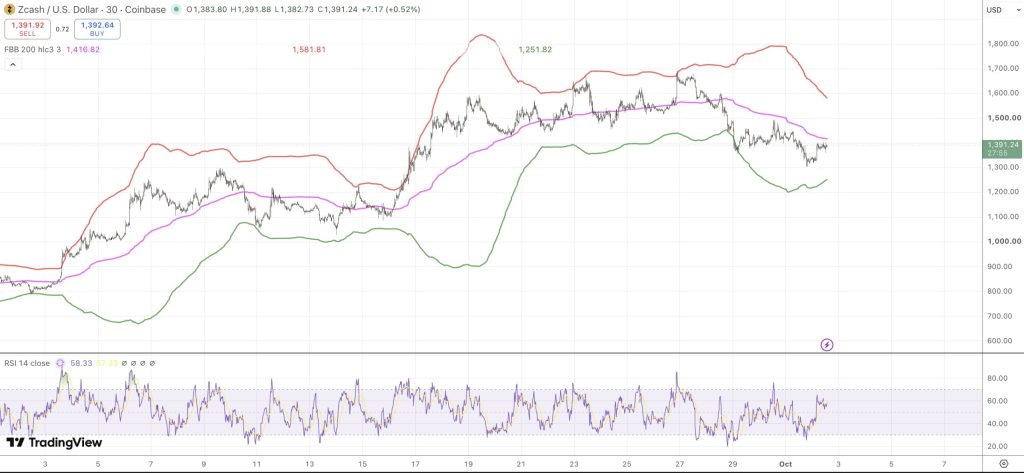
Zcash has been one of the most talked-about coins of 2026. But the story is complicated. ZEC is trading near $1,386 right now, which sounds impressive until you look at the chart. It peaked above $1,600 recently and has since pulled back. The question for the rest of 2026 is not whether ZEC can go up. It is whether it can hold what it has already gained.
Key Price Levels to Watch
The first hurdle is $1,418. That is the 200-day moving average on the 30-minute chart, and ZEC is trading just below it. If bulls can push through, the next stops are $1,500 and $1,591. On the downside, $1,245 is the first real support. If that breaks, $1,100 comes into play. For now, the chart shows ZEC consolidating after a massive run.
Prediction Markets vs. Wall Street Sentiment
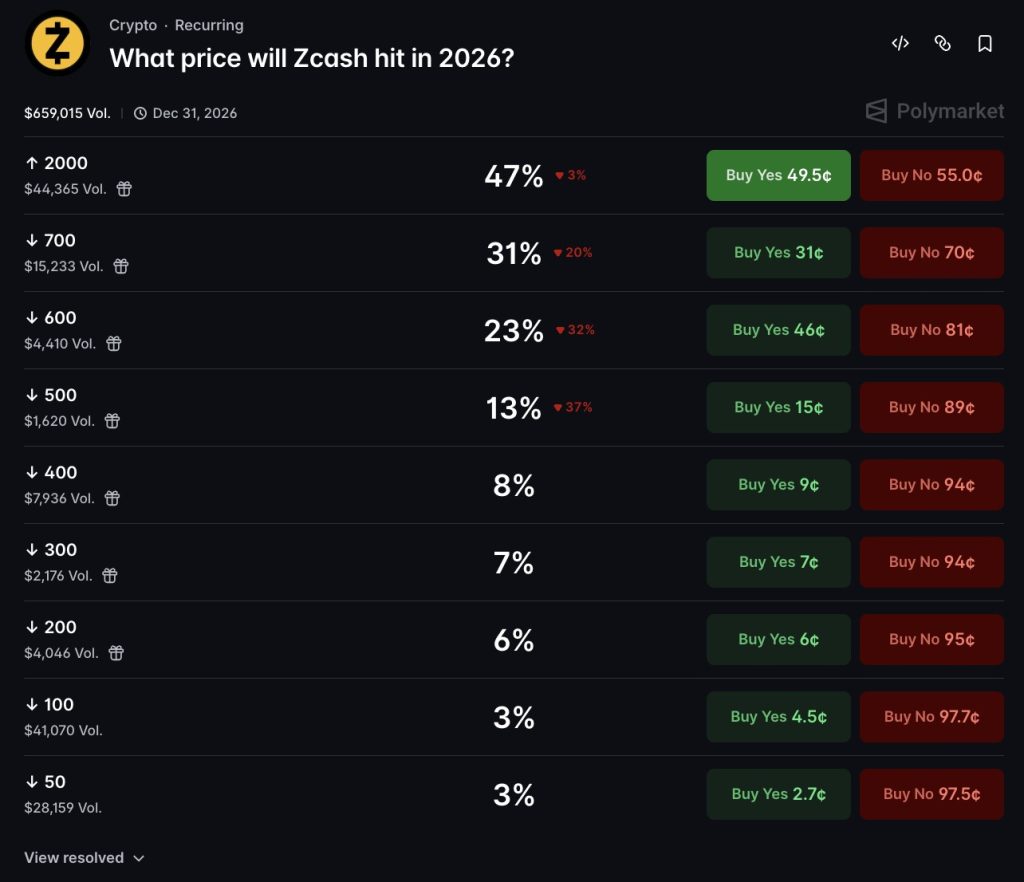
Prediction markets offer a reality check here. On Polymarket, traders give Zcash a 47% chance of hitting $2,000 before the end of 2026. That is essentially a coin flip. But the downside odds are just as telling. Traders see a **31% chance** of ZEC dropping to $700 and a 23% chance of falling to $600.
The market is not betting on a straight line up. It is pricing in extreme volatility. Only 8% think ZEC hits $400, and just 3% think it reaches $100. This tells me traders believe the floor is higher than it used to be, but they are not convinced $2,000 is a lock.
Author’s Take
A 47% chance of hitting $2,000 means the market is genuinely split. That is not a bullish signal. It is a signal of uncertainty. The 31% chance of dropping to $700 tells me traders are hedging their bets. If ZEC can close above $1,418 with volume, the path to $1,591 opens up. If it fails, $1,245 is the next stop. I think the year-end range is $1,500 to $2,000, but I would not bet against a sharp pullback first.
Why the Fundamental Story Looks Strong
The numbers behind Zcash are genuinely impressive. Grayscale reported that ZEC went from roughly $60 to around $1,500 in twelve months, a 19-fold increase. Its market cap climbed to 1.5% of Bitcoin’s in just one year.
The biggest catalyst was the launch of the Grayscale Zcash ETF (ticker: ZCSH) on August 25, 2026. It was the first spot Zcash ETF in the world, and it now holds close to $1 billion in assets. Grayscale has also filed for a ZCSH High Income ETF that would pay investors every two weeks using options premiums.
Zcash’s privacy technology is also evolving. The Zashi wallet now supports CrossPay, a feature that lets users send shielded ZEC to people on other blockchains without revealing the sender’s identity. If you want to understand how regulators view privacy coins like Zcash, our guide on how the US government classifies seized cryptocurrencies and CBDCs is a useful starting point. And as the broader crypto market matures in 2026, understanding new rules like the GENIUS Act is essential for any trader.
Price Prediction for End of 2026
If ZEC breaks $1,418 and holds, $1,591 is realistic by December. Reaching $2,000 would require a much stronger market-wide rally. Zcash co-founder Eli Ben-Sasson has set an ambitious target of $5,000 by year-end, but prediction markets are far less bullish. If ZEC stays below $1,245, the outlook turns bearish. For now, the bulls have momentum, but the $1,418 wall remains the biggest test. For those building a balanced portfolio, our guide on stablecoin and altcoin allocation explains how to position assets like ZEC alongside other holdings.