

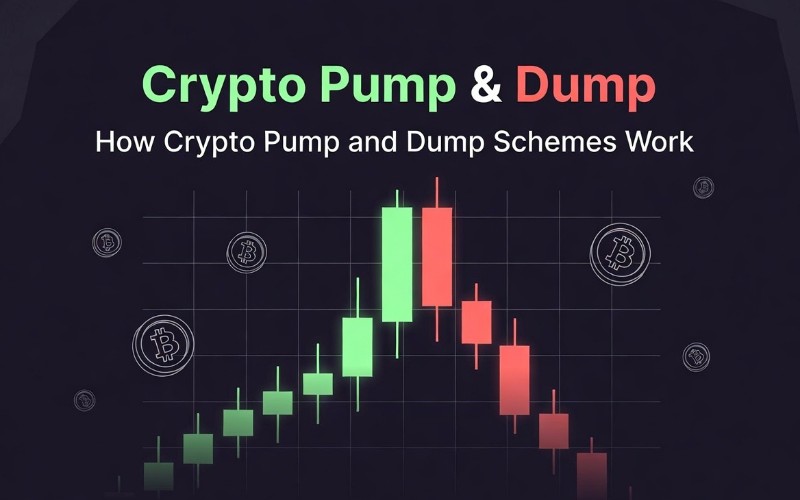
A token spikes 300% in an hour, your feed fills with people posting gains, and by the time you buy, the price has already collapsed. That’s a pump and dump in action, and the people who promoted it are the only ones walking away with profits.
This article breaks down exactly how pump and dump groups coordinate these schemes, the warning signs that reveal manipulation before it costs you money, and the steps traders take to protect themselves from becoming exit liquidity.
Your capital is at risk. This article is for informational purposes only and does not constitute financial advice.
What is a crypto pump and dump scheme
A crypto pump and dump is a coordinated scam where organizers artificially inflate a token’s price through fake hype and coordinated buying, then sell their holdings at the peak. Everyone who bought during the hype gets left holding tokens that are suddenly worth far less. The CFTC has warned that “customers should avoid purchasing virtual currency or tokens based on tips shared over social media” because pump and dump schemes “are often designed to benefit insiders and promoters at the expense of retail investors.”
The basic idea is simple. A group of people quietly buys a cheap, obscure token. They then flood social media with fake news and hype to get others to buy. Once the price spikes, they sell everything and walk away with profits while everyone else watches the price crash.
Three things happen in every pump and dump:
Artificial price inflation: Coordinated buying and fabricated news push prices up
Rapid selling: Organizers exit at the peak, which triggers a price collapse
Retail losses: People who bought during the hype hold tokens that are now worth a fraction of what they paid
How pump and dump groups operate
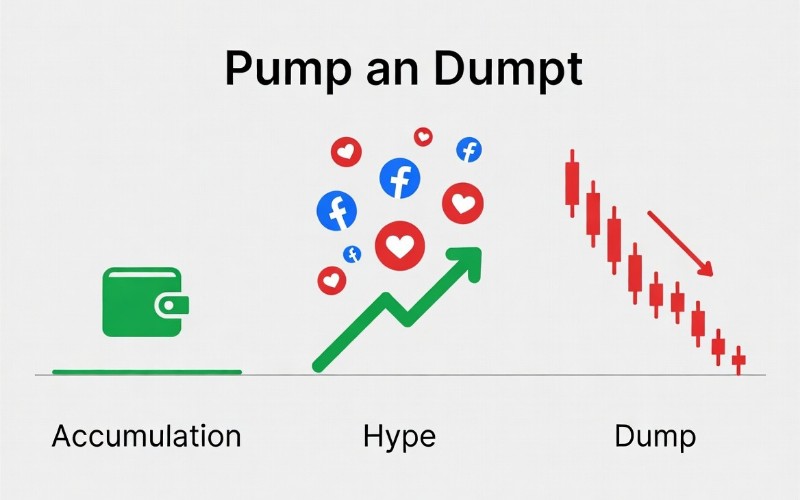
Pump and dump groups follow a predictable three-phase playbook. Knowing each phase makes it easier to spot manipulation before it costs you money.
1. Accumulation phase
The scheme starts quietly. Organizers spend days or weeks buying large amounts of an obscure, low-liquidity token. They pick tokens where even small buy orders can move the price, which means they can build a big position without attracting attention. During this phase, nothing looks unusual. The price stays flat, volume stays low, and no one outside the group knows anything is happening.
2. Promotion and hype phase
Once organizers have accumulated enough tokens, the noise begins. They flood Twitter/X, Reddit, Telegram, and Discord with misleading information designed to create a buying frenzy.
The tactics are predictable:
Fake news releases: Made-up announcements about partnerships, exchange listings, or technology breakthroughs that sound legitimate but aren’t
Coordinated social posts: Dozens of accounts posting similar messages at the same time to make the buzz look organic
Urgency messaging: Phrases like “this will 10x by tonight” or “last chance to get in” designed to pressure people into buying without doing any research
The goal is to get as many people as possible to buy as quickly as possible. More buyers means higher prices, and higher prices mean bigger profits for the organizers when they sell.
3. Dump phase
When the price hits a predetermined target, organizers sell everything. This usually happens within minutes of the initial pump signal. The sudden flood of sell orders overwhelms buyers, and the price collapses almost instantly.
People who bought during the hype phase are now stuck. They paid inflated prices for tokens that are suddenly worth a fraction of what they cost. Meanwhile, the organizers have already cashed out and moved on to the next scheme.
How crypto pump and dump groups recruit members
Pump and dump groups attract thousands of participants by promising easy profits. The structure of the group, however, ensures that organizers win while most members lose.
Telegram and Discord channels
Private messaging platforms are the primary hubs for pump and dump activity. Groups with thousands of members gather in dedicated channels that feature countdown timers, announcement sections, and the final reveal of the target coin. The format creates excitement and urgency that discourages careful analysis.
Social media promotions
Groups advertise openly on Twitter/X, Reddit, and YouTube. Posts showcase impressive profits, often fabricated, alongside promises of “guaranteed” returns. The target audience is inexperienced traders who haven’t yet learned to recognize manipulation patterns.
Paid VIP and inner circle tiers
Here’s where the real profit model becomes clear. Organizers sell premium access to “VIP” tiers where members pay fees for early signals. VIP members receive the target coin’s name seconds or minutes before free members, giving them time to buy earlier and sell before the collapse.
Free members essentially provide exit liquidity for paid participants. By the time they receive the signal and place their orders, VIP members are already selling into their buys.
Why traders fall for pump and dump scams
Pump and dump schemes exploit psychological triggers that can override rational thinking. Even experienced traders sometimes get caught.
Fear of missing out (FOMO): Intense urgency creates pressure to act immediately without research
Social proof: Seeing others post profits, even fabricated ones, builds false confidence
Greed: Promises of quick, massive gains override caution
Information asymmetry: Newcomers don’t recognize classic manipulation patterns and take the hype at face value
You might think you’d never fall for such obvious tactics. But when your feed is flooded with people posting gains and the price is climbing in real time, the pressure to act feels very real.
How to identify pump and dump stocks and crypto
Recognizing warning signs before you buy is the best defense against pump and dump schemes. Several red flags consistently appear across manipulation attempts.
Sudden unexplained price spikes
Legitimate price movements typically connect to identifiable catalysts like product launches, partnership news, or broader market trends. A sudden vertical spike with no clear reason warrants immediate skepticism. If you can’t find a credible explanation for why a token is suddenly up 200%, that absence of explanation is itself a warning sign.
High volume with no news catalyst
Massive trading volume that isn’t supported by corresponding news or fundamental developments suggests coordinated artificial buying. When volume explodes but nothing has actually changed about the project, someone is likely manufacturing demand.
Aggressive social media promotion
Hype campaigns from anonymous accounts, bots, or influencers without credible track records are a major red flag. Coordinated messaging across multiple platforms, where dozens of accounts post similar content at the same time, is a hallmark of organized manipulation.
Low liquidity and market cap
Scammers target small-cap, obscure tokens because limited capital can move prices dramatically. A token with low trading volume that isn’t listed on major exchanges is far easier to manipulate than a high-liquidity asset.
| Legitimate Price Movement | Pump and Dump Warning Signs |
|---|---|
| News-driven catalyst | No identifiable news |
| Gradual volume increase | Sudden volume explosion |
| Organic social discussion | Coordinated anonymous hype |
| Higher liquidity assets | Low-cap, obscure tokens |
Pump and dump vs rug pull
Traders often confuse pump and dumps with rug pulls, but the two scams work differently. The key distinction lies in what happens to the project itself.
In a pump and dump, organizers manipulate an existing token’s price, sell at the peak, and the token remains tradeable, just at a much lower price. The project still exists; it was simply used as a vehicle for manipulation.
A rug pull involves developers abandoning a project entirely. They often withdraw all liquidity from trading pools, which means the token becomes essentially untradeable. Holders can’t sell because there’s no one to buy.
| Pump and Dump | Rug Pull |
|---|---|
| Manipulates existing token price | Developers abandon project entirely |
| Organizers sell holdings at peak | Liquidity withdrawn from pools |
| Token still tradeable after dump | Token often becomes untradeable |
| Can target any low-cap token | Usually involves new project launches |
Is pump and dump illegal in crypto markets
In traditional securities markets, pump and dump schemes constitute securities fraud under market manipulation laws. The crypto landscape is more complex.
Many jurisdictions are extending securities laws to cover digital assets, though regulation varies globally. The CFTC and SEC in the United States have prosecuted crypto-related market manipulation cases. The CFTC has explicitly warned that “pump-and-dump schemes long pre-date the invention of virtual currencies” and that the agency “may bring actions against any persons who manipulate or attempt to manipulate virtual currencies.”
Enforcement remains challenging, however, due to the anonymity and cross-border nature of crypto operations. Organizers often operate from jurisdictions with limited regulatory oversight, making prosecution difficult even when manipulation is obvious.
How to protect yourself from pump and dump schemes
Several defensive habits can help you avoid becoming exit liquidity for scheme organizers.
1. Research before you buy
Before acting on any social media tip, investigate the project’s fundamentals. Check the team’s background, verify information through official channels, and read the whitepaper. If you can’t find credible information about a project, that absence is itself a warning sign.
2. Avoid unverified trading groups
Any group promising guaranteed returns or “insider” signals is almost certainly designed to profit at your expense. Legitimate trading communities don’t guarantee outcomes because no one can guarantee outcomes in trading.
3. Watch for unrealistic promises
Legitimate investments don’t guarantee 10x returns in hours or use extreme urgency tactics. If someone is pressuring you to act immediately on a “hot tip,” that pressure is often the manipulation itself.
4. Use trusted exchanges and news sources
Established cryptocurrency exchanges with better oversight and liquidity offer more protection than obscure platforms. For market information, rely on verified news outlets rather than social media hype. AtoZ Markets’ cryptocurrency coverage provides timely reporting to help traders stay informed through reliable sources rather than anonymous tips.
What to do if you suspect a pump and dump
If you suspect a scheme is underway, taking measured steps can protect you and potentially help others avoid losses.
Stop and assess: Don’t buy or add to your position under pressure. Step back from the hype.
Verify independently: Check official project channels and reputable news sources for legitimate catalysts.
Report the scheme: File complaints with relevant regulators like the CFTC, SEC, or FCA depending on your jurisdiction.
Document evidence: Screenshot promotional messages and chat logs for potential investigations.
Tip: If you’re feeling pressure to act immediately on a “hot tip,” that urgency itself is often the manipulation. Legitimate opportunities don’t disappear in minutes.
FAQs about crypto pump and dump schemes
How long do crypto pump and dump schemes usually last?
Most crypto pump and dumps complete their entire cycle, from initial signal to price collapse, within minutes to a few hours. The speed is intentional. Organizers want participants to act before they have time to research or think critically.
What does a pump and dump pattern look like on a price chart?
The pattern shows a sharp vertical price spike on unusually high volume, followed immediately by an equally steep decline. Traders sometimes call this distinctive shape a “pump and dump candle” because of how it appears on candlestick charts.
Can participants make money from pump and dump schemes?
Only organizers and the earliest participants, typically those in paid VIP tiers, consistently profit. The vast majority of participants who buy during the hype phase lose money when prices collapse. The math simply doesn’t work any other way.
Which cryptocurrency exchanges are most vulnerable to pump and dump activity?
Smaller, decentralized, or less-regulated exchanges with lower liquidity and minimal oversight are far more susceptible than major regulated platforms. Exchanges with high trading volumes and stricter listing requirements make manipulation more difficult and expensive.
Are pump and dump schemes more common in crypto than in traditional stock markets?
Yes, significantly. The combination of lighter regulation, thousands of low-liquidity tokens, and easy anonymous coordination through encrypted messaging apps makes crypto markets particularly vulnerable to manipulation.