

Binary options trading offers a deceptively simple proposition: predict price direction correctly and receive a fixed payout, or lose your entire stake. That all-or-nothing structure means a string of bad trades can wipe out an account faster than almost any other form of trading.
Risk management in binary options is the systematic practice of controlling how much capital you expose to loss on each trade. This guide covers position sizing rules, common mistakes that accelerate losses, and practical methods for surviving the losing streaks that every trader eventually faces.
Your capital is at risk. Binary options trading involves substantial risk of loss and is not suitable for all investors.
What is risk management in binary options trading
Risk management in binary options trading is a systematic way to control how much money you expose to potential loss on each trade. The core idea is straightforward: decide in advance how much you’re willing to lose, then stick to that limit regardless of how confident you feel about any particular trade.
What makes binary options different from forex or stock trading is the all-or-nothing outcome. You either receive a fixed payout or lose your entire stake. There’s no partial win, no cutting losses early, no waiting for the market to turn around. This structure makes deliberate risk control essential from the start.
Two concepts sit at the center of binary options risk management:
- Position sizing: The amount of money you allocate to each individual trade
- Capital preservation: Protecting your overall account from rapid depletion through consecutive losses
Why risk management is critical for binary traders
Without a structured approach, binary traders often experience what’s called “account blowup,” which means losing most or all of their capital in a short period. The European Securities and Markets Authority (ESMA) has cited research showing that between 74% and 89% of retail investor accounts lose money when trading leveraged products, including binary options.
The math creates a challenge. If a binary option pays 80% on winning trades but costs 100% on losing trades, you’d have to win more than 55% of your trades just to break even. Risk management helps you survive the inevitable losing streaks long enough for a profitable approach to actually work.
- Capital preservation: Keeping enough funds to continue trading after losses
- Longevity: Staying in the market long enough for your edge to show up
- Emotional stability: Reducing the stress that leads to impulsive decisions
How binary options trading works
A binary option presents a yes-or-no question. You predict whether an asset’s price will be above or below a specific level when the option expires. If you’re right, you’re “in the money” and receive a fixed payout, typically 70% to 90% of your stake. If you’re wrong, you’re “out of the money” and lose everything you risked.
Expiry times range from 60 seconds to several hours or days. Once you place a trade, you generally can’t exit early or adjust your position. Some platforms offer early closure at reduced payouts, though this isn’t universal.
Also Read: Binary Options Signals Explained
The unique risk profile of binary options
All-or-nothing payout structure
Every binary trade ends in one of two ways. You receive your predetermined return, or you lose everything you risked. There’s no middle ground where you take a small loss or a partial profit based on how close the price came to your target.
Fixed expiry times
Traditional traders can hold positions indefinitely, waiting for the market to move in their favor. Binary options remove this flexibility entirely. When the clock runs out, your trade settles whether the market was about to reverse in your direction or not.
Limited loss control mid-trade
Stop-loss orders, a standard risk tool in forex and stock trading, don’t apply to most binary options. Once you commit capital to a trade, that money stays at risk until expiration. You can’t cut your losses halfway through.
| Feature | Binary Options | Traditional Trading |
|---|---|---|
| Loss potential per trade | Fixed (full stake) | Variable (can use stop-loss) |
| Exit flexibility | Limited or none | Can exit anytime |
| Profit potential | Capped payout | Unlimited |
How to size your binary options positions
Calculating your risk per trade
Position sizing starts with one question: how much of your total account balance are you willing to lose on a single trade? That amount becomes your maximum trade size.
So if you have a $5,000 account and set a 2% risk limit, your maximum position would be $100. This calculation stays the same whether you feel extremely confident about a trade or only moderately so.
The 1 to 2 percent rule explained
Most experienced traders recommend risking no more than 1% to 2% of your account on any single binary trade. This guideline exists because even profitable approaches experience losing streaks. Risking small amounts ensures that a string of losses won’t devastate your account.
Here’s what this looks like in practice:
- Account balance: $5,000
- Risk percentage: 2%
- Maximum trade size: $100
With this approach, you could lose 10 consecutive trades and still retain 80% of your starting capital. That’s enough to recover.
Binary options risk management methods that fail
1. Trading based on gut feeling
Intuition without analysis produces inconsistent results. Markets don’t reward hunches. Emotional decision-making typically leads to overtrading and abandoning position sizing rules at exactly the wrong moments.
2. Martingale and progressive betting systems
The martingale approach involves doubling your trade size after each loss, theoretically recovering all previous losses with one win. In practice, this accelerates account depletion. A losing streak of just six trades would require risking 64 times your original stake, which quickly exceeds most account balances.
3. Risking large percentages per trade
Traders who risk 10% or more per trade can lose half their account in just seven consecutive losses. While larger positions offer bigger potential gains, they also dramatically increase the probability of account failure.
Proven binary strategy for managing risk
Fixed percentage-based position sizing
The most reliable binary strategy involves risking the same small percentage on every trade, regardless of how confident you feel. This consistency removes emotion from position sizing and ensures that no single trade can significantly damage your account.
The key is treating every trade the same way. A trade you feel great about gets the same 1% to 2% allocation as a trade you feel uncertain about.
Setting daily and weekly loss limits
Beyond individual trade limits, many traders establish session boundaries. For instance, stopping after losing 5% of your account in a single day prevents the compounding effect of emotional trading during difficult periods.
Using demo accounts for strategy validation
Before risking real capital, testing your approach in a demo environment reveals flaws without financial consequences. Most reputable platforms offer practice accounts with virtual funds, and spending time there first can save real money later.
Managing losing streaks in binary trade
Why losing streaks are inevitable
Even an approach with a 60% win rate will experience five or more consecutive losses roughly 1% of the time. Over hundreds of trades, losing streaks become statistical certainties rather than rare events. Knowing this in advance helps you respond rationally rather than emotionally when they occur.
How to protect your account during drawdowns
When losses accumulate, consider reducing your position size temporarily. Taking breaks between trading sessions can also prevent frustration from clouding judgment.
- Reduce trade size: Lower risk per trade during difficult periods
- Set session limits: Stop trading after a set number of consecutive losses
- Review without overreacting: Analyze trades before making changes to your approach
How timing affects risk in binary options
Market volatility varies throughout the trading day. Major economic announcements, market opens, and session overlaps create periods of heightened price movement. While volatility can increase profit potential, it also makes price direction harder to predict.
Shorter expiry times generally carry higher risk because small price fluctuations have greater impact on outcomes. Longer expiries allow more time for your analysis to prove correct, though they also expose you to more market events that could move prices unexpectedly.
Why high win rates can still lead to losses
A 70% win rate sounds impressive, yet it can still produce net losses. The relationship between win rate and payout ratio determines actual profitability.
If your winning trades pay 70% but your losing trades cost 100%, you’d have to win at least 59% of trades to break even. A trader winning 55% of trades with those payouts would still lose money over time.
| Win Rate | Average Win | Average Loss | Net Result |
|---|---|---|---|
| 70% | 70% payout | 100% loss | Slightly profitable |
| 50% | 70% payout | 100% loss | Net loss |
Psychological risks in binary options trading
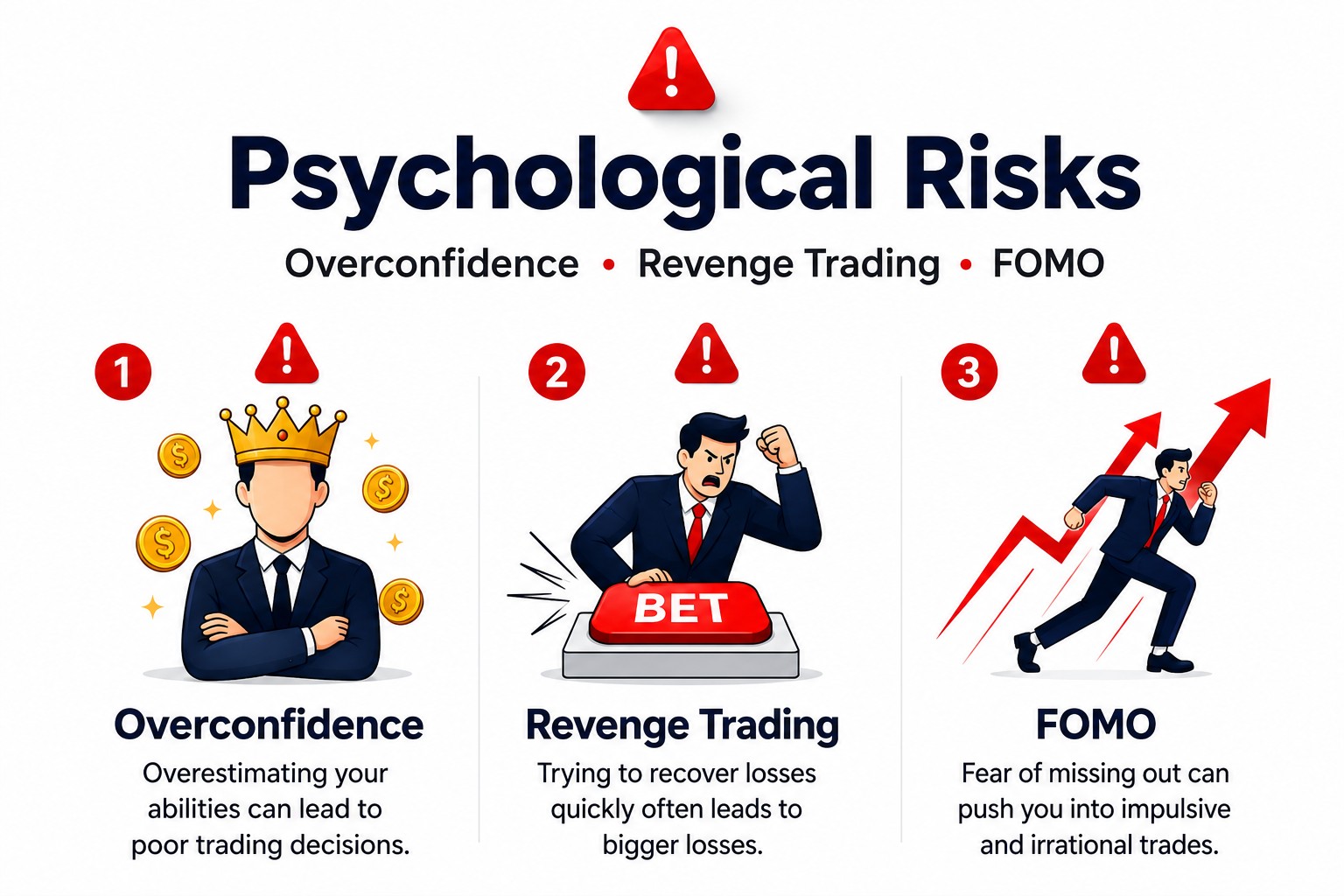
Overconfidence after winning streaks
Success can be dangerous. After several profitable trades, traders often increase position sizes or abandon their risk rules, believing they’ve figured out the market. This overconfidence typically precedes significant losses.
Revenge trading after losses
Revenge trading means immediately placing larger trades to recover losses. It ranks among the most destructive behaviors in binary options because it transforms manageable setbacks into account-threatening situations.
Fear of missing out on trades
FOMO leads traders to enter positions outside their planned approach simply because the market is moving. Impulsive trades typically lack the analysis that supports profitable decision-making.
How regulation affects binary options safety
Regulatory status varies significantly by jurisdiction. In the European Union, ESMA banned binary options sales to retail clients in 2018, citing investor protection concerns. The U.S. permits binary options only on regulated exchanges like Nadex.
Unregulated platforms carry counterparty risk beyond normal trading risk. Your funds may not be secure even if your trades are profitable. Verifying broker licensing through official regulatory databases provides an important layer of protection before depositing money.
Can risk management make binary options trading safe
Risk management reduces losses but cannot eliminate the inherent risks of binary options. No binary strategy guarantees profits. Even with perfect discipline, the mathematical structure of binary options, where losses typically exceed wins in absolute terms, creates a challenging environment.
What risk management does provide is sustainability. It extends your trading timeline, giving profitable approaches time to work while preventing single trades or short losing streaks from ending your participation in the market entirely.
Building a sustainable binary options trading approach
Successful binary options trading combines sound risk management with informed market analysis. Staying current with economic developments, central bank decisions, and market-moving news helps you make better predictions about price direction.
AtoZ Markets provides ongoing forex news and cryptocurrency guides coverage that supports informed trading decisions across multiple asset classes. Combining disciplined risk management with timely market intelligence creates a more complete trading approach than either element alone.
FAQs about binary options risk management
What is the best percentage to risk per binary options trade?
Most experienced traders recommend risking 1% to 2% of your total account balance per trade. This range balances growth potential with capital preservation, though your specific percentage depends on your risk tolerance and account size.
Does the 3 5 7 rule apply to binary options trading?
The 3-5-7 rule is a position sizing guideline from traditional trading suggesting you risk no more than 3% per trade, 5% per sector, and 7% total. It doesn’t translate directly to binary options, though the underlying principle of limiting exposure remains relevant.
Why do most binary options traders lose money?
The primary factors include lack of risk management, emotional trading, unrealistic profit expectations, and the mathematical disadvantage created by payout structures where losses exceed wins in absolute terms.
Can beginners trade binary options safely with proper risk management?
Risk management improves outcomes but doesn’t guarantee safety. Beginners benefit from starting with education and demo accounts before risking real capital, and from recognizing that binary options carry substantial risk regardless of experience level.