

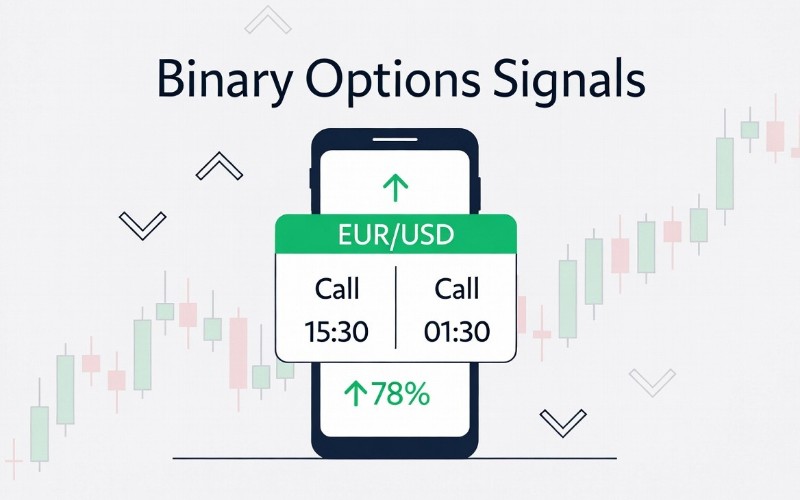
Binary options signals are real-time trade alerts that tell you which asset to trade, whether to bet on the price rising or falling, and when the option expires—delivered straight to your phone, email, or messaging app. They aim to simplify decision-making by packaging market analysis into actionable recommendations.
The catch is that signal quality varies dramatically across providers, and no alert guarantees a winning trade. This guide covers how binary signals work, the different types of providers available, what to look for when choosing a service, and the red flags that separate legitimate operations from scams.
Your capital is at risk. Trading binary options is highly speculative and may not be suitable for all investors. This article is for informational purposes only and does not constitute financial advice.
What are binary options signals
Binary options signals are real-time trade alerts that arrive via email, SMS, app notification, or messaging platforms like Telegram. Each alert tells you which asset to trade, whether to place a call (betting the price rises) or a put (betting it falls), and when the option expires. Think of them as ready-made trade setups delivered straight to your phone or inbox.
A typical signal includes four pieces of information: the asset name (like EUR/USD or Bitcoin), the direction, an expiration window ranging from 60 seconds to several hours, and sometimes a confidence rating. The idea is simple—signals aim to do the analysis for you, so you can skip the chart-reading and jump straight to execution.
That said, quality varies wildly between providers. Some services employ experienced analysts; others run basic algorithms with little oversight. No signal guarantees profits, and treating any alert as a sure thing is a fast way to lose money.
Read Also: Is Binary Options Gambling or Trading
How binary signals work
The journey from market analysis to trade alert follows a predictable path. First, someone or something identifies a potential trade setup. Then, that information gets packaged into a signal and sent to subscribers. Finally, the trader decides whether to act.
Signal generation methods
Signals come from two main sources. Algorithmic systems scan price charts using technical indicators—tools like moving averages or RSI that spot patterns in historical data. When certain conditions line up, the system fires off an alert automatically.
Human analysts take a different route. They read charts, follow economic news, and apply judgment before sending recommendations. Some services combine both approaches, using algorithms for initial screening while analysts make the final call.
Signal delivery channels
Speed matters here because binary options often expire within minutes. A signal that arrives late is essentially useless. Common delivery methods include:
- Email alerts: Reliable but sometimes delayed by spam filters
- SMS notifications: Fast and direct to your phone
- Mobile app push notifications: Near-instant with one-tap access to details
- Browser extensions: Desktop alerts while you’re working online
- Telegram groups: Popular for community-style signal sharing
Executing a binary signal trade
Once an alert lands, execution is usually manual. You open your broker’s platform, find the asset mentioned in the signal, select the direction (call or put), set the expiration time to match, and confirm the trade. The whole process takes under a minute when you’re familiar with your platform.
Delays can hurt, though. If the signal says to buy EUR/USD at 1.0850 and the price has already moved to 1.0865 by the time you log in, the trade setup may no longer make sense.
Types of binary signal providers
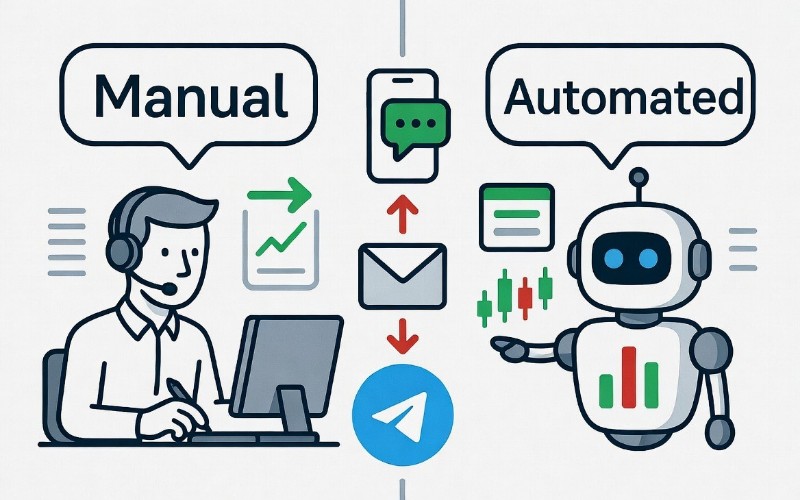
The market splits into a few distinct categories, each with its own trade-offs.
Manual signal services
Human analysts research markets and send trade recommendations directly to subscribers. You receive the alert and decide whether to follow it. The upside is human judgment and context; the downside is that analysts can only watch so many assets at once.
Trading signal bots
A trading signal bot is automated software that generates alerts—and sometimes executes trades—without human involvement. According to vfxAlert, one established provider, their signals “include direct binary signals, online charts, trend indicator, market news” in a single interface. Bots run around the clock and can monitor dozens of markets simultaneously.
Binary option software platforms
Some providers bundle charting tools, signal generation, and trade execution into one platform. This integrated approach reduces the gap between receiving an alert and placing a trade, though it often requires using a specific broker that connects to the software.
Key components of a binary signal
When a signal arrives, you’ll see a standardized format. Here’s what each element means:
| Component | What it tells you |
|---|---|
| Asset | The instrument being traded (EUR/USD, Gold, Apple stock) |
| Direction | Call (price goes up) or Put (price goes down) |
| Entry price | The recommended price level to enter |
| Expiration | Time until the option settles (5 minutes, 1 hour, etc.) |
| Signal strength | Confidence level, often shown as a percentage |
Not every provider includes all five components. At minimum, expect to see the asset, direction, and expiration—the three essentials for placing a trade.
How to choose a binary signal provider
With dozens of services competing for subscribers, careful evaluation protects both your capital and your time. The industry includes legitimate operations alongside outright scams.
1. Verify track record and accuracy claims
Self-reported win rates are easy to fabricate. Look for independently verified results through third-party tracking sites or audited performance records instead. Obsignals, for instance, claims “over 94% daily accuracy” on its website—but figures like that warrant scrutiny. Ask how accuracy is calculated and over what time period before taking any claim at face value.
2. Evaluate signal delivery speed
Binary options often expire within minutes, so even a 30-second delay can make a signal irrelevant. Testing delivery speed during a trial period gives you real data before committing to a paid subscription.
3. Check broker compatibility
Not all signal providers work with all brokers. Before subscribing, confirm that your preferred broker integrates with the service—or that you’re comfortable opening an account with a compatible broker.
4. Assess pricing and trial options
Pricing models vary considerably across the market:
Free tier: Limited features, often a lead generator for premium upgrades
Monthly subscription: Common range is $50 to $200 per month
Lifetime license: One-time payment for ongoing access
Performance-based fees: Provider takes a percentage of profits
Starting with a free trial or demo account lets you evaluate signal quality without putting money on the line.
5. Review user feedback and reputation
Forums, app store reviews, and trading communities offer unfiltered perspectives. The Sig-Zy app on Google Play, for example, accumulates user ratings that reflect real-world experience. Look for detailed reviews rather than simple star ratings, since short reviews can be manipulated more easily.
Free vs paid binary signals
Both models exist, and the right choice depends on your trading volume and expectations.
| Factor | Free Signals | Paid Signals |
|---|---|---|
| Cost | No upfront payment | Subscription or one-time fee |
| Signal frequency | Often limited to a few daily | Higher volume, more assets covered |
| Support | Minimal or community-based | Dedicated customer service |
| Features | Basic alerts only | Advanced filters, analytics, backtesting |
| Accountability | Variable quality | Generally higher standards |
Free signals often serve as marketing tools. Providers use them to attract you to a premium tier or to drive traffic to affiliated brokers. That doesn’t make free signals worthless, but knowing the business model helps you interpret what you’re receiving.
How to use binary signals with your broker
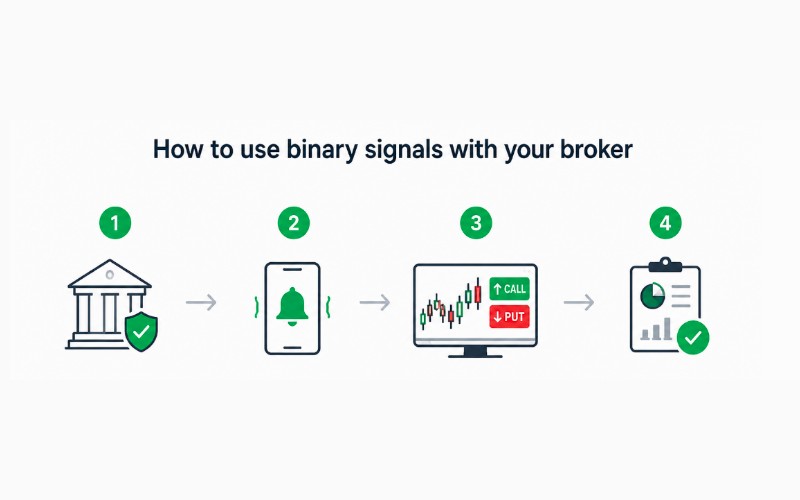
Setting up signals with your trading account involves a few practical steps.
1. Select a compatible broker
Your signal provider’s website typically lists supported brokers. Beyond compatibility, verify that the broker holds appropriate regulatory licenses for your jurisdiction—this protects you if something goes wrong.
2. Configure signal notifications
Most services let you customize alerts by asset class, trading session, or signal strength threshold. Narrowing your focus to markets you already understand often produces better results than trying to trade every alert that comes through.
3. Execute trades based on alerts
The workflow is straightforward: receive signal, open broker platform, locate asset, match the signal parameters, place trade. Practice this sequence until it becomes automatic, since speed matters when expiration windows are short.
4. Track performance and adjust
Keeping a trading journal helps you identify which signal types work well for your style. If certain assets or expiration windows consistently underperform, adjust your notification settings accordingly. Over time, patterns emerge that can guide your approach.
Risks and red flags of binary signal services
No signal guarantees profits, and the industry attracts its share of questionable operators.
Unrealistic accuracy guarantees
Claims of 90%+ win rates over extended periods are mathematically improbable in volatile markets. Legitimate providers acknowledge losing trades and present realistic performance expectations rather than promising near-perfect results.
Lack of transparent track records
Reputable services publish verified historical performance, often through third-party auditing. If a provider can’t show documented results, that absence tells you something important about how they operate.
Pressure tactics and upsells
Aggressive marketing—countdown timers, “limited spots available,” constant upgrade prompts—often signals a business model built on sales rather than trading performance. Legitimate services let their results speak for themselves.
Unregulated or anonymous providers
Services that hide ownership information or operate without any regulatory oversight present elevated risk. While signal providers themselves aren’t always regulated, transparency about the team and company structure indicates legitimacy.
Making informed trading decisions with binary trading software
Signals are tools, not guarantees. The most effective approach combines binary trading software with your own market awareness—understanding why a signal was generated rather than following it blindly.
Staying informed about market-moving events adds context to any signal you receive. Currency pairs react to central bank announcements; crypto assets respond to regulatory news and network developments. Checking AtoZ Markets’ forex and cryptocurrency news coverage before acting on a signal can help you understand whether broader market conditions support the trade.
Tip: Before acting on any signal, check whether major economic releases or news events are scheduled. Even accurate signals can fail when unexpected volatility hits the market.
FAQs about binary options signals
Are binary options signals legal to use?
Binary signals themselves are legal in most jurisdictions. However, binary options trading is restricted or banned in some countries, including the United States for retail traders and parts of Europe. Verify your local regulations before trading.
Can binary options signals be used for cryptocurrency trading?
Yes, many signal providers now cover cryptocurrency pairs alongside traditional forex and commodities. This makes them applicable to crypto binary options where such products are available through regulated brokers.
What is the minimum capital needed to start using binary signals?
Minimum requirements depend on your broker rather than the signal service. Many brokers allow trades starting from $1 to $25, though account minimums for deposits vary. Check your chosen broker’s specific requirements before signing up.
Do professional traders rely on binary options signals?
Some professional traders use signals as one input among many. Most combine them with independent technical and fundamental analysis rather than relying on signals exclusively. Signals can supplement research, but rarely replace it entirely.
How quickly does a trader need to act on a binary signal?
Speed varies by signal type, but most binary signals require action within minutes. Short expiration times mean delayed execution can invalidate the trade setup—the market may have already moved past the intended entry point by the time you log in.