


Altcoin sell pressure has reached a five-year extreme, with $209 billion more sold than bought on spot exchanges over the past 13 months, according to Yahoo Finance. For traders still active in this environment, the playbook looks nothing like the one that worked during the last bull run.
This guide covers seven defensive strategies for trading altcoins when prices are falling, along with how to identify which tokens are worth the risk and what macro factors could extend the downturn further.
Your capital is at risk. This article does not constitute financial advice.
What is happening to the crypto market
Trading altcoins in a bear market means shifting to defensive, high-caution approaches because selling pressure remains extreme and liquidity has dried up across most tokens. Yahoo Finance reported that altcoins are experiencing the heaviest selling in five years, with $209 billion more sold than bought on spot exchanges over the past 13 months. Monthly declines of 40–50% have become routine for smaller tokens, which makes timing and risk management far more important than chasing quick gains.
Bitcoin has held up better than most alternatives, though the broader market still sits roughly 45% below its all-time high. Many traders have rotated into stablecoins or stepped away from crypto entirely, leaving order books thin and price swings more violent than usual. For those still active, the environment rewards patience, strict position limits, and a willingness to sit in cash when setups look unclear.
What defines a crypto bear market
A crypto bear market refers to a sustained decline of 20% or more from recent highs, lasting weeks or months rather than days. The term separates prolonged downtrends from short-term corrections, which tend to reverse quickly within an ongoing uptrend.
You might also hear “crypto winter,” which describes an extended bear market stretching across multiple years. Knowing the difference helps set realistic expectations for how long capital may sit underwater before conditions improve.
Bear market: A prolonged downtrend measured from all-time highs, often lasting several months
Correction: A short-term pullback of 10–20% within a broader uptrend
Crypto winter: A multi-year bear market with depressed prices and low trading activity
How long do crypto bear markets typically last
Historical cycles suggest crypto bear markets can persist anywhere from several months to over two years. Bitcoin’s halving events, which occur roughly every four years, often serve as cycle markers. Bear phases typically unfold in the 12 to 18 months following a market peak.
Patterns from previous cycles
Crypto markets tend to follow a rhythm: expansion, peak, contraction, then accumulation. The contraction phase is where most bear market pain occurs, while accumulation sets the stage for the next rally. Recognizing where the market sits in this cycle can help inform whether to trade actively or wait on the sidelines.
Altcoin recovery timelines compared to Bitcoin
Altcoins generally lag Bitcoin during recoveries, sometimes by months. Many tokens from previous cycles never reclaim their prior highs, which underscores why selectivity matters so much. If you’re holding altcoins through a downturn, it’s worth acknowledging that not every project survives to see the next bull run.
Why altcoins fall harder than Bitcoin in bear markets
Bitcoin typically loses 60–70% from peak to trough in a bear market. Altcoins, on the other hand, often decline 80–95%. Several structural factors explain this gap.
Lower liquidity and higher volatility
Liquidity refers to how easily an asset can be bought or sold without moving the price significantly. Smaller altcoins have thin order books, so even modest sell orders can trigger outsized price drops. This illiquidity cuts both ways: prices can spike quickly on good news, then collapse just as fast when sentiment shifts.
Speculative capital exits first
When risk appetite fades, traders tend to sell their most speculative holdings first. Capital flows from high-risk altcoins toward Bitcoin or stablecoins, which accelerates losses in the long tail of the market. This rotation often happens quickly, leaving little time to react.
Project failure risk
Many altcoin projects lack sustainable funding or active development teams. Extended downturns expose weak fundamentals, and some tokens simply stop trading altogether. Due diligence matters more in bear markets because the margin for error shrinks considerably.
| Factor | Bitcoin | Altcoins |
|---|---|---|
| Liquidity | High | Variable |
| Volatility | Moderate | High |
| Project failure risk | Low | Elevated |
Seven strategies for trading altcoins in a bear market
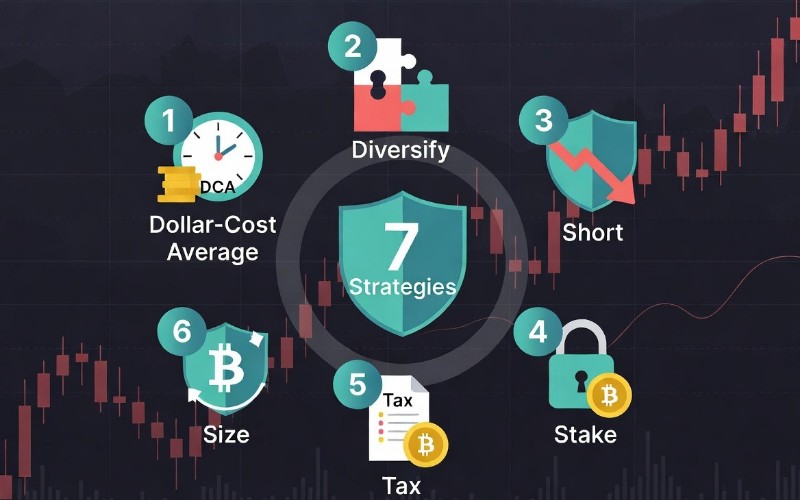
The following approaches can help manage risk and position for eventual recovery. Each one suits different risk tolerances and time horizons, so consider which aligns with your circumstances.
1. Use dollar-cost averaging to accumulate quality altcoins
Dollar-cost averaging, or DCA, involves investing a fixed amount at regular intervals regardless of price. Weekly or monthly purchases work well. This approach removes the pressure of timing the bottom and averages your entry price over time.
DCA works best for traders who believe in an altcoin’s long-term value but want to reduce the risk of buying too early. The key is consistency: stick to the schedule even when prices keep falling.
2. Diversify across altcoin sectors and market caps
Spreading capital across different sectors can reduce the impact of any single project failing. DeFi, layer-1 blockchains, and infrastructure tokens each carry different risk profiles.
Balancing large-cap altcoins with select mid-caps also helps, since larger tokens tend to be more liquid and resilient. Over-concentration in one niche, such as meme coins or AI tokens, amplifies risk. Diversification won’t eliminate losses, but it can smooth returns and preserve capital for better opportunities.
3. Short overvalued altcoins with strict risk limits
Shorting allows traders to profit when prices fall by borrowing and selling an asset, then buying it back at a lower price. Perpetual futures contracts on exchanges like Binance or Bybit are the most common vehicle for crypto shorts.
This approach is advanced and carries significant risk. A sudden rally can trigger liquidation, so strict stop-losses and modest position sizes are essential. If you’re unfamiliar with leverage, consider paper trading first to get comfortable with the mechanics.
4. Stake altcoins to earn yield while holding
Staking involves locking tokens to support a blockchain’s operations in exchange for rewards. Earning yield can partially offset price declines, turning a passive holding into something productive.
However, staking often comes with lock-up periods, meaning you can’t sell quickly if prices drop further. Smart-contract risk also exists, as bugs or exploits can result in lost funds. Weigh the yield against these trade-offs before committing capital.
5. Harvest tax losses to offset future gains
Tax-loss harvesting means selling losing positions to realize a capital loss, which can offset gains elsewhere in your portfolio. In some jurisdictions, this reduces your overall tax liability.
Rules vary by country, and crypto-specific regulations around wash sales are still evolving. Consulting a tax professional familiar with digital assets is a practical step before executing this approach.
6. Rotate from altcoins to Bitcoin during extended downtrends
Capital rotation involves selling altcoins and moving proceeds into Bitcoin, which historically loses less value and recovers sooner. This defensive move preserves capital for re-entry once conditions stabilize.
The trade-off is opportunity cost: if altcoins rally unexpectedly, you’ll miss part of the move. Still, many traders find the reduced volatility worth it during prolonged bear phases.
7. Set position size limits to protect your account
Position sizing means allocating only a small percentage of your total capital to any single trade. A common guideline is the 1% rule, which involves risking no more than 1% of your account on one position.
Pairing position limits with stop-loss orders creates a defined exit point if a trade moves against you. This discipline helps prevent a single bad trade from wiping out months of gains.
Also Read: Altcoins Spot Trading: What it is and How to Get Started
How to identify altcoins worth trading during a downturn
Not every altcoin deserves attention in a bear market. A quick checklist can help filter candidates worth researching further.
Strong fundamentals and active development
Check GitHub activity, roadmap progress, and team credibility. On-chain metrics like active addresses and transaction counts also signal whether a project has real usage or is fading into irrelevance.
Sufficient trading volume and liquidity
Daily trading volume indicates how easily you can enter and exit positions. Tokens with volume below $500,000 per day often become difficult to sell during sharp declines, which can trap you in a losing position.
Clear tokenomics with low inflation
Tokenomics refers to a project’s supply schedule, vesting unlocks, and emission rate. High inflation dilutes existing holders over time, so transparent and limited supply growth is preferable.
Development activity: Look for regular commits and updates on GitHub
Liquidity: Consistent daily trading volume above $500,000
Token supply: A transparent emission schedule with limited inflation
Risk factors that could deepen the altcoin bear market
External forces can extend or intensify downturns, so staying aware of macro risks helps with planning.
Macro-economic shocks and interest rate policy
Rising interest rates reduce appetite for risk assets, including crypto. Central bank decisions and inflation data often move markets quickly, sometimes within hours of an announcement.
Exchange failures or sudden regulatory moves
Exchange collapses, like those seen in previous cycles, can trigger sudden sell-offs and erode confidence across the entire market. Regulatory bans or enforcement actions in major markets carry similar weight.
Over-leverage and cascading liquidations
Leverage amplifies gains but also losses. When prices fall, leveraged positions get liquidated, forcing additional selling that accelerates the decline. Monitoring open interest and funding rates can offer early warning signs of potential liquidation cascades.
Staying informed with real-time altcoin coverage
Timely information is a practical edge in volatile markets. Regulatory shifts, project updates, and sentiment changes can move prices before most traders have a chance to react.
AtoZ Markets publishes daily cryptocurrency news covering altcoin developments, exchange announcements, and market analysis. Bookmarking a reliable source and checking it regularly can help you spot opportunities and risks earlier than the crowd.
FAQs about trading altcoins in bear markets
Can you make money trading altcoins in a bear market?
Yes, traders can profit through short-selling, staking for yield, or accumulating undervalued assets for the next cycle. Losses are also common, though, which makes risk management essential.
What is the 1% rule in crypto trading?
The 1% rule means risking no more than one percent of your total trading capital on any single trade. This approach helps protect your account from large drawdowns.
Should you hold altcoins or convert to stablecoins during a crash?
Converting to stablecoins preserves capital and allows re-entry at lower prices. Holding suits traders confident in an altcoin’s long-term fundamentals. Neither approach guarantees profit.
Are we expecting another crypto crash?
Market forecasts vary widely. Risk factors such as macroeconomic shifts, regulatory actions, and over-leverage can trigger sudden downturns at any time, so preparation matters more than prediction.