

Bitcoin tends to move first in a bull run, but the biggest percentage gains often come from altcoins that most investors haven’t discovered yet. The challenge is finding them before the crowd arrives.
This guide covers ten low-cap altcoins aligned with the dominant narratives analysts expect to drive the next cycle—AI integration, decentralized infrastructure, and real-world asset tokenization—along with the research framework and risk considerations that separate informed positioning from speculation.
Your capital is at risk. This article is not financial advice.
What Makes an Altcoin a Hidden Gem
According to CoinDCX’s 2026 bull run outlook, top altcoins for the next cycle focus on AI, DePIN, and institutional adoption, with analysts pointing to projects like Bittensor, Ondo Finance, Solana, and Fetch.ai. Yet the biggest percentage gains often come from smaller projects that fly under the radar before mainstream attention arrives.
A “hidden gem” in crypto typically means a low-cap altcoin with solid fundamentals but limited visibility. These projects usually trade below $500 million in market cap, which leaves room for significant upside compared to established tokens. The tradeoff, of course, is higher risk.
So what separates a genuine opportunity from noise? A few characteristics tend to show up consistently:
Low market cap: Smaller valuations mean even modest capital inflows can move prices substantially
Clear utility: The project solves a specific problem rather than existing purely for speculation
Active development: Regular code updates, transparent roadmaps, and responsive teams signal ongoing progress
Narrative fit: Connection to trending sectors like AI or decentralized infrastructure increases the chance of capital rotation
Ten Altcoins Set to Explode in the Next Bull Run
The projects below span DePIN, AI integration, and real-world asset exposure. YouHodler and CoinDCX have both identified these narratives as dominant themes for the upcoming cycle, and each token on this list connects to at least one of them.
| Coin | Ticker | Sector | Key Catalyst |
|---|---|---|---|
| Hivemapper | HONEY | DePIN | Decentralized mapping network |
| Phala Network | PHA | AI/Privacy | Confidential computing for dApps |
| Nolus | NLS | DeFi | Capital-efficient lending |
| Oraichain | ORAI | AI | AI-powered oracle services |
| io.net | IO | AI Infrastructure | Decentralized GPU computing |
| Fetch.ai | FET | AI Agents | Autonomous economic agents |
| Propy | PRO | RWA | Real estate tokenization |
| DIMO | DIMO | DePIN | Vehicle data monetization |
| Kima Network | KIMA | Infrastructure | Cross-chain settlement |
| LUKSO | LYX | Lifestyle | Digital identity and creative industries |
Hivemapper (HONEY)
Hivemapper runs a decentralized mapping network. Contributors earn HONEY tokens by capturing street-level imagery through dashcams, and the project has already mapped portions of major cities worldwide. Think of it as a crowdsourced alternative to Google Maps, except participants get paid for their data.
Phala Network (PHA)
Phala sits at the intersection of AI and privacy, providing confidential computing services for decentralized applications. Built within the Polkadot ecosystem, it allows smart contracts to process sensitive data without exposing that information publicly. Privacy-focused infrastructure tends to gain attention when AI adoption accelerates.
Nolus (NLS)
Nolus offers a hybrid lease model that blends lending and borrowing mechanics. The protocol targets improved capital efficiency in DeFi, appealing to users who want leverage without facing traditional liquidation risks. It’s a more specialized play within the broader DeFi category.
Oraichain (ORAI)
Oraichain functions as an AI-powered oracle and blockchain ecosystem. Smart contracts can access artificial intelligence services directly through the network, which positions the project within the AI-crypto convergence narrative that analysts keep highlighting.
io.net (IO)
io.net aggregates underutilized GPU computing power into a decentralized network. AI and machine learning workloads require massive compute resources, and demand currently outpaces supply. The project addresses that bottleneck by pooling distributed hardware.
Fetch.ai (FET)
Fetch.ai enables autonomous economic agents—software that can perform tasks and execute transactions independently. Following its merger with SingularityNET and Ocean Protocol, the combined entity represents one of the largest AI-blockchain integrations in the market right now.
Propy (PRO)
Propy facilitates real estate transactions on-chain. Property purchases can be recorded and executed via blockchain, giving the project direct exposure to the real-world asset tokenization trend. RWA has emerged as one of crypto’s strongest use cases during the current cycle.
DIMO (DIMO)
DIMO allows vehicle owners to earn tokens by sharing driving data through connected devices. It’s a practical DePIN application with measurable adoption, and automotive data monetization represents a growing market outside of crypto as well.
Kima Network (KIMA)
Kima operates as a cross-chain settlement layer, enabling asset transfers without traditional bridges. As multi-chain infrastructure becomes more important, settlement solutions that avoid bridge vulnerabilities gain relevance.
LUKSO (LYX)
LUKSO targets lifestyle and creative industries with a blockchain designed for fashion, gaming, and digital identity. Fabian Vogelsteller, an Ethereum developer who created the ERC-20 token standard, founded the project. That technical credibility helps in an otherwise underserved market segment.
Why Altcoins Surge During a Bull Run
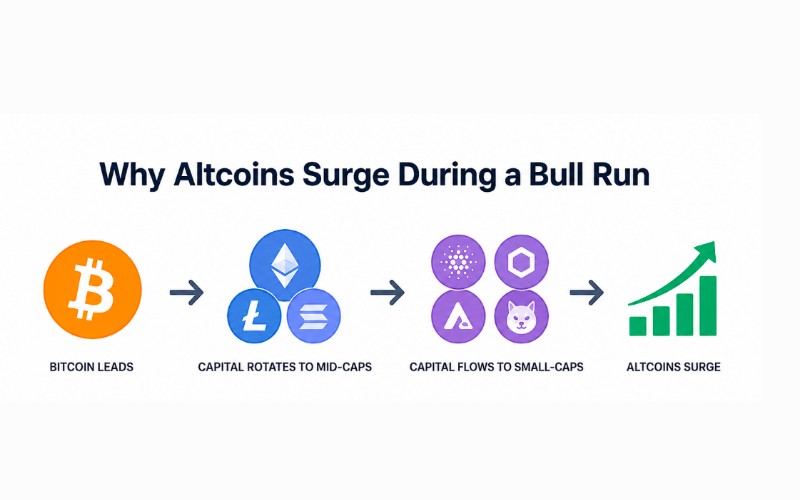
Bitcoin typically leads market cycles. It establishes new highs first, and then capital rotates outward into smaller assets. Traders call this rotation pattern “altcoin season,” and it occurs when investors seek higher percentage returns after Bitcoin’s initial surge stabilizes.
The mechanics are fairly straightforward. As Bitcoin dominance decreases, risk appetite across the market increases. Investors who captured gains in BTC often redeploy that capital into altcoins, and smaller market caps mean even modest inflows can produce outsized price movements.
Bitcoin dominance cycle: BTC leads, then capital flows to mid-caps and eventually small-caps
Rising risk appetite: Confidence from Bitcoin gains encourages speculation in higher-risk assets
Narrative momentum: Trending sectors attract concentrated attention and capital inflows
Key Crypto Trends Driving Cheap Coins to Invest in This Cycle
Three narratives dominate analyst projections for the next bull run. Real-world asset tokenization, decentralized physical infrastructure, and AI-blockchain integration each represent distinct investment themes, though some projects overlap across categories.
Real-World Asset Tokenization
RWA tokenization brings traditional assets onto blockchain rails. Real estate, bonds, and commodities can all be represented as tokens, enabling fractional ownership and faster settlement. According to Modern Diplomacy, “the real-world assets sector has proven to be one of crypto’s strongest use cases during this cycle.”
Institutional interest in tokenized assets continues growing, with Ondo Finance frequently cited as a sector leader. Propy and Nolus from the list above connect directly to this trend.
Decentralized Physical Infrastructure Networks
DePIN refers to crypto-incentivized networks that build real-world infrastructure through distributed participation. Mapping networks, wireless coverage, and compute resources all fall under this umbrella. The model rewards contributors with tokens for providing physical resources or data.
Hivemapper, DIMO, and io.net each represent different DePIN applications. The common thread is that participants earn by contributing something tangible rather than just staking tokens.
Artificial Intelligence and Blockchain Integration
The convergence of AI and crypto encompasses decentralized compute, autonomous agents, and data marketplaces. CoinDCX’s outlook specifically names “AI-Powered Crypto Agents & Protocols” as a top narrative for 2026.
Oraichain, Fetch.ai, and Phala Network each approach this intersection from different angles. All three benefit from the broader AI narrative, though their specific use cases vary considerably.
How to Find Altcoins With Explosive Potential Before They Surge
Identifying hidden gems before mainstream attention arrives requires systematic research rather than relying on social media tips. A few tools and frameworks help separate signal from noise.
Research Tools and On-Chain Platforms
Several platforms provide data for evaluating early-stage projects:
DeFiLlama: Tracks total value locked across DeFi protocols
Token Terminal: Offers fundamental metrics like revenue and active users
Dune Analytics: Enables custom on-chain queries for deeper analysis
CoinGecko: Provides market data, project information, and developer activity metrics
Fundamental and Tokenomics Analysis
Token supply schedules matter. Large upcoming unlocks can create selling pressure, while concentrated holdings raise centralization concerns. Treasury health, revenue models, and burn mechanisms all affect long-term price dynamics.
Red flags include vague roadmaps, anonymous teams, and tokenomics that heavily favor insiders. Projects with transparent documentation and verifiable on-chain activity tend to be safer bets.
Community Sentiment and Social Signals
Discord and Telegram activity, developer responsiveness, and organic follower growth can indicate genuine community interest. However, hype without substance remains a persistent risk in small-cap markets. A project with 100,000 Twitter followers but no working product is usually a warning sign.
How to Buy Low-Cap Altcoins Safely
Many hidden gems aren’t immediately available on major exchanges. Purchasing them often requires additional steps beyond a simple Coinbase transaction.
Centralized Exchanges
Platforms like KuCoin, MEXC, and Gate.io often list smaller projects before Binance or Coinbase do. Always verify listing legitimacy through official project channels, since fake tokens with similar names occasionally appear.
Decentralized Exchanges
For tokens only available on DEXs, Uniswap (Ethereum), Jupiter (Solana), and PancakeSwap (BNB Chain) serve as primary venues. Contract verification through official sources is essential before any swap. One wrong character in a contract address can result in lost funds.
Wallet Security Essentials
Hardware wallets provide the strongest protection for holdings. Ledger and Trezor remain the most widely used options. Seed phrases represent the single point of failure in crypto security—sharing them with anyone, for any reason, results in lost funds.
Risks of Investing in Low-Cap Altcoins
Small-cap altcoins carry risks that established cryptocurrencies do not. Understanding these risks upfront helps with position sizing and expectations.
Extreme volatility: Daily swings of 20% or more are common in low-cap markets
Low liquidity: Exiting positions at desired prices can prove difficult when order books are thin
Project failure: Many altcoins do not survive full market cycles
Regulatory risk: Legal status varies by jurisdiction and can change rapidly
How to Time Your Entry Before the Bull Run Peaks
Timing markets precisely is notoriously difficult. That said, certain approaches help manage risk without requiring perfect predictions.
Dollar-cost averaging spreads purchases across time, reducing the impact of short-term volatility. Rather than buying everything at once, regular smaller purchases smooth out entry prices.
Watching Bitcoin dominance provides context for rotation timing. Declining dominance often signals that altcoin season is approaching, though the relationship isn’t perfectly predictive. Most altcoins peak before Bitcoin in a cycle, so setting profit-taking targets rather than holding indefinitely tends to preserve gains more effectively.
Track These Altcoins With AtoZ Markets
AtoZ Markets provides real-time cryptocurrency news coverage alongside broader financial market analysis. For traders who treat crypto as part of a wider investment strategy, the integration of altcoin updates with forex and traditional market coverage offers a centralized information source rather than piecing together updates from multiple outlets.
Track the latest altcoin developments in our Cryptocurrency News section →
FAQs About Altcoins for the Next Bull Run
Which crypto under one dollar could explode during the next bull run?
Tokens like Fetch.ai (FET), Phala Network (PHA), and DIMO currently trade under one dollar while aligning with trending narratives. Price per token doesn’t indicate potential on its own—market cap and utility matter more than the dollar amount displayed.
How can investors identify if an altcoin is a scam?
Red flags include anonymous teams, absent code audits, unrealistic return promises, and liquidity that developers can withdraw at will. Verifying contracts through official sources before purchasing reduces exposure to fraudulent projects.
Is it better to buy altcoins or Bitcoin before a bull run begins?
Bitcoin typically leads cycles with lower relative risk, while altcoins offer higher potential returns alongside significantly greater volatility and failure risk. The right allocation depends on individual risk tolerance and investment timeline.
How long do investors typically hold altcoins during a bull run cycle?
Many traders set profit-taking targets rather than holding indefinitely. Most altcoins peak before Bitcoin does in a cycle, so exit strategies established before entry help avoid emotional decision-making when markets get euphoric.
What percentage of a crypto portfolio goes to low-cap altcoins?
Risk management practices generally suggest limiting speculative low-cap positions to a small portion of overall holdings. The majority of a crypto portfolio typically goes to established assets like Bitcoin and Ethereum, with smaller allocations to higher-risk plays.