

A meme coin is a cryptocurrency built around internet humor, viral content, or cultural jokes rather than any technical purpose. Unlike Bitcoin or Ethereum, which were designed to solve specific problems, meme coins exist primarily for speculation and community entertainment.
Dogecoin started as a joke in 2013, yet meme coins now represent billions of dollars in trading volume daily. This guide covers how meme coins work, what drives their value, the risks involved, and how traders approach this volatile corner of the crypto market.
Your capital is at risk. Meme coins are highly speculative assets with extreme price volatility. This article is for educational purposes only and does not constitute financial advice.
What is a meme coin
A meme coin is a cryptocurrency inspired by internet memes, jokes, or viral cultural moments. Unlike Bitcoin, which was built for decentralized payments, or Ethereum, which hosts applications, meme coins typically have no underlying technical purpose or economic function. Their value comes almost entirely from social media buzz, community enthusiasm, and occasionally celebrity endorsements.
The first meme coin, Dogecoin, launched in 2013 as a joke. Software engineers Billy Markus and Jackson Palmer created it to poke fun at the cryptocurrency craze, using the popular Shiba Inu dog meme as its mascot. What started as satire eventually attracted billions of dollars in market value.
Today, meme coins are built on existing blockchains like Ethereum and Solana rather than running their own networks. A developer can launch one in minutes using pre-built smart contract templates, which explains why thousands now exist.
How do meme coins work
At a technical level, meme coins operate like any other cryptocurrency token. They live on a blockchain, and smart contracts handle transactions. The difference lies in what drives their price.
Here’s the typical lifecycle:
- Token creation: A developer deploys a smart contract defining the token’s name, supply, and basic rules.
- Liquidity provision: The creator pairs the new token with another cryptocurrency on a decentralized exchange, making it tradable.
- Price discovery: Buying and selling activity determines the price from that point forward.
- Community building: Promotion happens through social media, memes, and influencer partnerships.
For utility tokens like Ethereum, demand comes from developers building applications on the network. For meme coins, demand comes from speculation and community hype. That distinction matters because it means meme coin prices can collapse the moment attention shifts elsewhere.
Why do people buy meme coins
Several factors draw traders to meme coins, and profit-seeking is only part of the story.
Low entry prices attract newcomers. When a token costs $0.00001, even $20 buys millions of units. Owning “a million of something” feels more exciting than owning 0.0003 Bitcoin, even if the dollar amounts are identical.
Speculative upside motivates many buyers. Early Dogecoin holders who bought at fractions of a cent saw extraordinary returns during the 2021 bull run. Stories like that spread quickly on social media, creating a lottery-ticket mentality.
Community belonging also plays a role. Joining a meme coin community feels like being part of an inside joke. The shared language, humor, and collective enthusiasm create genuine social connections, even when the underlying asset has no practical use.
Many meme coin buyers openly acknowledge they’re gambling rather than investing. The entertainment value is part of the appeal.
Meme coin characteristics
Meme coins share several features that set them apart from other cryptocurrencies.
Community-driven value
Price movements depend on social media activity, Reddit threads, and influencer posts rather than technological progress. A single tweet from a well-known figure can move prices by double digits within hours.
High volatility
Extreme price swings are normal. A 500% gain in one week followed by an 80% crash the next is not unusual. This volatility creates opportunities for short-term traders while making long-term holding exceptionally risky.
Limited or no utility
Most meme coins serve no practical function. They don’t power applications, facilitate specific transactions, or solve technical problems. Their purpose is simply to exist and be traded.
Large token supply
Meme coins typically launch with billions or trillions of tokens in circulation. Shiba Inu, for example, started with one quadrillion tokens. Massive supply keeps individual token prices low, which appeals to buyers who prefer holding large quantities.
Social media dependence
Without continuous online engagement, meme coins fade into obscurity. The tokens that survive longest maintain active communities across X, Reddit, and Telegram.
Popular meme coin examples
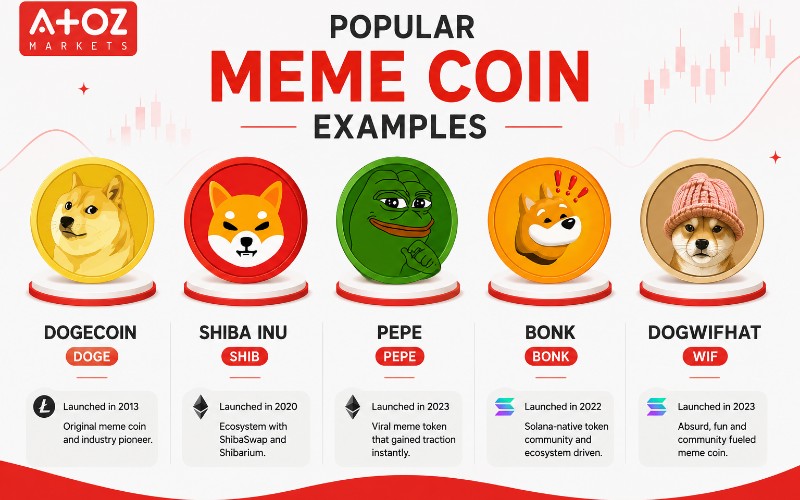
Thousands of meme coins exist, but a handful have achieved significant market capitalization and mainstream recognition.
Dogecoin (DOGE)
The original meme coin, created as a Bitcoin parody featuring the Shiba Inu dog meme. Dogecoin gained mainstream attention through Elon Musk’s repeated endorsements and briefly exceeded $80 billion in market cap during 2021.
Shiba Inu (SHIB)
Often called the “Dogecoin killer,” Shiba Inu launched in 2020 and has evolved beyond pure meme status. The project now includes ShibaSwap, a decentralized exchange, along with plans for a layer-2 blockchain called Shibarium.
Pepe (PEPE)
Based on the Pepe the Frog internet meme, this token launched in April 2023 and reached a $1.6 billion market cap within weeks. Pepe demonstrates how quickly meme coins can gain traction and how rapidly sentiment can shift.
Bonk (BONK)
A Solana-native meme coin launched in December 2022, designed partly to bring attention back to the Solana ecosystem during a difficult period. Bonk showed that meme coins can serve ecosystem-level marketing purposes.
Dogwifhat (WIF)
Another Solana-based token, this one featuring a dog wearing a knitted hat. Dogwifhat reached multi-billion dollar valuations in early 2024, demonstrating how absurdist imagery continues driving meme coin culture.
Meme coins vs other cryptocurrencies
Meme coins occupy a distinct category within the broader crypto landscape. The table below highlights key differences.
| Feature | Meme Coins | Utility Cryptocurrencies |
|---|---|---|
| Primary purpose | Entertainment, speculation | Technical applications, payments |
| Value driver | Social sentiment, hype | Technology adoption, use cases |
| Volatility level | Extremely high | Moderate to high |
| Development activity | Often minimal | Ongoing technical work |
| Typical lifespan | Many fade within months | Generally longer with active teams |
Treating meme coins like utility tokens and expecting long-term appreciation based on fundamentals misunderstands their nature entirely.
Benefits of meme coin trading
Despite the risks, meme coins offer certain advantages that explain their persistent popularity.
Low entry price
Fractional cent prices allow participation with minimal capital. Someone with $50 can experiment without significant financial exposure.
High upside potential
Early participants in successful meme coins have occasionally seen substantial returns. While rare, the possibility attracts traders willing to accept high risk.
Strong community engagement
Active online communities provide real-time market sentiment and entertainment. For traders who enjoy social aspects of markets, meme coin communities deliver engagement that traditional assets lack.
Accessibility for beginners
The simple concept makes meme coins an entry point for cryptocurrency newcomers. However, this accessibility can also lead inexperienced traders into significant losses.
Risks of buying meme coins
The dangers of meme coin trading are substantial. Anyone considering this market segment needs to understand what can go wrong.
Rugpulls and scams
A “rugpull” occurs when creators abandon a project and disappear with investors’ funds. Meme coins, with their often anonymous creators and minimal oversight, are particularly vulnerable to this type of fraud.
Extreme price volatility
Prices can drop 90% or more within days. Any gains can evaporate just as quickly, and timing exits proves nearly impossible even for experienced traders.
Lack of fundamental value
No underlying technology, revenue, or assets support meme coin prices. Value depends entirely on continued buyer interest, which can disappear overnight.
Regulatory uncertainty
Meme coins exist in a regulatory gray area. Future rules could impact their trading, legality, or exchange availability.
Liquidity problems
Smaller meme coins may become difficult to sell during market downturns. When everyone wants to exit simultaneously, buyers disappear and prices collapse.
Tip: Before trading any meme coin, research the project’s liquidity, creator transparency, and community activity. Consider only allocating funds you can afford to lose entirely.
How to buy meme coins
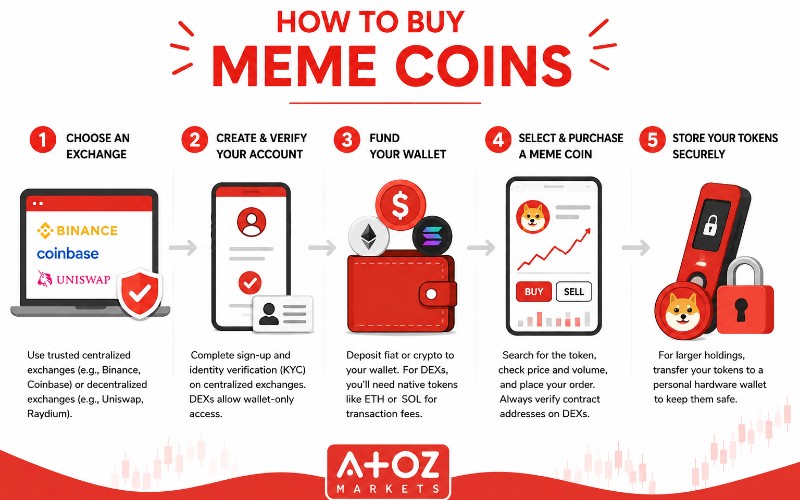
For those who understand the risks and still want exposure, here’s the general process.
1. Choose a cryptocurrency exchange
Major centralized exchanges like Coinbase and Binance list popular meme coins such as Dogecoin and Shiba Inu. Newer or smaller meme coins typically trade only on decentralized exchanges like Uniswap or Raydium.
2. Create and verify your account
Centralized exchanges require identity verification, commonly called KYC (Know Your Customer). Decentralized exchanges allow trading directly from a wallet without registration, though this adds complexity.
3. Fund your wallet
Deposit fiat currency or transfer existing cryptocurrency to your exchange wallet. For decentralized exchange trading, you’ll need the blockchain’s native token—ETH for Ethereum-based coins, SOL for Solana-based coins—to pay transaction fees.
4. Select and purchase a meme coin
Search for the token’s ticker symbol, review the current price and trading volume, then execute your buy order. When trading on decentralized exchanges, double-check contract addresses to avoid counterfeit tokens.
5. Store your tokens securely
For larger holdings, consider transferring tokens to a personal hardware wallet rather than leaving them on an exchange.
The outlook for meme coins
The future of meme coins remains uncertain, though their persistence suggests they’ve become a permanent feature of crypto markets. Some projects, like Shiba Inu, are attempting to develop genuine utility through DeFi applications and layer-2 solutions. Most, however, will likely fade as community interest wanes.
What seems clear is that meme coins reflect something real about how internet culture and financial markets now intersect. Whether that intersection produces lasting value or merely entertaining speculation depends on individual projects and broader market conditions.
Why meme coins matter for active traders
For traders following cryptocurrency markets, meme coins represent both opportunity and risk. The extreme volatility that makes them dangerous for long-term holders creates short-term trading opportunities for those with appropriate risk management.
Meme coin dynamics also provide insight into broader market sentiment. When meme coins surge, it often signals speculative excess across crypto markets. When they crash, it can foreshadow wider risk-off moves.
AtoZ Markets covers meme coin developments alongside traditional forex and cryptocurrency news, helping traders stay informed about this volatile market segment. For timely updates on meme coin movements and broader crypto market analysis, explore our Cryptocurrency News section.
FAQs about meme coins
Can a meme coin reach $1?
For most meme coins, reaching $1 is mathematically improbable due to massive token supplies. Shiba Inu reaching $1 would require a market capitalization exceeding $500 trillion—more than the entire global economy. Dogecoin, with its smaller supply, has a more realistic path to $1, though still unlikely.
Are meme coins actually worth anything?
Meme coins have market value determined by trading activity, but that value is based purely on speculation rather than underlying assets or revenue. Their worth can disappear rapidly if community interest fades.
How do you spot a meme coin rugpull before it happens?
Warning signs include anonymous development teams, liquidity locked for short periods or not at all, unrealistic promises of guaranteed returns, and pressure to buy quickly. Checking whether the smart contract has been audited and whether large token holdings are concentrated in few wallets can also reveal red flags.
What percentage of meme coin traders make money?
The vast majority of meme coin traders lose money. Gains typically concentrate among early buyers and insiders, while later participants often purchase near price peaks.