

A cryptocurrency fork occurs when a blockchain’s protocol changes, causing the network to split into two potential paths. The split can be temporary or permanent, and in some cases, it creates an entirely new cryptocurrency.
Forks have produced some of the most significant events in crypto history, from the Bitcoin Cash split to Ethereum’s transition to proof of stake. This guide covers how forks work, the difference between hard and soft forks, and what they mean for your holdings.
Your capital is at risk when trading cryptocurrencies. This content is for informational purposes only and is not financial advice.
What is a Cryptocurrency Fork
A cryptocurrency fork is a change to a blockchain’s protocol that causes the network to split. The split can be temporary or permanent, depending on the type of change and whether the community agrees on it. In practical terms, a fork updates the rules that determine which transactions the network considers valid.
Forks fall into two main categories: hard forks and soft forks. A hard fork creates a permanent, incompatible split that often results in a new cryptocurrency. A soft fork, by contrast, remains backward-compatible, meaning older software can still interact with the updated network. According to Coinbase, “a fork happens whenever a community makes a change to the blockchain’s protocol, or basic set of rules.”
Some forks are planned upgrades that the entire community supports. Others emerge from disagreements about a project’s direction, leading to a permanent split where two separate cryptocurrencies continue operating independently.
Why Cryptocurrency Forks Occur
Forks happen for different reasons, though most fall into a few common categories.
Protocol Upgrades and Network Improvements
The most common reason for a fork is a planned upgrade. Developers propose changes to improve transaction speed, add new features, or optimize how the network operates. When the community agrees on the changes, the fork proceeds smoothly and the network continues as one chain.
Community Disagreements Over Blockchain Direction
Not all forks are friendly. Sometimes developers, miners, and users disagree about fundamental aspects of a cryptocurrency’s future. When consensus breaks down, one group may fork the code and create a competing version. The Bitcoin and Bitcoin Cash split in 2017 is a well-known example of a contentious fork driven by disagreements over block size limits.
Security Patches and Bug Fixes
Security vulnerabilities occasionally require urgent action. When developers discover a critical bug or exploit, they may implement a fork quickly to protect users and their funds. In these cases, speed matters more than lengthy community debate.
Hard Forks vs Soft Forks Explained
The distinction between hard and soft forks determines what happens to the network after a protocol change.
| Feature | Hard Fork | Soft Fork |
|---|---|---|
| Backward Compatibility | No | Yes |
| Chain Result | Two separate blockchains | One blockchain |
| Node Requirements | All nodes upgrade | Only miners upgrade |
| New Cryptocurrency Created | Often yes | No |
What is a Hard Fork in Crypto
A hard fork introduces changes that older software cannot recognize. Nodes running the previous version will reject blocks created under the new rules, which forces the network to split. After a hard fork, two independent blockchains exist: one following the original rules and one following the updated protocol.
The key characteristic of a hard fork is its permanence. Once the split occurs, the two chains operate separately with their own transaction histories going forward. If you held coins before the fork, you typically end up with coins on both chains.
What is a Soft Fork
A soft fork maintains backward compatibility. Nodes running older software can still validate transactions and communicate with upgraded nodes, even if they don’t understand all the new features. This compatibility means the network stays unified rather than splitting into separate chains.
Soft forks are generally less disruptive because they don’t require every participant to upgrade immediately. However, they’re also more limited in the types of changes they can implement.
Key Differences Between Hard and Soft Forks
The practical differences affect how traders and holders experience each type of fork:
- Compatibility: Hard forks break compatibility with older software, while soft forks maintain it
- New coins: Hard forks often create a new cryptocurrency; soft forks do not
- Network unity: Hard forks can permanently divide a community; soft forks keep everyone on the same chain
How Blockchain Forking Works
The mechanics of a fork follow a predictable sequence, though the details vary by project.
The Fork Process Step by Step
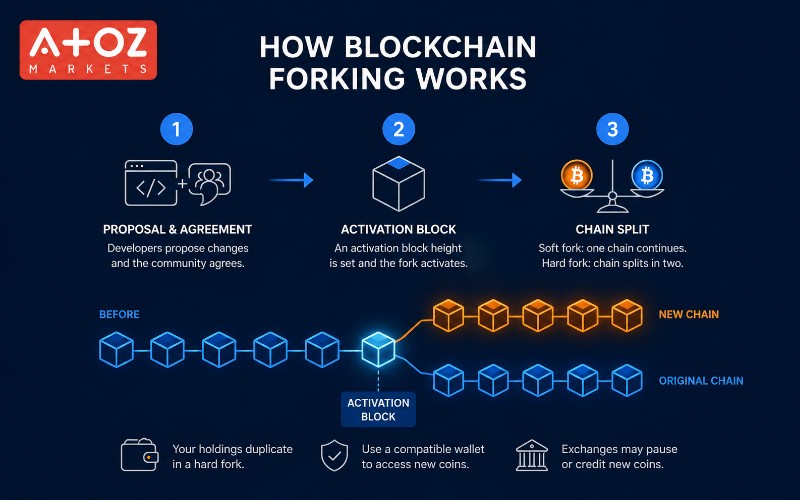
First, developers propose changes to the protocol and publish the updated code. The community then discusses the proposal, which can take weeks or months for significant changes. If enough participants agree, developers set an activation block height, which is a specific point in the blockchain where the new rules take effect.
Once miners produce the designated block, the fork activates. For soft forks, the network continues normally with the new rules in place. For hard forks, the chain splits at that block, and two separate blockchains begin operating independently.
What Happens to Your Cryptocurrency During a Fork
During a hard fork, your holdings essentially duplicate. If you held 1 BTC before the Bitcoin Cash fork, you had 1 BTC and 1 BCH afterward. The original coins remain on the original chain, while equivalent coins appear on the new chain.
However, accessing coins on the new chain sometimes requires specific steps. You may need to use a wallet that supports the forked cryptocurrency or import your private keys into compatible software. The exact process depends on the specific fork and the wallet you use.
How Crypto Exchanges Handle Forks
Crypto Exchanges typically announce their fork policies in advance. Some pause deposits and withdrawals around the fork date to prevent complications. Others credit users with new coins automatically if they held the original cryptocurrency at the time of the fork.
Not all exchanges support every fork. Smaller or contentious forks may not receive exchange support, which limits trading options for the new coins. Checking your exchange’s announcements before a fork helps you understand what to expect.
Bitcoin Fork Examples
Bitcoin has experienced numerous forks since its launch in 2009. A few stand out as particularly significant.
Bitcoin Cash
Bitcoin Cash launched in August 2017 after a prolonged debate about Bitcoin’s block size. One faction wanted to increase the block size limit to allow more transactions per block. Another faction preferred keeping blocks small and implementing other scaling solutions.
When the community couldn’t reach consensus, Bitcoin Cash forked from Bitcoin with an 8 MB block size limit compared to Bitcoin’s 1 MB. Both cryptocurrencies continue operating today with separate communities and market values.
Bitcoin SV
Bitcoin SV forked from Bitcoin Cash in November 2018, demonstrating that forked cryptocurrencies can themselves fork again. The split centered on further block size increases and competing visions for the network’s development. Bitcoin SV increased the block size limit to 128 MB and later removed the limit entirely.
SegWit Soft Fork
Not all significant Bitcoin upgrades created new coins. Segregated Witness, or SegWit, activated in August 2017 as a soft fork. The upgrade changed how transaction data is stored, effectively increasing Bitcoin’s transaction capacity without raising the block size limit.
Because SegWit was backward-compatible, the network stayed unified. Nodes that didn’t upgrade could still validate transactions, though they couldn’t take advantage of the new features.
Ethereum Fork Examples
Ethereum’s fork history includes both contentious splits and coordinated upgrades.
Ethereum Classic
The Ethereum and Ethereum Classic split in July 2016 followed the DAO hack. Attackers exploited a vulnerability in a smart contract called The DAO and drained approximately $60 million worth of ETH. The Ethereum community faced a choice: implement a hard fork to reverse the hack or preserve the blockchain’s immutability.
Most of the community supported the hard fork, which restored the stolen funds. However, a minority continued operating the original chain under the name Ethereum Classic, arguing that blockchains shouldn’t be altered even to fix hacks.
The Merge and Proof of Stake Transition
Ethereum’s transition from proof-of-work to proof-of-stake in September 2022, known as “The Merge,” represents a different type of fork. Rather than splitting the community, The Merge was a coordinated upgrade that the entire network adopted together.
According to the Ethereum Foundation, The Merge reduced Ethereum’s energy consumption by approximately 99.95%. The upgrade changed how the network validates transactions without creating a competing chain.
How Forks Impact Cryptocurrency Prices
Fork events often create notable price movements, though the direction and magnitude vary.
Pre-Fork Price Speculation
Trading activity typically increases before a fork as traders position themselves. Some accumulate coins hoping to receive tokens on both chains after a hard fork. This buying pressure can push prices higher in the weeks leading up to the fork date.
Post-Fork Market Volatility
After a fork, prices often swing as the market determines value for both chains. The original cryptocurrency may drop as some holders sell to buy the new coin. Meanwhile, the forked cryptocurrency’s price can be highly volatile as traders assess its long-term viability.
How Large Traders Influence Fork Prices
Large holders, sometimes called whales, can significantly impact prices around fork events. Their buying or selling decisions move markets more than smaller traders, which creates additional uncertainty during already volatile periods.
Benefits of Blockchain Forks
Forks serve several important functions in cryptocurrency development:
- Network upgrades: Forks allow developers to improve transaction capacity, add features, and optimize performance
- Security fixes: Critical vulnerabilities can be patched through coordinated forks
- Governance mechanism: When communities disagree, forks let each faction pursue its preferred direction
Risks of Forking a Cryptocurrency
Forks also introduce specific risks that traders and holders face.
Replay Attacks
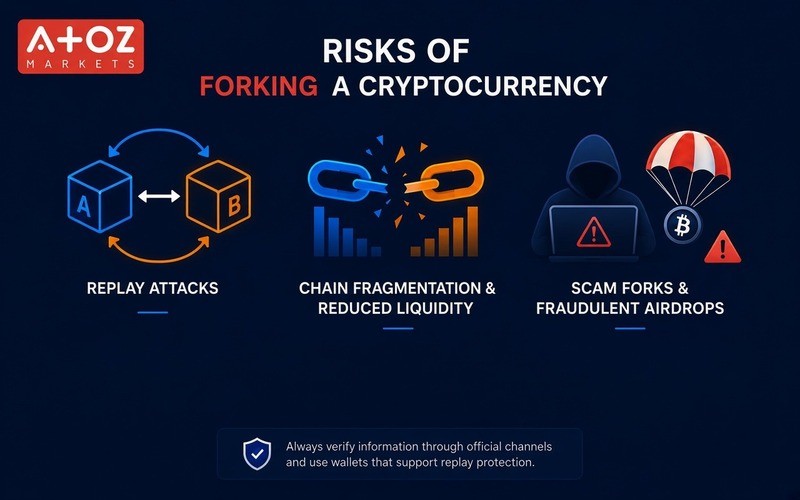
A replay attack occurs when a transaction valid on one chain is broadcast on the other chain without the sender’s consent. If both chains share the same transaction format, someone could copy your transaction from one chain and submit it on the other, potentially causing you to send coins on both chains unintentionally.
Well-designed forks include replay protection to prevent this issue, but not all forks implement adequate safeguards.
Chain Fragmentation and Reduced Liquidity
When a community splits, both resulting chains typically have fewer participants than the original. Mining power, developer attention, and trading volume divide between the two chains. This fragmentation can weaken both networks compared to what a unified chain might have achieved.
Scam Forks and Fraudulent Airdrops
Fake fork announcements are a persistent threat in cryptocurrency. Scammers may claim a fork is occurring and ask users to enter their private keys on malicious websites to “claim” new coins. Verifying fork announcements through official project channels helps avoid these scams.
Tax Implications of Forked Cryptocurrency
Receiving coins from a fork may create a taxable event depending on your jurisdiction. In the United States, the IRS treats forked cryptocurrency as ordinary income at the time you gain control over it. The taxable amount equals the fair market value of the new coins when you receive them.
Tax treatment varies significantly by country. Some jurisdictions tax forked coins immediately, while others only tax them when sold. Consulting a tax professional familiar with cryptocurrency helps clarify your specific obligations.
How Crypto Forks Continue to Shape the Market
Forks remain a fundamental part of how cryptocurrencies evolve. They enable protocol upgrades, resolve community disputes, and occasionally create entirely new digital assets. As blockchain technology matures, forks will likely continue playing a central role in cryptocurrency governance and development.
Why Understanding Forks Matters for Your Crypto Trading
Fork events can affect your holdings, create trading opportunities, and introduce risks like replay attacks. Knowing how forks work helps you evaluate announcements, understand price movements, and take appropriate steps to protect your coins.
For ongoing coverage of fork announcements and their market implications, AtoZ Markets’ cryptocurrency news section provides analysis for active traders.
Frequently Asked Questions About Cryptocurrency Forks
Do I automatically receive coins from a cryptocurrency fork?
If you hold the original cryptocurrency in a wallet where you control the private keys at the fork’s block height, you typically receive equivalent coins on the new chain. Exchange users receive forked coins only if their exchange supports the specific fork.
How do I prepare my wallet before a blockchain fork?
Moving cryptocurrency to a wallet where you control the private keys ensures access to coins on both chains. Following official announcements from the project’s development team provides guidance on any additional steps.
Can a cryptocurrency hard fork fail?
Yes. A forked cryptocurrency can fail to attract sufficient community support, developer activity, or mining power. Without adoption, the new chain may become effectively worthless over time.
What is the difference between a contentious fork and a planned upgrade?
A contentious fork occurs when the community disagrees and splits into competing chains. A planned upgrade is a coordinated change where the entire network moves to the new protocol together without creating a separate chain.
Are forked cryptocurrency tokens worth anything?
Forked tokens derive value from community adoption, developer support, and market demand. Some become valuable cryptocurrencies with active trading markets, while others fade into obscurity.