

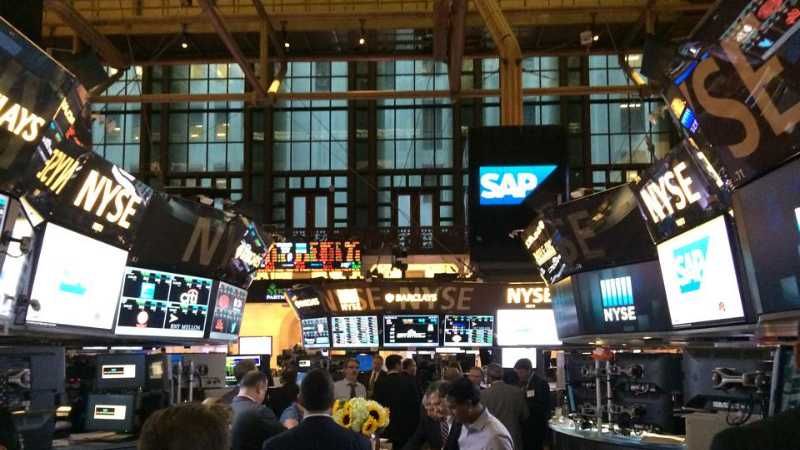
The S&P 500 and Nasdaq Composite finished higher on Thursday after Federal Reserve chairman Jerome Powell signaled that the central bank would continue to raise the interest rate.
The S&P 500 closed at 4,381.89, adding 16.2 points or 0.37 percent. The tech-heavy Nasdaq concluded the trading session at 13,630.61, rising by 128.41 points or 0.95 percent. Meanwhile, the Dow Jones Industrial Average lost 4.81 points or 0.01 percent to 33,946.71 at the closing bell.
Powell testified in front of the Senate Banking Committee on Thursday, saying the Fed would maintain its tight monetary policy albeit with “caution.” CFRA Research chief investment Sam Stovall said the market anticipated one more rate hike instead of two. Fed fund futures predict a 74 percent probability of a 25-basis-point hike in July.
“Investors are playing tug of war, as if they’re pulling petals from a daisy saying ‘bull market, not a bull market,'” said Stovall. “We don’t have much to trade on, second-quarter earnings don’t start in a couple weeks yet.”
U.S. Bank Wealth Management chief equity strategist Terry Sandven said the equity market was in a “pause mode.” Sandven explained that the balance between bulls and bears in the market implied volatility in the near future. He pointed out that Nasdaq had declined on Wednesday but recouped some of its loss in the following session.
“The Nasdaq is higher today but then again, it was off yesterday.”
Terry Sandven, U.S. Bank Wealth Management chief equity strategist
Heavyweight growth stocks boosted the Nasdaq’s gaining momentum on Thursday. Amazon jumped by 4.26 percent to $130.15, while Apple added 1.65 percent to trade at $187.00. Shares of Microsoft rose by 0.99 percent to $336.86.
Five of 11 major sectors within the S&P 500 advanced, with consumer discretionary posting the largest daily percentage gain of 1.53 percent. Real estate and energy sectors were the index’s worst-performing sectors, losing 1.44 percent and 1.30 percent, respectively.
Spirit AeroSystems’ stock plunged 9.4 percent after the aerostructures manufacturer said it would suspend production at its Wichita plant. Workers at said plant announced a strike on June 24 after most of them voted to reject a new four-year labor agreement. Boeing shares also lost 3.1 percent following the news. The aircraft maker is one of Spirit’s clients.
U.S.-listed shares Accenture posted a 1.9 percent decline to $307.25 after the IT consulting enterprise projected weaker-than-expected revenues in the fourth quarter. Darden Restaurants slipped 2.6 percent after forecasting a profit drop due to higher commodity prices.
Asian stocks decline
Stocks declined in the Asian market on Friday local time as global central banks’ policy outlook dampened risk appetite. The MSCI’s Asia-Pacific index, excluding Japan, fell by 1.3 percent. The index is on track to lose 4.2 percent for the week, its worst in three quarters.
The Chinese stock market was closed for a holiday, while the Hang Seng index in Hong Kong slipped 1.71 percent to 18,890.09. The index lost as much as two percent earlier in the session. South Korea’s Kospi fell by 0.91 percent to 2,570.10. The Japanese Nikkei 225 plummeted 1.45 percent to 32,781.54. The Nikkei 225 is set to post a 2.7 percent drop this week, breaking its 10-week gaining streak.
In Australia, the benchmark S&P/ASX 200 lost 1.34 percent to 7,099.20. New Zealand’s fell by 0.013 percent to 11,737.55.
Besides the Fed, the Bank of England (BoE) and European Central Bank (ECB) have indicated they will further increase rates due to stubborn inflation. The BoE hiked its cash rate by a half percentage point on Thursday, despite earlier predictions of a 25-basis-point hike. The market forecasts the BoE’s rate to peak at six percent this year.
Investors also predict the ECB will increase its key rate in July and September. According to analysts, the ECB’s terminal rate may hit over four percent.