


Day trading attracts thousands of new participants each year, many drawn by social media success stories and the appeal of working from anywhere. What those stories rarely mention is that research consistently shows 70-90% of day traders lose money, and most quit within their first year.
This article covers what makes day trading difficult, what the research actually says about success rates, and practical steps that can improve your odds if you decide to proceed.
Your capital is at risk. Day trading involves substantial risk of loss and is not suitable for all investors. This article is for informational purposes only and does not constitute financial advice.
Key takeaways
Day trading is widely considered one of the hardest ways to make money in financial markets. Failure rates often exceed 60-90% for beginners, and success typically takes years of practice, strict discipline, and the ability to handle significant financial and emotional pressure.
High failure rate: Most day traders lose money, and the majority never achieve consistent profitability.
Emotional control required: Fear and greed drive common mistakes like holding losing positions too long or exiting winners too early.
Significant time commitment: Day trading often demands 10-12 hours of screen time daily, according to Investopedia.
Steep learning curve: Developing the skills to trade profitably typically takes one to three years, if it happens at all.
Why day trading is one of the hardest forms of trading
Day trading means buying and selling financial instruments within the same trading session, closing all positions before the market closes. Unlike swing trading or long-term investing, there’s no overnight window to wait for a position to recover.
What makes day trading particularly difficult is the speed at which decisions happen. Positions open and close within hours or minutes, leaving little time to think things through. A bad entry can’t be held overnight hoping for improvement because losses crystallize the same day.
Constant monitoring: Active attention throughout trading hours is the baseline expectation.
Professional competition: Retail traders face algorithms and institutional desks with better technology, data, and capital.
No recovery buffer: Unlike longer-term approaches, day traders can’t wait out temporary price moves against them.
You might assume that more trading activity creates more opportunities to profit. Often, the opposite proves true because each trade introduces transaction costs and another chance for error.
Day trading success rates according to research
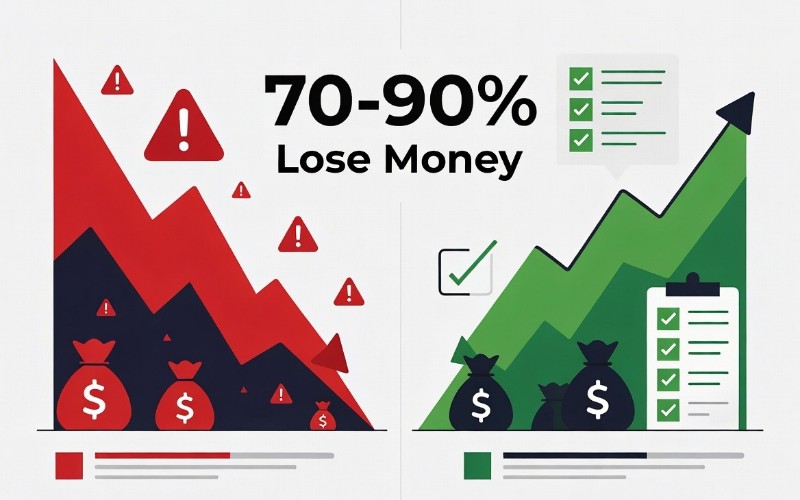
The data on day trading profitability tells a sobering story. While success stories spread widely on social media, academic research points in a different direction.
What academic studies reveal about profitability
A frequently cited study from the University of California found that only about 1% of day traders consistently profit after fees. Research on the Brazilian market, published in academic journals, concluded that 97% of day traders who persisted for more than 300 days lost money.
“The day trading industry, and numerous books and advertisements about day trading, actively promote the idea that day trading is a viable path to wealth,” notes analysis from Current Market Valuation. “The evidence suggests otherwise.”
Broker-disclosed loss percentages
Regulated brokers in the EU and UK are required to disclose what percentage of retail client accounts lose money when trading CFDs and similar products. Disclosures typically range from 70-80%, though some brokers report even higher figures.
How many traders quit within the first year
Most beginners abandon day trading before developing any real competence. According to Trade That Swing, many traders quit within their first year, often after depleting their initial capital or experiencing the psychological toll of repeated losses. The traders who eventually succeed typically describe a multi-year journey of losses, adjustment, and gradual improvement.
Cognitive and psychological demands that make day trading difficult
Beyond technical skills, day trading imposes mental and emotional demands that many beginners don’t anticipate.
Analytical thinking and real-time decision making
Processing price action, news events, and technical indicators simultaneously while under time pressure creates significant cognitive load. This isn’t passive observation. It’s active problem-solving with money on the line, and the mental fatigue accumulates throughout the trading day.
Emotional discipline and loss management
Fear and greed create predictable mistakes. Traders often hold losing positions hoping for recovery while cutting winning trades too early to lock in gains.
“Revenge trading” describes the pattern of making impulsive trades after a loss, attempting to recover quickly. This behavior typically compounds losses rather than reversing them, and it’s one of the most common ways traders blow up their accounts.
Managing stress during market volatility
Watching positions move against you triggers genuine stress responses. The physical and mental toll resembles high-pressure professional environments, yet many approach day trading expecting it to feel like a casual side activity. It rarely works out that way.
How risky is day trading compared to long-term investing
Comparing day trading to long-term investing helps frame what you’re actually getting into.
| Factor | Day Trading |
|---|---|
| Time horizon | Minutes to hours |
| Decision frequency | Dozens daily |
| Emotional stress | Very high |
| Capital exposure per trade | Concentrated |
| Recovery opportunity | None within session |
Long-term investors benefit from the historical tendency of markets to rise over extended periods. Day traders, by contrast, operate in a zero-sum environment where gains come directly from other participants’ losses.
Capital and time requirements to start day trading
Practical barriers to entry often surprise beginners who’ve seen claims about starting with minimal capital.
The pattern day trader rule explained
In US equity markets, FINRA’s Pattern Day Trader rule requires maintaining at least $25,000 in a margin account if you execute four or more day trades within five business days. This regulation doesn’t apply to forex or cryptocurrency markets, which partly explains their popularity among newer traders with smaller accounts.
Realistic starting capital for different markets
Undercapitalization ranks among the primary reasons traders fail. While forex and crypto markets technically allow smaller starting amounts, limited capital restricts position sizing and leaves little room for the inevitable learning-curve losses. Starting with too little money often means a single bad week can wipe out an entire account.
Daily time commitment most beginners underestimate
“The reality of day trading often means 10-to-12 hour days glued to screens, constant monitoring of the market, and no guaranteed paycheck,” according to Investopedia.
This time includes not just active trading hours but also pre-market preparation, post-market analysis, and ongoing education. Day trading is closer to a full-time job than a side hustle.
Technical skills beginners need before day trading
Day trading is not a shortcut to wealth. It requires developing specific competencies over time.
Chart reading and price action analysis
Technical analysis involves interpreting price charts, candlestick patterns, support and resistance levels, and various indicators. “Price action” refers to analyzing raw price movements rather than relying solely on calculated indicators. Learning to read charts takes months of practice before patterns start making sense.
Order types and trade execution
Understanding market orders, limit orders, and stop-loss orders is foundational. Execution speed matters because “slippage,” the difference between expected and actual fill prices, directly affects profitability. A few cents of slippage on each trade adds up quickly when you’re making dozens of trades daily.
Risk-to-reward ratios and position sizing
A risk-to-reward ratio compares potential loss to potential gain on each trade. Position sizing determines how much capital to allocate per trade, preventing single losses from devastating an account. Both concepts are central to surviving long enough to learn.
Why most day traders lose money
Several structural factors work against day trading success beyond individual skill levels.
Competing against algorithms and institutional traders
Institutional participants have advantages in speed, data access, and capital that retail traders cannot match. High-frequency trading firms execute thousands of trades per second using sophisticated algorithms. When you enter a trade, you’re often on the other side of a transaction from someone with far more resources.
The zero-sum reality of short-term trading
Unlike long-term investing where rising markets can lift all participants, day trading is essentially zero-sum. Every dollar gained comes from another trader’s loss, minus transaction costs. Someone has to lose for someone else to win.
Underestimating the learning curve
Most sources indicate it takes one to three years of consistent practice before traders achieve any profitability. Many quit before completing this learning period, never discovering whether they could have succeeded with more time.
High trading costs eating into profits
Commissions, spreads, and platform fees compound with frequent trading. A strategy that appears profitable in backtesting may lose money after accounting for real-world transaction costs. The more you trade, the more you pay.
How much do day traders realistically earn
Earnings expectations often diverge dramatically from reality.
Median outcome: Most day traders do not earn positive returns after costs.
Successful minority: Those who profit typically describe years of losses before reaching consistency.
Income variability: Even profitable traders experience significant month-to-month swings that make income unpredictable.
The traders who do make money often have substantial capital to work with, which allows them to generate meaningful returns from small percentage gains.
How beginners can improve their day trading odds
For those who choose to proceed despite the risks, certain practices correlate with better outcomes.
1. Practice with a paper trading account first
Paper trading means simulated trading without real money at risk. This allows strategy testing and platform familiarization, though emotions differ significantly when real capital is involved. It’s a starting point, not a complete preparation.
2. Specialize in one asset class or market
Focusing on stocks, forex, or crypto rather than all three allows deeper understanding of specific market dynamics. AtoZ Markets provides specialized news coverage for forex and cryptocurrency traders seeking market-relevant information.
3. Maintain a detailed trading journal
Recording entry and exit points, reasoning, emotional state, and outcomes reveals patterns in both successful and unsuccessful trades. Looking back at a month of trades often shows mistakes that weren’t obvious in the moment.
4. Set and respect daily loss limits
A daily loss limit is a predetermined amount at which you stop trading for the day. This prevents emotional revenge trading that typically compounds losses. Walking away after hitting a limit is one of the hardest disciplines to develop.
5. Analyze losing trades more than winners
Reviewing losses identifies weaknesses in strategy or execution. Winning trades can result from luck, but losing trades more reliably reveal process errors.
Is day trading worth the risk for beginners
Day trading can work for some individuals, but the evidence suggests it functions more like a demanding profession than a path to easy income. Those who succeed typically treat it with the seriousness of a full-time career, investing years in skill development before expecting consistent returns.
For beginners weighing whether to pursue day trading, the honest question is whether the required time and capital investment could be better allocated elsewhere. The answer depends on individual circumstances, risk tolerance, and realistic expectations about the journey ahead.
FAQs about day trading difficulty
Can beginners start day trading with only $100?
Technically yes, particularly in forex or crypto markets, but severely limited capital restricts position sizing and increases the risk of total account loss from normal market fluctuations.
Why does the US require $25,000 to day trade stocks?
The Pattern Day Trader rule is a FINRA regulation designed to ensure traders have sufficient capital to absorb losses from frequent trading activity in equity markets.
Is it realistic to make $1,000 per day from day trading?
While possible for experienced traders with significant capital and a proven edge, this is not a realistic expectation for beginners and requires substantial account size to achieve without excessive risk.
How long does it typically take to become a profitable day trader?
Most sources indicate one to three years of consistent practice before traders achieve any profitability, and many never reach that milestone regardless of time invested.
What is the difference between day trading and gambling?
Day trading involves analysis and strategy while gambling relies primarily on chance, but without proper risk management and a genuine statistical edge, day trading outcomes can resemble gambling results.
Is day trading forex or crypto easier than trading stocks?
Each market has different characteristics. Forex and crypto offer lower capital requirements and extended trading hours, but higher volatility and available leverage can increase risk rather than reduce difficulty.