

Decentralized exchanges processed over $1.5 trillion in trading volume during 2024, according to DeFiLlama data—yet most crypto holders have never completed a single DEX swap. The barrier isn’t technical complexity; it’s simply knowing where to start.
This guide walks through everything from connecting your first wallet to executing a swap, comparing platforms, and avoiding the most common mistakes that trip up newcomers.
Your capital is at risk. DEX trading involves smart contract risks and price volatility. This is not financial advice.
What is a decentralized exchange in crypto
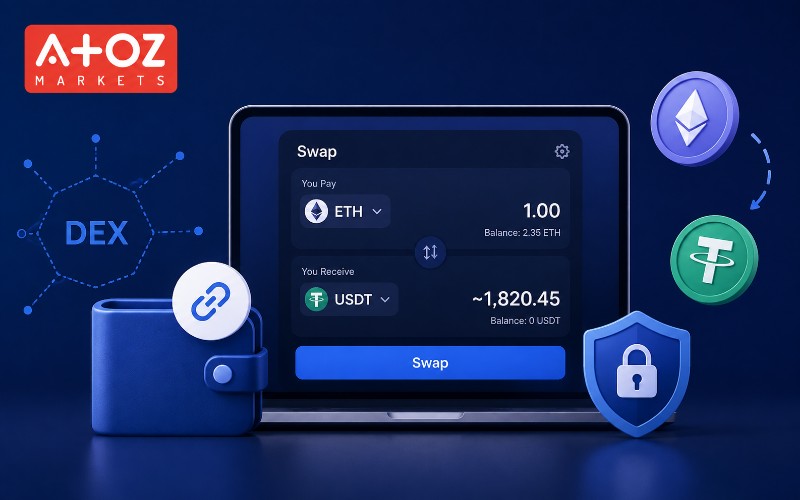
A decentralized exchange, or DEX, lets you swap cryptocurrencies directly from your own wallet without handing your funds to a middleman. Instead of depositing tokens into an exchange’s account, you connect your personal wallet, approve a trade, and a smart contract executes the swap on the blockchain. The whole process happens peer-to-peer.
Smart contracts are self-executing programs that live on a blockchain. When you trade on a DEX, the smart contract automatically matches your swap request with available liquidity and settles the transaction. No company holds your assets at any point.
- Non-custodial: Your private keys stay with you throughout the entire trade.
- Permissionless: No account signup, identity checks, or approval process required.
- On-chain settlement: Every swap records directly to the blockchain for transparency.
How DEXs differ from centralized exchanges
The biggest difference comes down to who controls your money. On a centralized exchange like Coinbase or Binance, you deposit funds into the platform’s wallet. The exchange holds your crypto until you withdraw it. On a DEX, your tokens remain in your personal wallet until the exact moment a swap executes.
| Feature | Centralized Exchange (CEX) | Decentralized Exchange (DEX) |
|---|---|---|
| Asset custody | Exchange holds your funds | You hold funds in your wallet |
| KYC required | Yes | No |
| Token listings | Curated and limited | Open and permissionless |
| Account creation | Required | Not required |
| Trade settlement | Internal ledger | On-chain via smart contract |
Custody and control of your assets
When you use a CEX, you’re trusting the platform to safeguard your crypto. If the exchange gets hacked or goes bankrupt, your funds could be at risk. DEXs eliminate this concern because you never give up control of your private keys.
Privacy and KYC requirements
Most DEXs skip identity verification entirely. You can start trading the moment you connect a wallet. That said, regulatory requirements vary by country, so it’s worth checking local rules before diving in.
Token availability and listings
DEXs often list new tokens before centralized platforms do. Anyone can create a liquidity pool for a token, which means early access to emerging projects. The flip side is a higher chance of encountering scam tokens, since there’s no vetting process.
Trade execution and settlement
CEX trades settle on the platform’s internal ledger, which is fast but opaque. DEX trades settle directly on the blockchain, so you can verify every transaction. Confirmation times depend on the network—Solana settles in seconds, while Ethereum can take a minute or longer during busy periods.
What you need before trading on a DEX
Before your first swap, you’ll want to gather a few essentials. The setup takes about ten minutes if you already own some crypto.
A non-custodial crypto wallet
You’ll use a wallet like MetaMask, Trust Wallet, or Phantom to connect to DEX interfaces. The wallet stores your private keys and signs transactions on your behalf. Make sure the wallet supports the blockchain network you plan to trade on.
Cryptocurrency for swaps and gas fees
You actually need two types of crypto. First, the token you want to trade. Second, the native token of the blockchain to pay transaction fees. On Ethereum, that’s ETH. On Solana, it’s SOL. On BNB Chain, it’s BNB.
Tip: Keep extra native tokens in your wallet for gas. Failed transactions still consume fees, and running out mid-swap can leave you stuck.
Understanding of blockchain networks
Different DEXs operate on different blockchains. Uniswap runs on Ethereum, PancakeSwap on BNB Chain, and Jupiter on Solana. Your wallet and the DEX interface need to be set to the same network, or your funds won’t appear on the platform.
How to connect your wallet to a DEX
Connecting your wallet is the gateway to DEX trading. The process is similar across most platforms, though a few precautions can save you from costly mistakes.
1. Select a DEX platform compatible with your network
Choose based on the tokens you want to trade. For Ethereum-based tokens, Uniswap is the standard. For BNB Chain tokens, PancakeSwap is popular. For Solana tokens, Jupiter aggregates rates across multiple DEXs.
2. Visit the official DEX website
Phishing sites are a real threat in crypto. Scammers create near-identical domains to steal wallet connections. Always bookmark official URLs or use the built-in browser in your wallet app. Double-check the URL before connecting.
3. Click connect wallet and choose your provider
Look for a “Connect Wallet” button, typically in the top-right corner of the interface. Select your wallet provider from the list. If you’re using WalletConnect, you can scan a QR code from your mobile wallet.
4. Approve the connection request
Your wallet will display a popup asking for permission. This step only shares your public address with the DEX. It does not grant access to your private keys or authorize any spending.
5. Confirm you are on the correct blockchain network
Check the network indicator in your wallet. If you’re connected to Ethereum mainnet but the DEX expects Arbitrum, your tokens won’t show up. Most wallets let you switch networks with a single click.
How to complete your first DEX swap
With your wallet connected, you’re ready to execute a trade. The interface typically shows two fields: the token you’re swapping from and the token you’re receiving.
1. Choose the token pair for your swap
Select your “From” token and your “To” token using the dropdown menus. You can search by name or paste a contract address for newer tokens. Always verify contract addresses from official sources like CoinGecko before swapping.
2. Enter the trade amount and review the quote
Type in how much you want to swap. The DEX displays an estimated output based on current liquidity pool prices. This quote can shift slightly before execution, especially for volatile tokens.
3. Set your slippage tolerance
Slippage is the acceptable price difference between the quote and final execution. Default settings, usually 0.5% to 1%, work for most trades. Volatile tokens or low-liquidity pools may require higher tolerance to avoid failed transactions.
4. Confirm and sign the transaction
Click “Swap” and your wallet will prompt you to approve the transaction. Review the estimated gas fee before signing. Once confirmed, the transaction broadcasts to the network.
5. Wait for blockchain confirmation
Your swap enters a pending state while validators process it. Confirmation times vary by network. Solana often settles in seconds, while Ethereum can take a minute or more during congestion. You can track progress on a blockchain explorer.
Types of decentralized exchanges
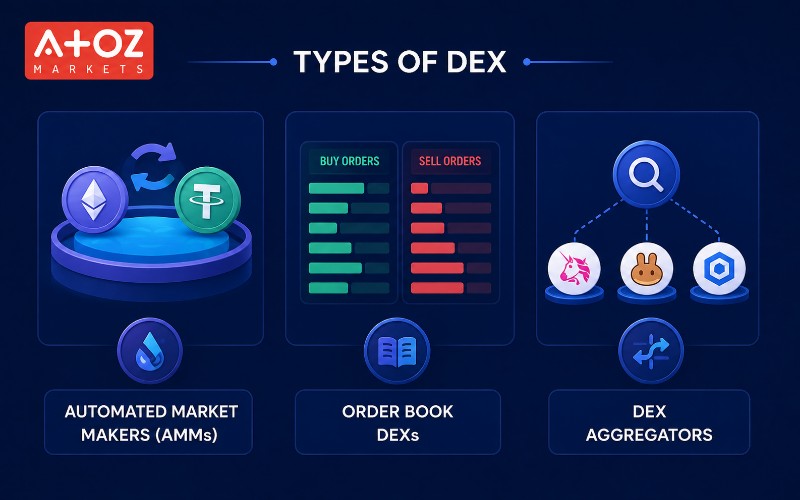
Not all DEXs work the same way. The model affects pricing, speed, and available features.
Automated market makers
Automated market makers, or AMMs, are the most common DEX type. Instead of matching buyers with sellers, AMMs let you trade against liquidity pools funded by other users. Uniswap and SushiSwap pioneered this approach.
Order book DEXs
Order book DEXs function more like traditional exchanges, with visible buy and sell orders. Platforms like dYdX use this model, often with off-chain order matching for faster execution.
DEX aggregators
DEX aggregators search multiple platforms simultaneously to find the best price for your trade. 1inch and Jupiter are popular aggregators that can save money on larger swaps by splitting orders across pools.
Popular DEX platforms for crypto trading
Here’s a quick overview of leading platforms and their primary use cases.
Uniswap on Ethereum
Uniswap is the largest DEX by trading volume on Ethereum. It offers deep liquidity for major tokens but comes with higher gas fees during network congestion.
PancakeSwap on BNB Chain
PancakeSwap provides a lower-fee alternative on BNB Chain. It’s popular for trading BSC tokens and offers additional features like yield farming.
Jupiter on Solana
Jupiter is Solana’s leading DEX aggregator. It searches multiple Solana-based DEXs to find the best rate, with fast settlement and minimal fees.
dYdX for derivatives
dYdX focuses on perpetual contracts and derivatives trading. It’s more advanced territory, better suited for experienced traders.
Curve Finance for stablecoin swaps
Curve specializes in stablecoin-to-stablecoin trades. Its design minimizes slippage when swapping between assets like USDC and USDT.
DEX trading fees and costs explained
Trading on a DEX involves several cost layers beyond the swap itself.
Network gas fees
Gas fees go to blockchain validators who process your transaction, not to the DEX. Ethereum mainnet fees can range from a few dollars to $50 or more during congestion. Solana and BNB Chain typically cost fractions of a dollar.
Liquidity provider and swap fees
A small percentage, often around 0.3%, is taken from each trade. This fee goes to liquidity providers who supply tokens to the pool.
Price impact and slippage
Price impact occurs when your trade is large relative to the pool’s liquidity, moving the price against you. Slippage is the price change that happens between quoting and execution. Both can eat into your returns on larger trades.
Tips to reduce trading costs
- Trade during periods of low network activity to pay lower gas fees.
- Use Layer 2 networks or cheaper chains like Solana for smaller trades.
- Consider DEX aggregators to find better rates on larger swaps.
Risks of trading on a decentralized exchange
DEXs offer freedom, but that freedom comes with responsibility. A few risks are worth understanding before you start.
Smart contract vulnerabilities
Bugs in a DEX’s code can be exploited by hackers. Even audited protocols have suffered exploits. Checking for security audits from firms like Certik or OpenZeppelin provides some reassurance, though not a guarantee.
Fake tokens and scam projects
Anyone can create a token with the same name as a legitimate project. Scammers exploit this by creating fake tokens that drain wallets when you interact with them. Always verify contract addresses from official sources.
Failed transactions and lost gas
If your swap fails due to low slippage tolerance or insufficient gas, the transaction reverts. Your tokens stay in your wallet, but the gas fee is still consumed.
Impermanent loss for liquidity providers
Impermanent loss affects users who provide liquidity to DEX pools. It occurs when the price ratio of deposited tokens changes, potentially leaving you with less value than if you had simply held the tokens.
Benefits of using a DEX over centralized platforms
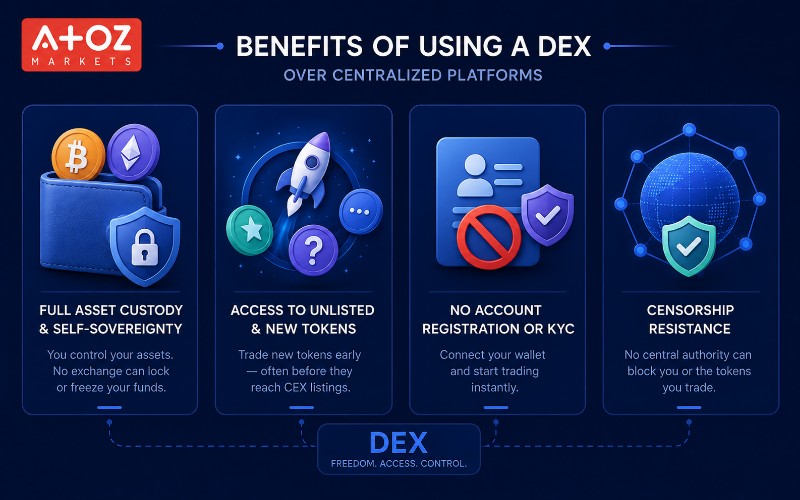
Despite the risks, DEXs offer distinct advantages for certain use cases.
Full asset custody and self-sovereignty
You maintain complete control of your assets. No exchange bankruptcy or withdrawal freeze can lock you out of your funds.
Access to unlisted and new tokens
DEXs let you trade tokens the moment a liquidity pool launches, often before centralized exchange listings.
No account registration or KYC
You can start trading immediately by connecting a wallet. No signup forms, no identity documents, no waiting for approval.
Censorship resistance
DEXs generally cannot block specific users or tokens from trading. For users in regions with limited financial access, this provides an important alternative.
How to stay safe when using DEXs
A few habits can dramatically reduce your risk exposure when trading on DEXs.
Verify token contract addresses
Always find the official contract address from a trusted source like CoinGecko, CoinMarketCap, or the project’s official channels. Never trust addresses from unverified search results or social media comments.
Use hardware wallets for larger holdings
For significant amounts of crypto, a hardware wallet like Ledger adds a physical layer of security. Transactions require approval on the device itself.
Check smart contract audits
Before using an unfamiliar DEX, look for audit reports from reputable security firms. The extra research can prevent significant losses.
Start with small test transactions
When trying a new platform or token, send a small test amount first. Verify everything works as expected before committing to a larger trade.
Getting started with DEX trading and DeFi
Using a DEX is a foundational skill for participating in decentralized finance. Once you’re comfortable with basic swaps, you can explore lending protocols, yield farming, and liquidity provision.
The learning curve is real, but so is the control you gain over your own assets. Start small, verify everything, and build confidence through experience.
For ongoing coverage of decentralized exchange developments and DeFi trends, follow AtoZ Markets’ Cryptocurrency News section.
FAQs about using decentralized exchanges
What happens if my DEX transaction fails?
The swap reverts and your tokens stay in your wallet, but the gas fee is still consumed by the network. You can retry with higher slippage tolerance or an increased gas limit.
Can I buy cryptocurrency directly on a DEX without already owning crypto?
No, DEXs handle crypto-to-crypto swaps only. You’ll first acquire cryptocurrency through a centralized exchange, on-ramp service, or peer-to-peer platform.
Are profits from DEX trading subject to taxes?
In most jurisdictions, swapping one cryptocurrency for another is a taxable event. Maintain detailed transaction records and consult local tax guidance.
How do I transfer tokens between different blockchains to use other DEXs?
Bridge protocols allow cross-chain transfers, though they introduce additional smart contract risk. Popular bridges include Wormhole and LayerZero-based solutions.
What is the minimum amount required to make a trade on a DEX?
There’s no set minimum, but network gas fees can make very small trades uneconomical. On Ethereum mainnet, fees sometimes exceed the trade value itself for small swaps.