

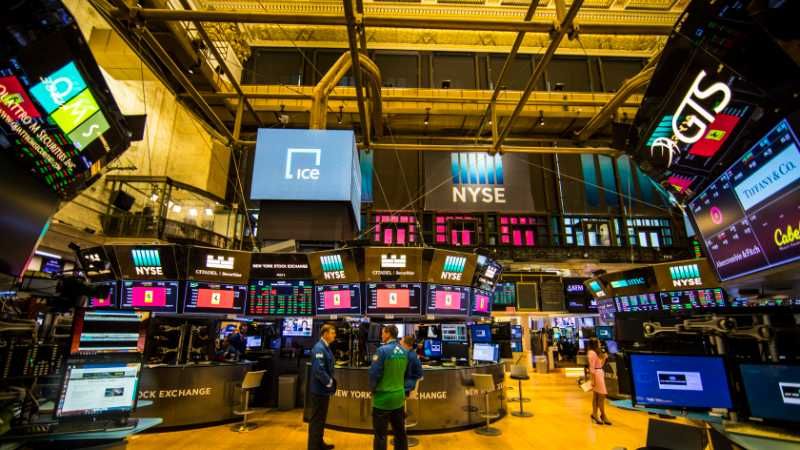
Global stock indexes had a quiet start to the week, with modest gains despite declining shares of major tech companies.
After experiencing drops the previous week, the Dow Jones Industrial Average rose by 0.6 percent or around 210 points. The S&P 500 and Nasdaq Composite showed slight gains, increasing by 0.2 percent.
While sectors such as financials, energy and industrials showed positive performance, the shares of key players in this year’s stock rally, namely Microsoft, Apple and Alphabet, experienced losses on Monday. Alphabet, in particular, led the way with a decline of 2.5 percent, while Microsoft and Apple saw losses of at least 1.1 percent.
The Wall Street Journal reported that investors and analysts seemed unconcerned about the lackluster performance of tech stocks. They attributed it to expected volatility leading up to a crucial inflation report on Wednesday and the upcoming earnings season.
According to Janus Henderson Investors research director Matt Peron, there may be some adjustments in the market before those events. These adjustments are primarily driven by positioning rather than fundamental factors.
The WSJ said that companies beyond the technology sector had recently received support from robust economic data. Despite concerns of an imminent recession, there is scant evidence of a slowdown.
Worker demand remained high, consumer spending remained robust and the housing market exhibited indications of a potential recovery.
Before the U.S. trading on Monday, data showed that consumer inflation in China had remained stagnant in June. Factory-gate prices also experienced their sharpest decline in over seven years. These developments indicate weak demand within the world’s second-largest economy.
According to Bloomberg, investors in Asia maintain their expectations for concrete actions from Beijing to bolster its sluggish economic recovery. The difficulties faced by China’s economy are impacting various markets, with the chairman of mining giant Rio Tinto Group warning of potential repercussions on demand for industrial metals.
Mary Manning, a fund manager at Alphinity Investment Management, explained on Bloomberg Television that there is a distinction between the short-term reopening trend in China and the long-term growth trajectory.
While reopening is underway, she pointed out that it will not result in a rapid V-shaped recovery like in other nations. Instead, the recovery in China is expected to be considerably slower.
In contrast, U.S. markets were relatively unaffected, with investors primarily concerned about domestic inflation rather than deflation in other regions.
Inflation remains significantly higher than the Federal Reserve’s two percent target. As a result, most investors anticipate that the Fed will raise its benchmark federal funds rate by 0.25 percent during its meeting later this month.
“There’s a difference between the short-term reopening thematic in China and the longer-term trajectory for growth.”
Mary Manning, fund manager at Alphinity Investment Management
Support for interest rates triggers bond sell-off, boosts U.S. treasury yields
The WSJ said that the prevailing belief in the need for the Fed to raise interest rates to a higher level than previously expected and sustain them for a longer duration had led to a sell-off in bonds and a notable increase in U.S. Treasury yields.
In the previous week, the yield on the 10-year Treasury note experienced an upward movement for the first time since early March, surpassing the four percent threshold once more. The increase in yield also reversed the declines observed following the collapse of Silicon Valley Bank.
The benchmark 10-year U.S. Treasury note saw its yield settle at 4.006 percent on Monday, slightly lower than the 4.047 percent recorded on Friday.
Numerous investors and analysts perceive the increase in Treasury yields as a potential stock threat. This view amplifies the appeal of government bonds as a safer alternative in contrast to riskier investments.