

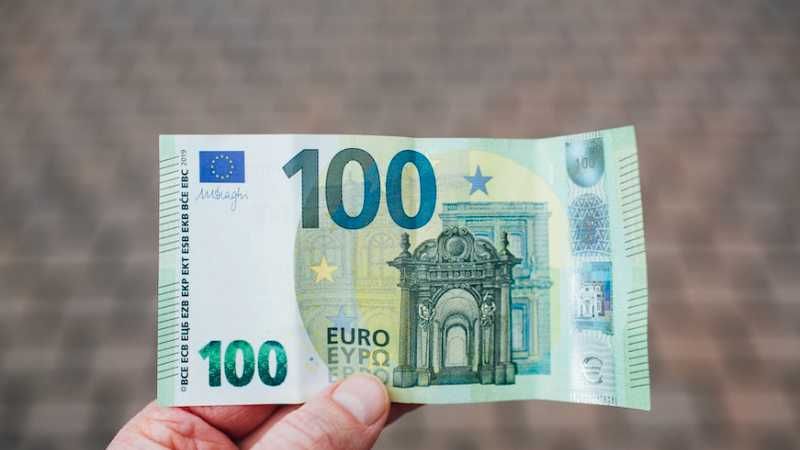
The euro advanced to a five-week high against the U.S. dollar on Thursday after the European Central Bank raised its key rate for the eighth consecutive time.
The eurozone currency traded at $1.0952 earlier in the season before retreating to $1.0948 later in the afternoon. Against the Japanese yen, the euro gained 1.2 percent to 153.52. The currency earlier hit 153.68 yen per euro, the highest in nearly 15 years.
On Thursday, the ECB raised its key rate by 25 basis points to 3.5 percent, the highest in 22 years. ECB officials also increased their inflation projection per year from 4.6 percent to 5.1 percent. Deutsche Bank predicted that the ECB would deliver a final rate hike next month, increasing the region’s key rate by another quarter of a percentage point.
“There were hawkish elements in the latest ECB press conference, in particular the upwardly revised 2025 inflation forecasts,” read the Deutsche Bank’s research note. “There were a few dovish elements too. President (Christine) Lagarde clearly signaled a hike in July but deliberately avoided guiding expectations for September.”
The ECB’s decision came after the U.S. Federal Reserve opted to forego an interest hike on Wednesday. The U.S.’s federal fund rate currently stands in the 5.00 to 5.25 percent range. However, the market expects the Fed to raise the benchmark rate by 25 basis points in the next policy meeting.
“Our baseline expectation is a final 25-bp hike in July to a terminal rate of 3.75%. The risks remain clearly to the upside.”
Deutsche Bank economists
The DXY, an index that tracks the dollar’s performance against six major currencies, fell to a one-month low of 102.08 on Thursday. Scotiabank chief FX strategist Shaun Osborne said the U.S. dollar could continue its decline and breach “new-range lows” in the near future. According to Osborne, the expectation that global central banks will soon end their monetary tightening cycles “bolster risk-taking” among investors.
Analysts point out that recent economic data showcases resilience in the U.S. economy. Retail sales in the U.S. rose by 0.3 percent in May despite an earlier forecast of a 0.1 percent decline. Data showed that building materials supported the surge in retail sales last month. The U.S. Labor Department also reported that unemployment claims were steady at 262,0000 for the week ending on June 10.
The Bank of Japan (BoJ) also recently decided to maintain its “ultra-dovish” monetary policy and yield curve control program. BoJ officials projected that inflation in Japan would slow later this year. The yen extended its decline against the euro in Asian forex trading on Friday local time following the BoJ’s decision. Analysts had earlier predicted that the Japanese central bank would make an adjustment to its yield curve control.
European markets may fall behind
European stocks and the euro will likely lose out to the U.S. markets in the coming months, according to analysts. The region’s financial markets rallied in early 2023, yet analysts said the falling global economic performance and the AI hype on Wall Street would negatively affect said markets.
The S&P 500 has gained around 15 percent since New Year, rising by more than 20 percent from its October 2022 low. The U.S. benchmark index overtook Europe’s STOXX 600 in late May for the first time this year. The STOXX 600 index and the euro also lag when priced in dollars. The euro added 3.6 percent over the dollar, while the STOXX 600 rose by 14 percent on an annual basis.
UBS O’Connor co-chief investment officer Bernie Ahkong said European stocks were “less interesting and attractive” than their U.S. counterparts. Ahkong pointed out a divergence in the EU’s monetary policy, with experts predicting more rate hikes in the region. Morgan Stanley chief European equity strategist Graham Secker said the slow post-pandemic recovery in China also contributed to the decline in European financial markets.