

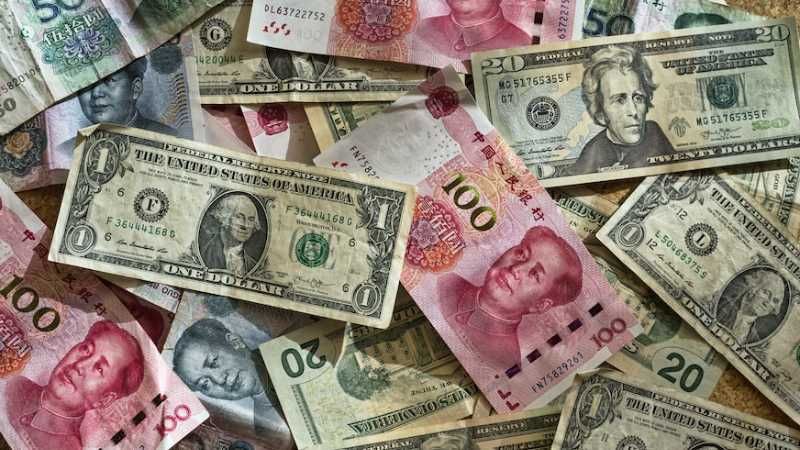
Argentina has announced it will allow commercial banks to open customer accounts in Chinese yuan. This decision responds to the country’s ongoing limited U.S. dollar supply challenge.
In a recent statement, the central bank of Argentina declared that it had included the yuan as an accepted currency for deposit-taking in both savings and current accounts.
The decision came following approval from Argentina’s securities regulator to allow the issuance of securities in the local market that are settled in yuan.
According to Dong Jinyue, a senior economist at BBVA Research, yuan accounts could entice people and businesses in Argentina to convert their Argentinian peso to the Chinese yuan.
Previously in April, Argentina shifted its payment method for Chinese imports. Instead of using U.S. dollars, the country began using yuan, which aligns with China’s aim to enhance the use of its currency in bilateral trade settlements.
Speaking to South China Morning Post, a senior research fellow at the Hinrich Foundation, Stephen Olson, said China had become more uneasy with the dominant position of the U.S. dollar in facilitating global trade due to escalating geopolitical tensions.
He explained that although it would be hard to replace the U.S. dollar as the global reserve currency, China was pursuing a long-term strategy to internationalize the yuan.
Following a meeting between Argentinian Economy Minister Sergio Massa met and Chinese Minister of Commerce Wang Wentao in June, the People’s Bank of China and Argentina’s Central Bank agreed on a three-year bilateral currency swap worth 130 billion yuan (equal to $17.9 billion or 4.5 trillion pesos).
According to the Buenos Aires Herald newspaper’s report on Thursday, Argentina is set to pay $2.7 billion to the International Monetary Fund on Friday.
This payment will be made using special drawing rights from the international financial institution and accessible yuan acquired through the country’s currency swap agreement with China.
Growing use of yuan
A recent report by Allianz Trade highlights that the efforts of some emerging markets to shift from the U.S. dollar have sparked concerns about the potential decline of its dominance.
However, Allianz Trade chief economist Ludovic Subran said that the dynamics influencing the role of the U.S. dollar as a reserve currency would unfold over a more extended period than what current news headlines on de-dollarization suggest.
Per the report, the status of the currency will be influenced predominantly by the private sector’s usage of the U.S. dollar for trade and investment. This influence holds more significance than the portfolio allocation choices made by central banks.
The report also noted that the role of the U.S. dollar in private-sector transactions has remained unchanged. It shows only minor adjustments, influenced by variables such as foreign exchange turnover, bond issuance by non-financial companies and transactions facilitated through the “Swift financial messaging system.”
China has long aimed to establish the yuan as the leading global currency and has undertaken substantial endeavors to pursue this goal recently.
One such initiative was the introduction of the Cross-Border Interbank Payments System (CIPS) in 2015. This system was designed to streamline cross-border payments conducted in yuan.
In 2018, China pioneered the world’s first crude oil futures contracts denominated in yuan. This development enabled exporters to sell oil using the yuan as the currency of transactions.