

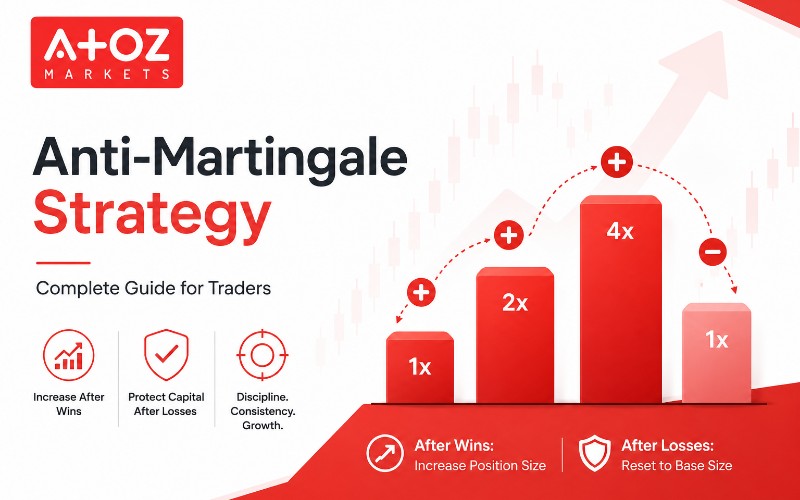
The anti-Martingale strategy flips conventional trading logic: instead of doubling down after losses, you increase position size after wins and scale back when trades go against you. It’s a position sizing method built around the idea that winning streaks signal favorable conditions worth pressing, while losing streaks suggest it’s time to protect capital.
This guide covers how the system works mechanically, where it differs from traditional Martingale and pyramiding approaches, which markets suit it best, and the specific risks that can undermine even disciplined execution.
Risk Disclaimer: Your capital is at risk. This content is for educational purposes and does not constitute financial advice.
What is the anti-Martingale system
The anti-Martingale strategy is a position sizing method where traders increase their trade size after wins and decrease it after losses. According to Investopedia, this system is “designed for momentum-driven markets to let winners run and protect capital during downturns.” The approach flips traditional loss-chasing logic on its head.
Think of it this way: when trades are going well, market conditions might be favoring your approach. So you lean in. When trades are going poorly, something might have shifted. So you pull back.
The strategy goes by a few different names:
- Reverse Martingale: The most common alternative term in trading circles
- Paroli system: A name borrowed from gambling that now appears in trading literature
- Positive progression: The broader category describing any system that increases bets after wins
What makes the anti-Martingale approach distinct is its focus on capital preservation. Rather than betting bigger to recover losses, you’re betting bigger only when you have profits to work with.
Anti-Martingale vs Martingale
The Martingale and anti-Martingale systems take opposite paths to the same destination. Both aim to manage position sizing across a series of trades, yet they do so in fundamentally different ways.
| Feature | Martingale |
|---|---|
| After a win | Reduce or maintain position |
| After a loss | Double position |
| Risk profile | High blowout risk |
| Capital requirement | Very high |
| Best conditions | Mean-reverting markets |
Position sizing after wins
With the anti-Martingale approach, a winning trade signals that conditions might favor your strategy. You increase your next position, essentially using recent profits to fund larger trades. The idea is to compound gains while the market cooperates.
The Martingale system works differently. After a win, you maintain or reduce your position size because the system assumes wins and losses will eventually balance out.
Position sizing after losses
Here’s where the anti-Martingale system shows its defensive side. After a losing trade, you reduce your position size, often returning to your original base amount. A losing streak won’t rapidly drain your account because each subsequent loss is smaller than the last.
Martingale traders do the opposite. They double down after losses, which can spiral quickly. Five consecutive losses with doubling means your sixth trade is 32 times your original size. That math gets uncomfortable fast.
Risk exposure comparison
The Martingale strategy requires theoretically unlimited capital because losses can compound indefinitely. According to analysis published on TradingView, “losses can snowball quickly, requiring significant funds to maintain positions.”
The anti-Martingale system caps your maximum loss during losing periods at your base position size. Your largest positions only appear when you’ve already built up profits that can absorb a potential reversal.
How the anti-Martingale strategy works
The mechanics are straightforward, though following them consistently takes discipline. You establish rules before trading and stick to them regardless of how you feel in the moment.
Increase position size after winning trades
After a profitable trade, you increase your next position by a predetermined amount. Some traders double their size after each win. Others use smaller increments, like 50% increases.
Consistency matters more than the specific multiplier you choose. Whatever increase you decide on, you apply it systematically after every win until you reach your maximum position limit.
Reduce position size after losing trades
A losing trade triggers an immediate reduction. Most traders return directly to their base position size rather than stepping down gradually.
This reset does two things at once. First, it protects remaining capital from further drawdown. Second, it provides a psychological fresh start. You’re beginning again rather than trying to dig out of a hole with oversized positions.
Set maximum position limits
Even during extended winning streaks, a ceiling on position size prevents one bad trade from erasing multiple winners. Without a cap, a single reversal at maximum exposure can wipe out everything you’ve built.
Many traders set their maximum position at three to four times their base size. This allows meaningful profit compounding while keeping downside risk within acceptable bounds.
Anti-Martingale position sizing example
A practical example helps illustrate how the system works in practice. Consider a trader starting with a base position of one lot:
- Trade 1 (Base): Enter with 1 lot, trade wins
- Trade 2 (Win): Increase to 2 lots, trade wins
- Trade 3 (Win): Increase to 4 lots (maximum cap reached), trade wins
- Trade 4 (Win): Maintain 4 lots (already at cap), trade loses
- Trade 5 (Loss): Return to 1 lot base position
In this sequence, the trader captured three winning trades at progressively larger sizes. When the losing trade finally arrived, the damage was limited because the position was capped rather than continuing to grow.
The key takeaway: profits accumulated during the winning streak provided a buffer against the eventual loss.
Anti-Martingale vs pyramiding
Traders sometimes mix up anti-Martingale and pyramiding because both involve increasing position size during favorable conditions. However, they operate on different timeframes.
Anti-Martingale adjusts position size between separate trades based on the outcome of the previous trade. Each trade stands alone, and the sizing decision happens before you enter.
Pyramiding involves adding to a single winning position as it moves in your favor. You’re building a larger position within one trade, not across multiple independent trades.
Both approaches aim to maximize gains when things are working. The difference is scope. Anti-Martingale applies across your trading sequence. Pyramiding applies within individual positions. Some traders combine both methods, using pyramiding within trades and anti-Martingale sizing across trades.
Best markets for anti-Martingale trading
The anti-Martingale system performs best when markets trend rather than chop sideways. Momentum is the friend of positive progression systems.
Forex trading
Currency pairs can sustain strong trends during major economic events, central bank announcements, or geopolitical developments. The forex market’s deep liquidity also allows for smooth position size adjustments without significant slippage.
Traders who follow forex news on AtoZ Markets can identify trending conditions that favor anti-Martingale approaches. Economic calendars and central bank commentary often signal when directional moves are likely.
Cryptocurrency trading
Crypto markets are known for extended directional moves that can last weeks or months. Bitcoin and major altcoins frequently enter trending phases that create favorable conditions for positive progression systems.
The same volatility that makes crypto challenging also amplifies anti-Martingale returns during winning streaks. Staying current with AtoZ Markets’ cryptocurrency coverage helps identify when momentum is building.
Stock and index markets
Equity markets in clear bull or bear phases work well with anti-Martingale sizing. Index futures, in particular, offer the liquidity needed for frequent position adjustments without excessive transaction costs.
However, ranging markets present a challenge. During consolidation periods, prices move sideways without clear direction, and the anti-Martingale system can generate losses through repeated position reductions followed by small wins at base size.
Risks of the anti-Martingale system
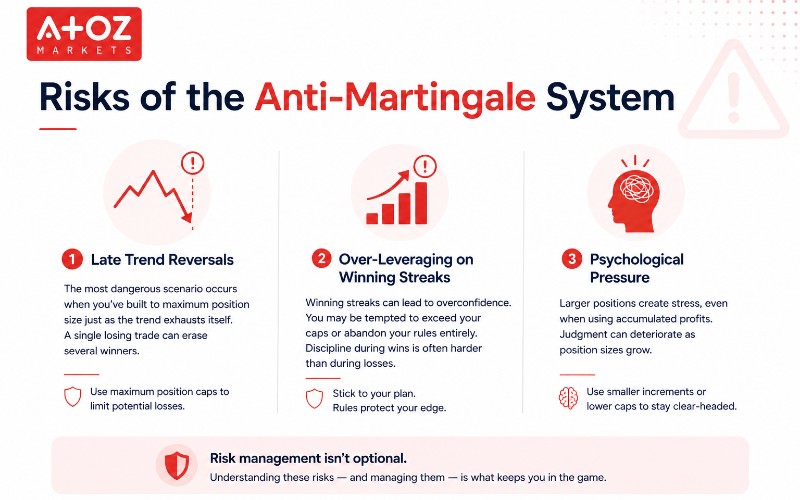
No position sizing method eliminates risk. The anti-Martingale system has specific vulnerabilities worth understanding before implementation.
Late trend reversals
The most dangerous scenario occurs when you’ve built to maximum position size just as the trend exhausts itself. Your largest exposure coincides with the reversal, and a single losing trade can erase several winners.
This is precisely why maximum position caps matter. They limit how much you can lose when this scenario eventually occurs, because it will occur at some point.
Over-leveraging on winning streaks
Confidence can become overconfidence during extended winning periods. After several consecutive wins, traders may feel tempted to exceed their predetermined caps or abandon their rules entirely.
Discipline during winning periods is often harder than discipline during losses. Profits feel like validation, which makes rule-breaking seem justified in the moment.
Psychological pressure
Managing larger positions creates stress, even when those positions represent accumulated profits rather than fresh capital. Some traders find their judgment deteriorates as position sizes grow.
If decision-making quality drops at larger sizes, smaller position increments or lower maximum caps can help maintain clarity.
Common anti-Martingale mistakes to avoid
Several pitfalls trip up traders who implement the anti-Martingale system:
- No maximum position cap: Unlimited scaling leads to catastrophic single-trade losses when reversals occur
- Abandoning rules after losses: Emotionally switching to Martingale-style doubling down defeats the entire purpose
- Using in ranging markets: The strategy generates losses when wins and losses alternate frequently without sustained direction
- Ignoring transaction costs: Frequent position changes can erode profits through spreads and commissions
- Inconsistent multipliers: Changing your increase ratio based on intuition undermines the systematic logic
Tip: Writing down your rules before trading and reviewing them before each session makes them harder to rationalize away than mental commitments.
Why active traders use the anti-Martingale approach
The appeal of the anti-Martingale system comes down to alignment. Position size aligns with market conditions and recent trading performance. When trades are working, you press your advantage. When they’re not, you protect your capital.
This psychological alignment matters more than it might seem. Unlike Martingale systems that require increasing commitment during losing periods, anti-Martingale lets you step back when the market isn’t cooperating. You’re not fighting the tape with bigger and bigger bets.
For traders following market trends through AtoZ Markets’ news coverage, the strategy offers a systematic way to capitalize on identified momentum while maintaining risk discipline. The rules are clear, the logic is sound, and the execution depends entirely on consistency.
FAQs about anti-Martingale trading
Is the anti-Martingale strategy profitable for forex and crypto traders?
Profitability depends heavily on market conditions and execution discipline. The strategy can enhance returns during trending periods but may underperform in choppy, directionless markets. No position sizing method guarantees profits regardless of market environment.
What position size increase is typical with anti-Martingale?
Common approaches include doubling after wins or using smaller increments like 50% increases. The right choice depends on individual risk tolerance, account size, and the volatility characteristics of your chosen market. More volatile markets often warrant smaller increments.
Can the anti-Martingale system be automated with trading bots?
Yes, the rule-based nature of the system makes it well-suited for algorithmic implementation. The logic is simple enough to code: if previous trade won, increase size by X; if previous trade lost, return to base size. However, automated systems still require monitoring for changing market conditions that may make the strategy temporarily unsuitable.
Does the anti-Martingale strategy work in sideways or ranging markets?
Generally, no. When wins and losses alternate without sustained momentum, the strategy generates losses through a predictable pattern: position reductions after losses followed by small wins at base size, then another loss just as you’ve increased again. Trending conditions are essential for the approach to work effectively over time.