

Finding the right brokerage is one of the most important decisions a commercial construction firm makes. The wrong fit means inadequate limits, coverage gaps on active job sites, and a renewal scramble every twelve months. The top insurance brokerages for commercial construction firms differ most in specialization, program scope, and whether they treat your account as a long-term risk relationship or a transaction. The five options below cover the range.
What to Look for in a Construction Insurance Broker
Construction risk doesn’t look like most commercial risk. Multi-state operations, layered subcontractor chains, wrap-up programs, and excess towers above $10M are standard on mid-to-large projects, and a generalist agency rarely has the underwriting relationships or in-house knowledge to place them properly.
Before picking a brokerage, look at a few key factors: construction-specific credentials like CPCU and CRIS, access to multiple carriers rather than a single market, capacity for complex programs like OCIP or CCIP, and whether the broker’s involved year-round or only surfaces at renewal. Claims advocacy and experience modification rate (EMR) support matter just as much. They determine what you’ll pay for years to come, not just the current policy period.
1. Unlimited Contractors Insurance
- Best for: Large, multi-state contractors ($1M+ annual revenue, typically $5M to $100M+) needing complex risk-transfer programs
- Coverage focus: General liability, workers’ compensation, commercial auto, excess/umbrella towers ($10M to $100M+), builder’s risk, surety bonding, OCIP/CCIP, subcontractor default insurance (SDI), contractor’s professional liability, pollution coverage
- Standout: Four-phase, year-round stewardship cycle (risk discovery, program design, market placement, and active stewardship) replaces the once-a-year renewal conversation.
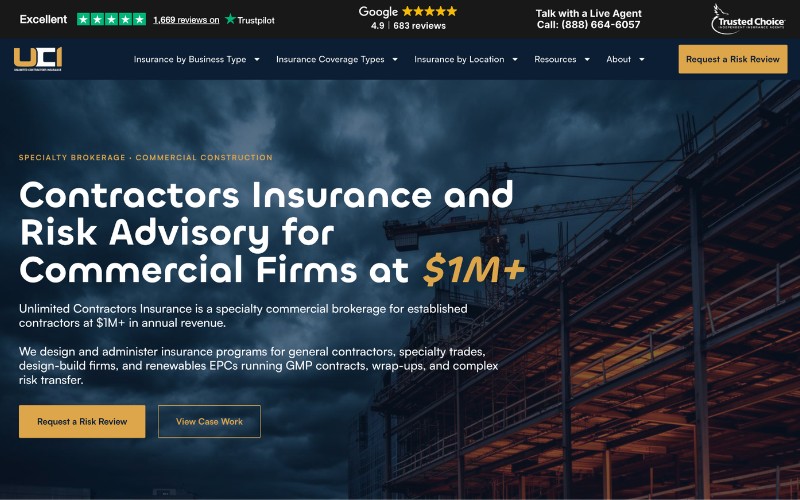
Unlimited Contractors Insurance operates as a specialty commercial brokerage serving contractors structured into three revenue bands: Band I specialty trades ($5M to 25M),BandIImid-marketGCs(25M to 100M),andBandIIIenterprisecontractors(100M+). The team holds CPCU and CRIS credentials with 15+ years of average construction-insurance experience, and places coverage across 30+ carrier markets including Travelers, Liberty Mutual, Zurich, CNA, AIG, The Hartford, Berkley, and Chubb. Published case studies include a 34% premium reduction on a solar EPC account and a $180M construction-value OCIP placement on a medical campus GMP contract. Licensed in 47 states. Every submission goes through a live risk-review call with a senior advisor (no online quote engine), with typical response within 2 business hours to 1 business day.
2. The Hartford Contractor Insurance Plans
- Best for: Small to mid-size contractors seeking standardized, carrier-direct coverage with deep market credibility
- Coverage focus: General liability (including General Liability Choice® with contractor’s broad form endorsement), commercial auto, workers’ compensation, contractor’s equipment, builder’s risk
- Standout: Over 200 years in property and casualty insurance; insures more than 1 million small businesses with dedicated underwriting, claims, and risk engineering specialists
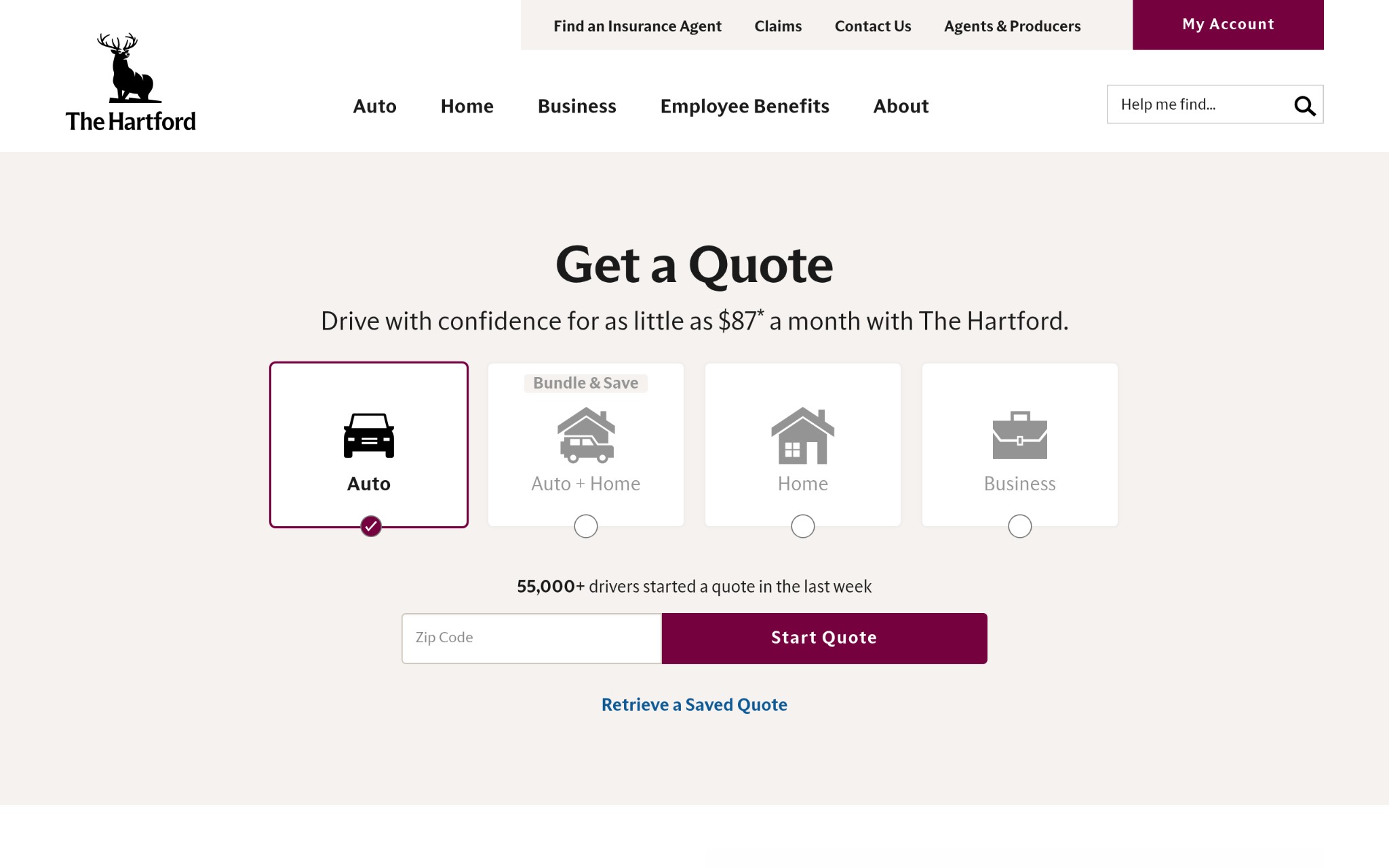
The Hartford was founded in 1810 and is headquartered in Hartford, Connecticut, with approximately 19,100 employees. Its contractor-specific products include limited professional liability and wrap-up coverage under the General Liability Choice endorsement, a meaningful differentiator for firms that need more than a bare GL policy. The Hartford suits contractors who want carrier-direct placement backed by institutional depth. Firms needing high-limit excess towers or formal wrap-up program design should confirm whether The Hartford’s current contractor program accommodates that scope.
3. AXA XL
- Best for: Large commercial contractors with complex or specialty risk, particularly those with environmental, marine, or cross-border exposure
- Coverage focus: Property, casualty, environmental liability, professional liability, specialty lines (marine, energy, aviation), and reinsurance
- Standout: Operates in over 200 countries and territories across 100+ offices on 6 continents; named Product Innovator on Advisen’s Pacesetters Index from 2016 to 2020
AXA XL is the property, casualty, and specialty risk division of AXA, founded in 1986 and headquartered in Stamford, Connecticut. AXA acquired XL Group Ltd. in September 2018 for $15.3 billion. The company employs 7,400 people and delivers products through three groups: AXA XL Insurance, AXA XL Reinsurance, and AXA XL Risk Consulting. Recent recognition includes the Zywave Cyber Claims Team of the Year award in 2025. For commercial construction firms operating internationally or carrying large environmental and professional liability exposure, AXA XL’s breadth is a genuine asset. Contractors with simpler, domestic-only programs may find the platform sized beyond their needs.
4. Chubb

- Best for: Mid-market to enterprise contractors and multinational construction firms needing a globally backed carrier with deep property and casualty lines
- Coverage focus: Commercial property, marine, general casualty, workers’ compensation, package policies, professional liability, accident and health, and reinsurance
- Standout: The largest publicly traded property and casualty insurance company in the world, operating in 55 countries and territories and in the Lloyd’s market in London
Chubb’s roots go back to a marine underwriting business opened in New York City in 1882. The company as it exists today was formed when ACE Limited, founded in 1985, acquired The Chubb Corporation for $28.3 billion and took on the Chubb name in January 2016. Headquartered in Zurich, Switzerland, Chubb reported 43,000 employees as of 12/31/2024. Its North America Commercial P&C Insurance segment covers large, middle-market, and small commercial businesses, making it one of the few carriers on this list with genuine capacity across every construction firm size band. That scale cuts both ways, though: large contractors get broad limits and international program support, while smaller firms may receive less hands-on attention than a specialty brokerage would provide.
5. InsuredBetter
- Best for: Small contractors and business owners who want to compare quotes across multiple carriers through a local independent agent
- Coverage focus: Workers’ compensation, general liability, professional liability, business owners policies, cyber liability, and industry-specific coverage
- Standout: Marketplace model. Independent agents with access to multiple carriers rather than a single insurer give clients more policy choices at comparison pricing.
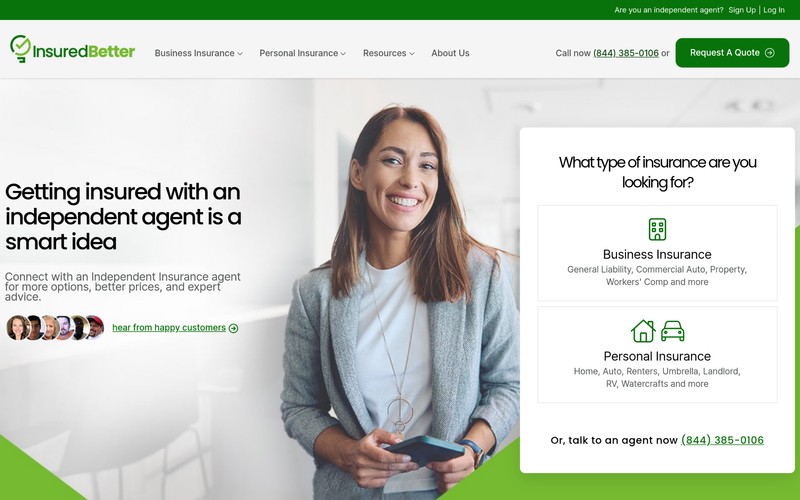
InsuredBetter is headquartered in New Brighton, Minnesota, and runs a consumer-facing platform that connects small business owners with local independent agents. Those agents aren’t tied to a single carrier the way a captive agent would be; they can shop policies across multiple insurers to find the right match. The service costs consumers nothing. But the platform’s core strength – broad access for small buyers – is also its ceiling: it’s a matching service, not a specialty brokerage. Contractors who need OCIP design, high-limit excess towers, or EMR management programs won’t find that kind of depth here. InsuredBetter’s founding year and team size aren’t publicly available.
Read Also: 5 Best Contractor Insurance Providers in Washington for 2026
How Much Does Contractor Insurance Actually Cost
Contractor insurance premiums vary by revenue band, project type, claims history, and state. The table below shows published premium ranges and program types as of October 2026, drawn from available brokerage and carrier data.
| Provider / Band | Typical Annual Premium Range | Program Type |
|---|---|---|
| UCI, Band I ($5M to $25M revenue) | $35,000 to $180,000 | Specialty trade contractor programs |
| UCI, Band II ($25M to $100M revenue) | $180,000 to $750,000 | Mid-market GC programs |
| UCI, Band III ($100M+ revenue) | $750,000 to $7M+ | Enterprise / OCIP / CCIP programs |
| The Hartford (small business) | Not published by program tier | Carrier-direct; mono-line and multi-line |
| AXA XL | Not published | Specialty and complex risk; negotiated |
| Chubb | Not published | Large commercial; negotiated per account |
| InsuredBetter | Not published | Varies by carrier match |
Premium is only part of the cost picture. EMR affects workers’ comp rates year over year. A brokerage that actively manages claims and audit cycles can reduce that multiplier over time, which compounds into meaningful savings on multi-year programs. So the sticker price at renewal isn’t the full story.
Bottom Line
The top insurance brokerages for commercial construction firms aren’t interchangeable. The right fit depends on revenue size, project scope, and whether a firm needs a specialty risk-transfer program or a more straightforward carrier-direct policy. Large multi-state contractors with wrap-up, excess, or OCIP requirements need a brokerage with construction-specific credentials and multi-carrier reach. Smaller firms or those in earlier growth stages may be better served, at least for now, by a marketplace platform or a carrier-direct program. At any tier, a broker’s year-round involvement – not just the attention they bring during renewal week – is usually what separates a well-structured program from one riddled with gaps.