

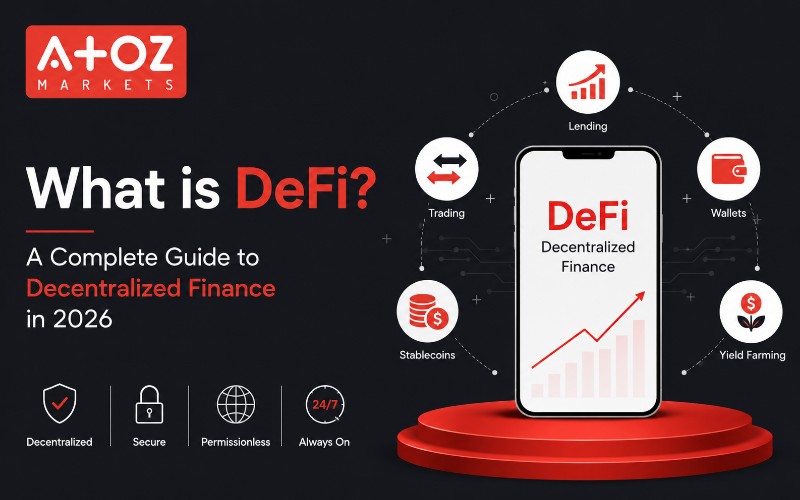
DeFi, short for decentralized finance, is a blockchain-based system that lets users lend, borrow, trade, and earn interest on cryptocurrency without banks or brokers handling the transactions. Smart contracts—self-executing code on networks like Ethereum—replace the middlemen, running 24/7 and giving users direct control over their assets.
This guide covers how DeFi works, the main applications within the ecosystem, the benefits and risks involved, and practical steps for getting started.
Your capital is at risk. This article is for informational purposes only and does not constitute financial advice.
What is DeFi
DeFi, short for decentralized finance, refers to a blockchain-based ecosystem offering financial services like lending, borrowing, and trading without banks or brokers acting as middlemen. These services run 24/7 on public networks such as Ethereum, using smart contracts—self-executing code that automates transactions and gives users direct control over their assets. As Wikipedia puts it, “Decentralized finance provides financial instruments and services through smart contracts on a programmable, permissionless blockchain.”
So what does that actually look like in practice? Instead of walking into a bank branch, filling out forms, and waiting for approval, you connect a digital wallet to a website and interact with software that handles everything automatically. No loan officer, no business hours, no paperwork.
A few characteristics define how DeFi operates:
- Permissionless access: Anyone with an internet connection and a crypto wallet can participate
- Self-custody: You hold your own assets through private keys rather than trusting an institution
- Transparency: Every transaction gets recorded on a public blockchain that anyone can verify
- Automation: Smart contracts execute transactions when conditions are met, removing the need for human intermediaries
How does decentralized finance work
Two technologies make DeFi possible: blockchain networks and smart contracts. Understanding how they work together explains why financial services can run without centralized institutions managing them.
Blockchain and smart contracts
A blockchain functions as a distributed ledger—a database shared across thousands of computers that permanently records every transaction. No single company or government controls it, and changing past records is practically impossible because doing so would require altering data on thousands of machines simultaneously.
Smart contracts are programs stored on the blockchain that execute automatically when specific conditions are met. Think of a vending machine: you insert money, select an item, and the machine dispenses it without needing a cashier. Smart contracts work the same way, except they handle financial transactions instead of snacks.
Ethereum remains the primary blockchain for DeFi applications, though networks like Solana, Avalanche, and Arbitrum have attracted significant activity. Each blockchain has different trade-offs in terms of speed, cost, and security.
DeFi protocols and dApps
A protocol in DeFi refers to the underlying rules and code that govern a particular service—lending, trading, or something else. A dApp, short for decentralized application, is the user-facing interface that lets you interact with the protocol.
When you visit a DeFi website to swap tokens or deposit funds, you’re using a dApp. Behind the scenes, the protocol handles the actual transaction logic. The dApp is just the front door.
The DeFi ecosystem explained
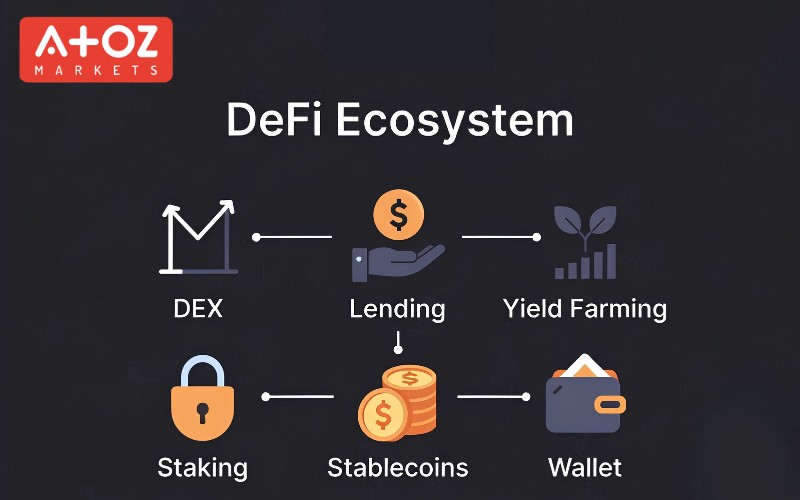
The DeFi ecosystem includes interconnected platforms offering services that mirror traditional finance. Each operates without central authorities, relying on code and community governance instead.
Decentralized exchanges
Decentralized exchanges, commonly called DEXs, let users trade cryptocurrencies directly with one another. Unlike centralized exchanges such as Coinbase or Binance, DEXs never take custody of your funds. You connect your wallet, execute a trade, and the assets move directly between wallets.
Platforms like Uniswap use automated market makers, or AMMs, to set prices. Rather than matching buyers with sellers through an order book, AMMs use liquidity pools—collections of tokens deposited by users—and algorithms that adjust prices based on supply and demand.
Lending and borrowing platforms
DeFi lending platforms allow users to earn interest by depositing cryptocurrency into lending pools. Borrowers can access funds from those pools by providing collateral, typically worth more than the loan amount.
Aave and Compound are among the largest lending protocols. Interest rates adjust automatically based on how much supply and demand exists in each pool. There are no loan officers, credit checks, or approval processes—just code executing transactions.
Yield farming and staking
Yield farming involves depositing assets into liquidity pools to earn rewards, often paid in the protocol’s native token. Returns can be attractive, though strategies range from straightforward to highly complex.
Staking works differently. When you stake tokens, you lock them to help secure a blockchain network. In return, you receive rewards—similar to earning interest, but tied to network participation rather than lending. Both yield farming and staking carry risks, including the possibility of losing deposited funds.
Stablecoins in DeFi
Stablecoins are cryptocurrencies designed to maintain a steady value, usually pegged to the US dollar. They reduce the volatility that makes other cryptocurrencies difficult to use for everyday transactions.
USDC and DAI are widely used stablecoins in DeFi. They serve as a stable unit of account, letting users move in and out of volatile assets without converting back to traditional currency.
DeFi wallets
A DeFi wallet is a non-custodial wallet where you control your private keys—the cryptographic passwords proving ownership of your assets. MetaMask and Trust Wallet are popular examples.
Unlike a bank account, there’s no customer service to call if you lose access. Your private keys are your sole responsibility. Lose them, and your funds are gone permanently. This trade-off between control and responsibility sits at the heart of DeFi.
DeFi vs traditional finance
The structural differences between DeFi and traditional finance, often called CeFi for centralized finance, are significant. Here’s a direct comparison:
| Feature | Traditional Finance | DeFi |
|---|---|---|
| Control | Banks and institutions | Users via smart contracts |
| Access requirements | Bank account, ID verification | Crypto wallet only |
| Operating hours | Business hours, weekdays | 24/7, 365 days |
| Intermediaries | Required | Eliminated |
| Transparency | Limited visibility | Fully public on blockchain |
| Dispute resolution | Regulatory bodies, courts | None—code is final |
Traditional finance offers consumer protections and recourse when problems arise. DeFi offers autonomy and accessibility, but users bear full responsibility for their decisions and mistakes.
Benefits of DeFi
Accessibility and financial inclusion
DeFi opens financial services to anyone with internet access. No bank account, credit history, or government ID is required. For people in regions with limited banking infrastructure, DeFi can provide access to lending, savings, and trading that would otherwise be unavailable.
Transparency and user control
Every transaction on a public blockchain is verifiable. You can audit smart contract code, track fund flows, and confirm that protocols operate as advertised. Self-custody means no institution can freeze your assets or deny access without your private keys.
Speed and lower costs
Cross-border transactions that take days through traditional banking can settle in minutes on blockchain networks. Removing intermediaries often reduces fees, though network congestion can temporarily increase transaction costs during periods of high demand.
No intermediaries required
Smart contracts replace the functions of banks, brokers, and clearinghouses. This disintermediation creates efficiency, though it also means there’s no one to contact when something goes wrong.
Risks of DeFi
Smart contract vulnerabilities
Code can contain bugs. According to blockchain security firm Chainalysis, DeFi exploits resulted in over $3 billion in losses during 2022 alone. Audits help identify vulnerabilities, but they don’t guarantee security. Even audited protocols have been exploited.
Market and price volatility
Cryptocurrency prices can swing dramatically within hours. If you’ve borrowed against collateral and its value drops sharply, your position may be liquidated automatically—sometimes within minutes—leaving you with losses.
Regulatory uncertainty
DeFi exists in a legal gray area in most jurisdictions. Regulations are evolving, and what’s permissible today might face restrictions tomorrow. Users remain responsible for understanding their local tax and compliance obligations.
Scams and rug pulls
A rug pull occurs when developers abandon a project and disappear with user funds. The pseudonymous nature of crypto makes accountability difficult. Researching projects thoroughly before committing funds is essential, though even careful research doesn’t eliminate risk entirely.
How to get started with DeFi
1. Set up a DeFi wallet
Download a non-custodial wallet like MetaMask or Trust Wallet. During setup, you’ll receive a seed phrase—a series of words that can recover your wallet if you lose access. Store this phrase offline and never share it with anyone. Anyone with your seed phrase can access your funds.
2. Fund your wallet with cryptocurrency
Purchase cryptocurrency, typically ETH for Ethereum-based DeFi, from a centralized exchange. Then transfer it to your wallet address. Double-check addresses before sending—blockchain transactions are irreversible, and sending to the wrong address means losing those funds permanently.
3. Connect to a DeFi platform
Visit a DeFi protocol’s official website and connect your wallet. Always verify you’re on the legitimate site, as phishing attempts are common. Bookmark trusted URLs rather than clicking links from search results or social media, where fake sites often appear.
4. Start with low-risk DeFi applications
Consider beginning with simple token swaps or stablecoin deposits before exploring complex yield farming strategies. Starting small helps you learn the mechanics without significant financial exposure.
Is DeFi a good investment
DeFi offers potential opportunities—high yields, innovative financial products, and exposure to a growing sector. Yet it also carries substantial risks that traditional investments don’t, including smart contract exploits, regulatory uncertainty, and extreme volatility.
Whether DeFi makes sense as an investment depends entirely on your risk tolerance, technical understanding, and financial goals. Some investors allocate a small portion of their portfolio to DeFi; others avoid it entirely. Neither approach is inherently right or wrong.
Tip: Consider DeFi exposure as part of a diversified strategy rather than a standalone bet, and never commit more than you can afford to lose.
DeFi regulation and legal considerations
Regulatory frameworks for DeFi remain under development worldwide. The US Securities and Exchange Commission has signaled increased scrutiny of DeFi protocols, while the European Union’s MiCA regulation introduces new compliance requirements for crypto assets.
Users are generally responsible for reporting DeFi income and gains for tax purposes, even when platforms don’t issue traditional tax documents. Consulting a tax professional familiar with cryptocurrency can help clarify obligations in your jurisdiction.
Why DeFi matters for active traders
For traders already monitoring crypto markets, DeFi introduces additional opportunities. DEXs offer access to tokens before they list on centralized exchanges. Lending protocols can generate yield on idle assets between trades. The 24/7 nature of DeFi aligns with the always-on mentality of active trading.
However, the complexity and risks mean DeFi participation requires ongoing education and vigilance. AtoZ Markets covers DeFi developments alongside broader cryptocurrency news, helping traders stay informed about protocol launches, security incidents, and regulatory shifts.
FAQs about decentralized finance
Is Bitcoin considered DeFi?
Bitcoin itself is a cryptocurrency and payment network, not a DeFi application. However, wrapped Bitcoin, known as wBTC, allows BTC to be used within Ethereum-based DeFi protocols by representing Bitcoin as an Ethereum-compatible token.
What does DeFi stand for?
DeFi stands for decentralized finance, a term encompassing blockchain-based financial services that operate without traditional intermediaries like banks or brokers.
Is DeFi legal in the United States?
DeFi is not explicitly illegal in the US, though it operates in a regulatory gray area. Users remain responsible for tax reporting and compliance with applicable laws, which continue to evolve.
What is the difference between DeFi and CeFi?
DeFi uses smart contracts on public blockchains without intermediaries, while CeFi, or centralized finance, relies on traditional institutions to custody assets and process transactions. In CeFi, you trust a company; in DeFi, you trust code.
Can you lose money in DeFi?
Yes. Losses can occur through smart contract exploits, market volatility, scams, or user errors like losing private keys. DeFi carries significant risk, and there’s no safety net or customer support when things go wrong.