

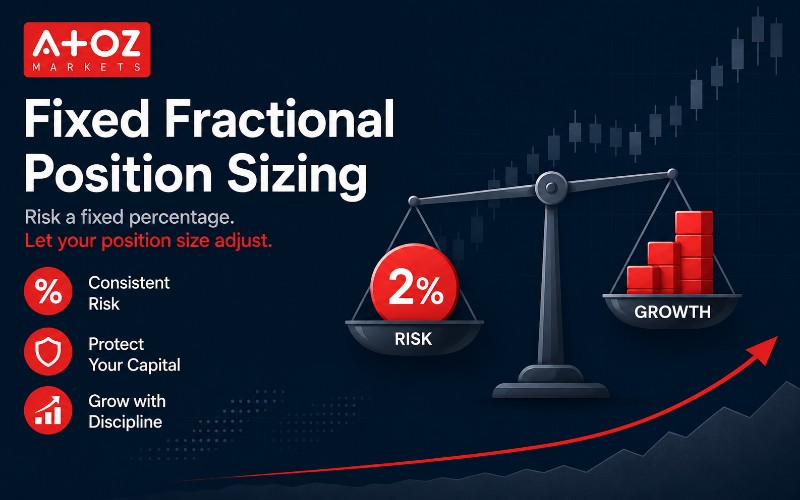
Fixed fractional position sizing is a risk management method where traders risk a consistent percentage of their account equity—typically 1% to 2%—on every trade. The position size automatically scales up as the account grows and down during losses, which protects capital during drawdowns while allowing for compounded returns over time.
This approach has become the standard for retail and professional traders alike because it removes guesswork from trade sizing. Below, we break down how the formula works, walk through forex and crypto examples, and compare this method to alternatives like the Kelly Criterion.
Your capital is at risk. This article is for educational purposes only and does not constitute financial advice.
What Is Fixed Fractional Position Sizing
Fixed fractional position sizing is a risk management technique where you risk a consistent percentage of your account equity on every trade. Most traders settle on somewhere between 1% and 2%. The position size then scales automatically—growing when your account grows, shrinking when your account shrinks. This built-in adjustment protects capital during losing streaks while allowing for compounded growth over time.
You might also hear this called “fixed risk position sizing” because the percentage at risk stays the same regardless of the trade setup. According to Adaptrade, “the idea behind fixed fractional position sizing is that you base the number of contracts or shares on the risk of the trade.” That single principle is why so many retail and professional traders rely on this approach.
Why Position Sizing Matters for Forex and Crypto Traders
Position sizing determines how much capital goes into any single trade. Even a profitable strategy can blow up an account if the sizing is off. On the other hand, proper sizing gives you the runway to survive the inevitable losing streaks that every trader faces.
- Capital preservation: Controlling trade size is your primary defense against catastrophic losses, especially in leveraged markets like forex and crypto.
- Consistency: A standardized sizing method takes emotional, impulsive decisions out of the equation.
- Long-term survival: Effective position sizing is often what separates traders who stick around long enough to become profitable from those who don’t.
How Fixed Fractional Position Sizing Works
The method relies on two key variables: your total account equity and a predetermined risk percentage. Every time you place a trade, you calculate your position size based on these inputs along with the specific risk of that trade.
Account Equity and Risk Percentage
Account equity is the total current value of your trading account. You select a fixed percentage of this equity to risk on any single trade—often something small like 1% or 2%. This percentage is sometimes called your “account risk.”
So if you have $10,000 and you’ve decided to risk 2% per trade, your account risk is $200. That number changes as your account balance changes.
Stop-Loss Distance and Trade Risk
“Trade risk” refers to the financial risk on a specific trade. It’s determined by the distance between your entry price and your stop-loss price.
A wider stop-loss means more risk per unit, so you take a smaller position to keep your percentage risk constant. A tighter stop-loss means less risk per unit, so you can take a larger position. The stop-loss distance is what makes each trade’s position size unique even though the percentage risk stays the same.
Dynamic Adjustment as Your Account Changes
Here’s where the method really shines. Your position size automatically scales up after winning trades as your equity grows. After losing trades, it scales down as your equity shrinks.
All calculations are based on your current equity, not your starting balance. This creates a self-correcting system that reduces exposure during drawdowns and increases exposure during profitable periods.
How to Calculate Fixed Fractional Position Size
The formula itself is straightforward once you understand the components.
The Position Sizing Formula
Position Size = (Account Equity × Risk Percentage) ÷ Trade Risk
Breaking that down:
- Account Equity: The total capital in your trading account right now
- Risk Percentage: The fixed percentage you’re willing to risk, expressed as a decimal (2% = 0.02)
- Trade Risk: The distance between entry and stop-loss, converted to a dollar value per unit
Forex Position Sizing Example
Let’s say you have a $10,000 account and want to risk 2% per trade. You’re looking to buy EUR/USD at 1.0750 with a stop-loss at 1.0700—a 50-pip stop.
| Component | Value |
|---|---|
| Account Equity | $10,000 |
| Risk Percentage | 2% |
| Dollar Risk | $200 |
| Stop-Loss Distance | 50 pips |
| Pip Value (Standard Lot) | $10 |
| Trade Risk per Standard Lot | $500 |
| Position Size | 0.4 standard lots |
You divide your $200 account risk by the $500 trade risk per standard lot. The result is 0.4 standard lots, or 4 mini lots.
Crypto Position Sizing Example
Now consider a $5,000 crypto account with a 3% risk tolerance. You want to buy Bitcoin at $65,000 with a stop-loss at $63,500—a $1,500 risk per BTC.
Your dollar risk is $150 (3% of $5,000). Divide that by the $1,500 trade risk per Bitcoin, and your position size is 0.1 BTC. The math works the same way regardless of the asset class.
Benefits of Fixed Fractional Position Sizing

This method offers several distinct advantages for traders who want structure in their risk management.
Consistent Risk Across Every Trade
By risking the same percentage on every trade, you create uniformity in your risk exposure. Whether you’re trading a tight scalp or a wide swing setup, your account risk stays constant. The position size adjusts to accommodate the trade, not the other way around.
Compound Growth Potential
As your account equity grows, your position sizes increase proportionally. A 2% risk on a $10,000 account is $200. A 2% risk on a $15,000 account is $300. This allows for accelerated returns over time through compounding, though the same principle works in reverse during drawdowns.
Reduced Emotional Trading Decisions
Having a predetermined formula removes the guesswork. You’re less likely to oversize after a win or undersize after a loss because the math dictates the decision, not your feelings about the last trade.
Automatic Adjustment to Account Fluctuations
After a series of losses, your position sizes automatically decrease. This protects remaining capital and prevents the “death spiral” that can occur when traders maintain the same size through a drawdown. The system is self-correcting without requiring any manual intervention.
Challenges and Limitations of Fixed Fractional Sizing
No method is perfect. Understanding the potential drawbacks helps you decide if this approach fits your trading style.
Slower Growth During Winning Streaks
Compared to more aggressive sizing methods, fixed fractional is conservative. During strong winning streaks, account growth may feel slower because position size increases are gradual. Each win only slightly increases the next position size.
Discipline Required for Consistent Application
The method only works if applied with strict discipline on every single trade. Skipping calculations or emotionally overriding the formula undermines its entire purpose. One oversized trade can undo weeks of disciplined risk management.
Gap Risk and Slippage in Volatile Markets
In highly volatile markets, your stop-loss may not execute at the intended price due to slippage or weekend gaps. This can cause your actual loss to exceed your planned percentage risk. The formula assumes your stop-loss will fill at the price you set, which isn’t always the case.
How to Implement Fixed Fractional Sizing in Your Trading System

Here’s a practical approach to putting this method into action.
1. Set Your Risk Tolerance Percentage
Choose a small, consistent percentage—typically 1% to 3%—that aligns with your personal risk appetite and experience level. Many professional traders stick to 1% or less. Newer traders often start at 1% to 2% while they’re still refining their edge.
2. Define Stop-Loss Levels for Each Trade
Before considering any entry, determine your stop-loss level. This is essential for calculating trade risk. Without a defined stop-loss, you can’t complete the position sizing formula.
3. Calculate Position Size Before Entering
Always perform the calculation before you execute. This ensures your trade size is based on logic rather than emotion. Running the numbers after you’ve already entered defeats the purpose.
4. Use Position Sizing Tools or Calculators
Many trading platforms offer free position sizing calculators that automate this process. These tools reduce the chance of manual error and speed up your workflow.
Tip: Keep a simple spreadsheet or use your broker’s built-in calculator to speed up the process without sacrificing accuracy.
5. Review and Adjust Your Approach Periodically
Periodically review your trading results to evaluate whether your chosen risk percentage is helping you meet your goals. You may decide to adjust based on performance, though frequent changes can introduce inconsistency.
Fixed Fractional vs Other Position Sizing Methods
Understanding how fixed fractional compares to alternatives helps you choose the best fit for your style.
| Method | How It Works | Best For |
|---|---|---|
| Fixed Fractional | Risks a set percentage of account equity on each trade | Most traders seeking consistent, scalable risk management |
| Fixed Unit | Trades the same lot or contract size on every trade | Beginners seeking simplicity |
| Kelly Criterion | Calculates optimal risk based on win rate and reward-to-risk ratio | Experienced traders with reliable performance data |
Fixed Fractional vs Fixed Unit Sizing
Fixed unit sizing is simpler but rigid. You trade the same size—say, 1 mini lot—regardless of account balance. If your account doubles, you’re still trading 1 mini lot. If your account gets cut in half, you’re still trading 1 mini lot.
Fixed fractional is dynamic. It scales your position up or down as equity changes, which provides more responsive risk management.
Fixed Fractional vs Kelly Criterion
The Kelly Criterion aims for mathematically optimal growth by calculating position size based on historical win rate and reward-to-risk ratio. In theory, it maximizes long-term growth.
In practice, Kelly can suggest aggressive position sizes that many traders find uncomfortable. It also requires highly accurate performance data to work properly. If your win rate or reward-to-risk ratio fluctuates, Kelly’s recommendations become unreliable.
Choosing the Right Method for Your Strategy
Your choice depends on experience level, strategy type, and personal risk tolerance. For most retail traders, fixed fractional offers a solid balance of safety, consistency, and growth potential. It’s simple enough to implement consistently while still being responsive to account changes.
Common Position Sizing Mistakes Traders Make
Avoiding these pitfalls is critical for long-term success.
Risking Too Much Capital Per Trade
Oversizing by risking 5% to 10% or more per trade dramatically increases the risk of large drawdowns. A 50% drawdown requires a 100% gain just to break even. The math gets ugly fast when position sizes are too large.
Ignoring Market Volatility
A 2% risk in a stable market might translate to a large position. The same 2% in a volatile market might be quite small. The same risk percentage can mean vastly different position sizes depending on the stop-loss distance, which is influenced by market conditions.
Abandoning the System After Consecutive Losses
A common emotional reaction to losing streaks is abandoning the rules entirely. Some traders revenge trade with oversized positions. Others become too scared to trade at all. Both responses undermine the systematic approach that makes fixed fractional sizing effective.
Managing Trade Risk with a Disciplined Sizing Strategy
A disciplined sizing approach transforms risk management from guesswork into a systematic process. By controlling losses and allowing for scalable growth, fixed fractional position sizing gives traders a framework to survive market volatility and work toward their financial goals.
The method isn’t complicated, but it does require consistency. Every trade, every time, without exception. That discipline is what separates traders who use position sizing as a tool from those who just know about it.
To support your trading decisions with timely market information, explore AtoZ Markets’ Forex News and Cryptocurrency News sections for the latest developments.
FAQs About Fixed Fractional Position Sizing
What does 0.05 lot size mean in forex trading?
A 0.05 lot size represents a micro lot position in forex. It’s a fraction of a standard lot and allows traders to control smaller amounts of currency while managing risk more precisely. For context, a standard lot is 100,000 units, so 0.05 lots equals 5,000 units.
How does fixed fractional position sizing work with leverage?
Fixed fractional sizing calculates position size based on actual dollar risk, not margin requirements. Leverage determines how much margin is required to hold that position, but the risk percentage remains constant regardless of leverage used. Higher leverage doesn’t change your risk—it changes how much capital is tied up in margin.
What is the 3-5-7 rule in trading?
The 3-5-7 rule is a risk management guideline suggesting traders risk no more than 3% on a single trade, limit exposure to 5% in correlated positions, and cap total portfolio risk at 7%. It’s a framework for managing overall account exposure, not just individual trade sizing.
Can beginner traders use fixed fractional position sizing effectively?
Yes. This method is well-suited for beginners because it provides a systematic, rules-based approach that removes guesswork. It helps new traders develop disciplined risk management habits from the start, which is often more valuable than any specific trading strategy.