

AI stock trading bots use machine learning and real-time data analytics to analyze markets, generate trading signals, and execute buy or sell orders automatically—without requiring a human to click the button. They’ve become increasingly popular among retail traders looking to remove emotional decision-making from their strategies, though the technology comes with both genuine advantages and significant limitations.
This guide covers how AI trading bots actually work, which platforms are worth considering, what they cost, and how to evaluate whether automated trading fits your approach.
Risk Disclaimer: Your capital is at risk. AI trading bots do not guarantee profits, and past performance does not indicate future results. This article is for informational purposes only and does not constitute financial advice.
What Are AI Stock Trading Bots
AI stock trading bots are automated software programs that use machine learning and real-time data analytics to scan markets, spot patterns, and execute trades without human intervention. Rather than relying on gut feelings or manual chart-watching, these bots process vast amounts of price data, news headlines, and technical indicators to make trading decisions in milliseconds.
The technology behind them typically combines two main components. Machine learning algorithms analyze historical price movements to recognize patterns that might signal future opportunities. Natural language processing, or NLP, reads financial news and social media to gauge market sentiment before humans can even finish reading a headline.
What makes these bots appealing is their consistency. A bot follows its programmed rules every single time, whether the market is calm or chaotic. It won’t panic-sell during a dip or get greedy during a rally. That said, consistency doesn’t equal profitability—a bot that consistently follows a flawed strategy will consistently lose money.
How AI Trading Bots Analyze and Execute Trades
Market Data Analysis and Pattern Recognition
AI bots continuously monitor price charts, trading volumes, and historical data to identify potential trade setups. The machine learning component improves over time by learning from past market behavior, though this learning process doesn’t guarantee accurate predictions about future movements.
Think of it like a very fast, very focused research assistant that never sleeps. The bot scans thousands of data points simultaneously, looking for specific conditions that match its programmed criteria.
News Sentiment and Real-Time Data Processing
NLP allows bots to scan earnings reports, financial news, and social media posts to assess market sentiment. When a company announces unexpected earnings or a central bank hints at policy changes, the bot can react before most human traders finish reading the first paragraph.
This speed advantage matters most during high-impact news events. However, NLP isn’t perfect—sarcasm, nuance, and context can trip up even sophisticated algorithms.
Automated Trade Execution Through Broker APIs
Once a bot identifies a trade matching its criteria, it sends orders directly to your brokerage account through an API, which is essentially a secure connection that lets different software systems communicate. This eliminates the delay between spotting an opportunity and actually placing the order.
The entire process—from signal detection to order execution—can happen in milliseconds. For comparison, a human trader typically takes several seconds at minimum to analyze, decide, and click.
Types of AI Stock Trading Bots
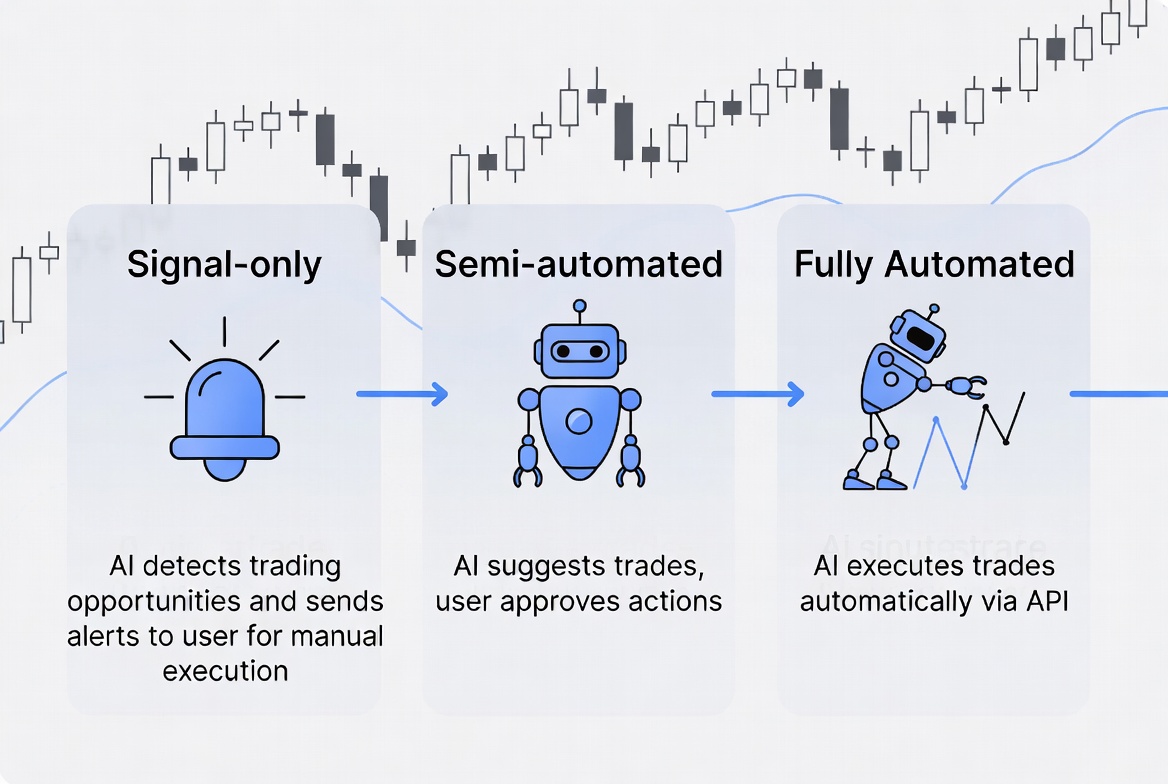
Not all AI trading bots operate the same way. The main difference lies in how much control you retain over the actual trade execution.
| Type | How It Works | Best For |
|---|---|---|
| Signal-only bots | Generate trade alerts; you execute manually | Traders wanting AI insights with manual control |
| Semi-automated bots | Suggest trades; require approval before execution | Intermediate traders building confidence |
| Fully automated bots | Execute trades automatically via API | Hands-off traders; those trading multiple markets |
Signal-only bots act more like research tools than trading systems. They tell you what they see, but you decide whether to act. Fully automated bots handle everything from analysis to execution, which sounds convenient but also means errors happen automatically too.
Do AI Stock Trading Bots Actually Work
This is the question most people actually want answered. The honest response: sometimes yes, sometimes no, and it depends heavily on factors beyond the bot itself.
Reported Performance and Success Rate Claims
Some platforms advertise impressive win rates, but these figures often come from backtests—simulations using historical data that may not reflect real market conditions. According to StockBrokers.com’s 2026 guide, “AI trading bots can help you find ideas faster or execute them more consistently, but they’re not a shortcut to guaranteed returns.”
Backtested results tend to look better than live trading results for several reasons. The backtest knows exactly what happened, while live trading involves slippage, delayed fills, and market conditions that shift unpredictably.
Factors That Influence AI Bot Performance
Several variables determine whether a bot performs well in practice:
Market conditions: A bot optimized for trending markets often struggles during choppy, sideways periods.
Strategy quality: The underlying trading logic matters more than the AI label attached to it.
Configuration accuracy: Incorrect settings can lead to unexpected losses, even with a sound strategy.
Data quality: Bots analyze whatever data they receive, so garbage in means garbage out.
Warning Signs of Unrealistic Promises
Be skeptical of any platform promising guaranteed returns or pressuring you to deposit funds quickly. Legitimate services provide transparent information about their strategies, fees, and historical performance—including losses.
Other red flags include vague explanations of how the AI works, no verifiable track record, and testimonials that sound too good to be true. If a bot could reliably generate 500% returns, the creators probably wouldn’t be selling access for $50 a month.
Best AI Stock Trading Bots for Beginners and Active Traders
Trade Ideas
Trade Ideas is known for its AI-powered “Holly” system, which scans markets and generates trade ideas primarily for day traders. The platform includes backtesting tools and has built a following among active traders who want AI-assisted idea generation rather than full automation.
StockHero
StockHero offers a user-friendly interface with preset strategies and connects to multiple brokers. The platform includes paper trading—simulated trading with virtual money—which allows testing before risking real capital.
TradersPost
TradersPost connects directly to brokerages and supports TradingView alerts, making it popular among retail traders who already use TradingView for charting. The platform bridges the gap between analysis tools and automated execution.
TrendSpider
TrendSpider focuses on automated technical analysis and chart pattern recognition. The platform includes bot trading tools and backtesting capabilities for traders who want to verify strategies before deployment.
Tickeron
Tickeron offers AI-powered pattern recognition and trading signals with both free and premium tiers. The platform tends to suit swing traders looking for multi-day setups rather than rapid intraday scalping.
AI Stock Trading Bot Pricing and Costs
Monthly Subscription Plans
Most platforms operate on tiered subscription models. Basic plans typically range from $20 to $50 monthly with limited features, while premium tiers can exceed $200 monthly for advanced automation, more simultaneous bots, and faster execution speeds.
Transaction and Brokerage Fees
Your broker’s commissions and spread costs still apply regardless of whether a human or bot places the trade. Some platforms also charge per-trade fees on top of subscriptions, which can add up quickly for high-frequency strategies.
Hidden Costs to Consider
Several expenses aren’t immediately obvious when evaluating platforms:
Data feeds: Real-time market data sometimes requires a separate subscription from your broker or a third-party provider.
API access: Some brokers charge for API connectivity or limit the number of API calls per minute.
Strategy marketplace: Premium or third-party strategies often carry additional licensing fees.
Free AI Trading Bots vs Paid Platforms
Free options exist, but they come with trade-offs. Free bots typically offer fewer trading pairs, delayed data, basic strategies, and often include advertisements or aggressive upsells to premium tiers.
Paid platforms generally provide real-time execution, advanced customization, priority support, backtesting capabilities, and multiple broker integrations. The difference becomes most apparent when you’re trying to execute time-sensitive trades or troubleshoot an issue during market hours.
Free tiers work well for learning platform mechanics and paper trading. Once you’re ready to trade with real money, the limitations often become frustrating enough to justify a paid subscription.
How to Choose an AI Bot for Stock Trading
Security and Platform Legitimacy
Before connecting any platform to your brokerage account, check for regulatory compliance, company transparency, and user reviews. Understand how the platform handles your API keys and account credentials, since these provide direct access to your trading account.
Broker Compatibility
Verify the bot integrates with your existing brokerage. Popular compatible brokers include Interactive Brokers, TD Ameritrade, Alpaca, and Tradier. Switching brokers just to use a specific bot rarely makes sense unless you’re unhappy with your current broker anyway.
Minimum Capital Requirements
Factor in any minimum account balances required by platforms or strategies. Some sophisticated strategies require larger account sizes to function properly due to position sizing rules or diversification requirements.
Strategy Customization Options
Assess whether the platform allows custom strategy building, parameter adjustments, or only offers preset templates. More flexibility typically means a steeper learning curve, but also more control over how your money gets traded.
How to Set Up Your First AI Trading Bot for Stocks
1. Select Your AI Trading Platform
Choose based on your experience level, budget, and broker compatibility. Starting with a platform that offers paper trading reduces the risk of expensive learning mistakes.
2. Connect Your Brokerage Account via API
Follow the platform’s instructions to generate API keys from your broker and securely link your account. API keys function like passwords—never share them publicly or with untrusted parties.
3. Configure Your Trading Strategy
Define entry and exit rules, position sizing, and which assets you want to trade. Starting with simple strategies before adding complexity tends to produce better learning outcomes and fewer unexpected surprises.
4. Backtest With Historical Data
Run your strategy against past market data to evaluate how it would have performed. Look for consistent results across different market conditions rather than spectacular returns during one specific period.
5. Begin With Paper Trading
Test the bot with simulated trades before risking real capital. Paper trading reveals configuration errors and builds familiarity with the system without financial consequences.
Pros and Cons of Using AI Stock Trading Bots
Advantages for AI Traders
24/7 market monitoring: Bots watch markets continuously without fatigue or distraction.
Emotion-free execution: Removes fear and greed from trading decisions.
Speed: Executes trades in milliseconds when conditions are met.
Consistency: Follows strategy rules without deviation or second-guessing.
Risks and Limitations
No guaranteed returns: Bots are subject to market volatility and can lose money just like human traders.
Over-optimization: Strategies performing well in backtests sometimes fail in live markets due to curve-fitting.
Technical failures: API disconnections or platform outages can cause missed trades or stuck positions.
Ongoing oversight required: “Fully automated” doesn’t mean “fully hands-off.”
AI Stock Trading Bots vs Crypto Trading Bots
| Factor | Stock Trading Bots | Crypto Trading Bots |
|---|---|---|
| Market hours | Limited to exchange hours | 24/7 trading |
| Volatility | Generally lower | Typically higher |
| Regulation | More regulated markets | Less regulatory oversight |
| Broker integration | Requires compatible stock broker | Connects to crypto exchanges directly |
Some platforms like StockHero support both stock and crypto trading, which simplifies things if you’re active in multiple markets. The underlying bot technology is similar, but the market dynamics differ significantly.
Are AI Bots Right for Your Stock Trading Strategy
AI trading bots work best for traders with a clear strategy who want to automate execution rather than decision-making. They’re tools, not magic solutions, and they require realistic expectations along with ongoing oversight.
The traders who tend to succeed with bots already understand their strategy well enough to program it. Those hoping a bot will figure out a profitable strategy for them usually end up disappointed.
For ongoing coverage of AI trading tools, broker developments, and market-moving news, explore AtoZ Markets’ Forex News and Cryptocurrency News sections.
FAQs About AI Stock Trading Bots
What brokers are compatible with AI stock trading bots?
Popular AI trading platforms typically integrate with brokers like Interactive Brokers, TD Ameritrade, Alpaca, and Tradier through secure API connections. Check your chosen platform’s documentation to confirm compatibility before committing to a subscription.
How do AI trading bots perform during stock market crashes?
AI bots follow their programmed rules regardless of market conditions, which can lead to significant losses during extreme volatility if stop-losses aren’t properly configured. Many traders pause automated trading during major market disruptions to avoid unexpected outcomes.
Can beginners use AI stock trading bots without programming skills?
Yes, most modern AI trading platforms offer no-code interfaces with preset strategies and visual bot builders. Starting with paper trading helps beginners learn platform mechanics before committing real capital.