


The moving averages indicator is a popular technical analysis tool that is used to identify trends in the market. This indicator smooths out price data by creating a moving average of past prices. The most common moving averages are the Simple Moving Average (SMA) and the Exponential Moving Average (EMA).
When the market is in an uptrend, the moving averages will be pointing upwards. This indicates that prices are generally rising. In a downtrend, the moving averages will be pointing downwards, indicating that prices are generally falling.
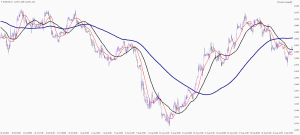
The moving averages indicator can also be used to identify support and resistance levels in the market. When prices are bouncing off of the moving average line, this is an indication that there is support at that level. Similarly, when prices are struggling to break through the moving average line, this is an indication of resistance.
The moving averages indicator can be used in conjunction with other technical indicators to form a complete trading strategy. For example, many traders use moving averages in conjunction with support and resistance levels to trade breakouts.
Different Types of Moving Averages
Exponential Moving Average (EMA)
The exponential moving average (EMA) is a type of moving average that places more weight on recent prices. This makes it more responsive to recent price changes than a simple moving average.
The formula for calculating an exponential moving average is:
EMA = Price(t) * k + EMA(y-1) * (1 – k)
where:
t = the current period
y = the previous period
k = the weighting factor
The weighting factor, k, is calculated as: 2 / (n + 1) where n is the number of periods in the moving average.
For example, a 10-period EMA would have a weighting factor of 2 / (10 + 1) = 0.182.
Simple Moving Average (SMA)
The simple moving average (SMA) is the most common type of moving average. It is calculated by taking the arithmetic mean of a given set of data.
For example, a 10-day SMA would be calculated by adding up the closing prices for the past 10 days and then divided by 10.
The formula for calculating a simple moving average is:
SMA = (Price(t) + Price(t-1) + … + Price(t-n)) / n
where:
t = the current period
n = the number of periods in the moving average
A simple moving average is less responsive to recent price changes than an exponential moving average. This makes it a good choice for identifying longer-term trends.
Moving Average Convergence Divergence (MACD)
The moving average convergence divergence (MACD) is a technical indicator that is used to identify trends in the market. The MACD is calculated by subtracting the 26-period exponential moving average (EMA) from the 12-period EMA.
The MACD line is the difference between the 12-period EMA and the 26-period EMA.
The MACD histogram is a graphical representation of the MACD line. It is used to identify where the MACD line is relative to the signal line.
The signal line is a 9-period EMA of the MACD line.
MACD = 12-period EMA – 26-period EMA
Signal line = 9-period EMA of MACD line
MACD histogram = MACD line – Signal line
The MACD is a popular technical indicator that is used by many traders to identify trends in the market. The most common way to use the MACD is to look for divergences between the MACD line and the price action. A bullish divergence occurs when the MACD line forms higher lows while prices are forming lower lows. This is an indication that prices may be about to reverse course and start moving higher.
A bearish divergence occurs when the MACD line forms lower highs while prices are forming higher highs. This is an indication that prices may be about to reverse course and start moving lower.
Linear Weighted Moving Average (LWMA)
The linear weighted moving average (LWMA) is a type of moving average that gives more weight to recent prices. This makes it more responsive to recent price changes than a simple moving average.
The LWMA is calculated by taking the arithmetic mean of a given set of data and then multiplying each data point by a weighting factor. The weighting factor is calculated as: (n – 1) / n where n is the number of periods in the moving average.
For example, a 10-period LWMA would have a weighting factor of (10 – 1) / 10 = 0.9.
The formula for calculating a LWMA is:
LWMA = (Price(t) * 0.9) + (Price(t-1) * 0.8) + … + (Price(t-n) * 0.1)
where:
t = the current period
n = the number of periods in the moving average
The LWMA is a popular technical indicator that is used by many traders to identify trends in the market. The most common way to use the LWMA is to look for divergences between the LWMA and the price action. A bullish divergence occurs when the LWMA forms higher lows while prices are forming lower lows. This is an indication that prices may be about to reverse course and start moving higher.
A bearish divergence occurs when the LWMA forms lower highs while prices are forming higher highs. This is an indication that prices may be about to reverse course and start moving lower.
Smoothed Moving Average (SMMA)
The smoothed moving average (SMMA) is a type of moving average that gives more weight to recent prices. This makes it more responsive to recent price changes than a simple moving average.
The SMMA is calculated by taking the arithmetic mean of a given set of data and then multiplying each data point by a weighting factor. The weighting factor is calculated as: 2 / (n + 1) where n is the number of periods in the moving average.
For example, a 10-period SMMA would have a weighting factor of 2 / (10 + 1) = 0.1818.
The formula for calculating a SMMA is:
SMMA = (Price(t) * 0.1818) + (Price(t-1) * 0.1636) + … + (Price(t-n) * 0.0455)
where:
t = the current period
n = the number of periods in the moving average
The SMA is a popular technical indicator that is used by many traders to identify trends in the market. The most common way to use the SMMA is to look for divergences between the SMMA and the price action. A bullish divergence occurs when the SMMA forms higher lows while prices are forming lower lows. This is an indication that prices may be about to reverse course and start moving higher.
A bearish divergence occurs when the SMMA forms lower highs while prices are forming higher highs. This is an indication that prices may be about to reverse course and start moving lower.
The risk involved with forex trading online shouldn’t be overlooked. There is a chance of losing a significant amount of money if you don’t know what you’re doing. It is crucial to gain a knowledge of the market prior to you even begin investing with money. Keep reading our lessons.