


There are a number of ways to trade breakouts in the forex market, and which one you use will depend on your own personal trading style. Some traders prefer to wait for a breakout to occur before entering a trade, while others may enter a trade before the breakout occurs. There is no right or wrong way to trade breakouts, and it is up to each individual trader to decide what works best for them.
One of the most popular ways to trade breakouts is to wait for a breakout to occur and then enter a trade in the direction of the breakout. This can be done by placing a buy order just above the point of the breakout, or a sell order just below the point of the breakout. The stop loss for this trade would then be placed just outside of the recent high or low, depending on which direction the breakout occurred.
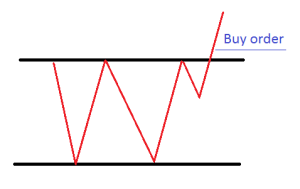
Another way to trade breakouts is to enter a trade before the breakout occurs. This is done by placing a pending order just above or below the level at which the breakout is expected to occur. The stop loss for this trade would then be placed just outside of the level at which the breakout is expected to occur. This type of trade can be more risky, as there is no guarantee that the breakout will actually occur. However, if it does occur, this type of trade can have a large profit potential.
Benefits of the Forex Breakout Strategy
The breakout strategy has the following advantages.
- The strategy model allows you to make significant profits in a short period of time. This opportunity exists because when the price exits a sideways trend, it often is very volatile.
- The strategy model uses a fairly reliable signal that allows you to determine price direction.
The above advantages are based on reflective nature of the market. When a signal appears many traders see it and by taking action they are strengthening volatility. Breaking the level of support or resistance is one of the most reliable signals (except trend reversal). The main disadvantage of such strategy is low efficiency when working on a flat market.
Analysis of the Two Breakout Trading Models
Let’s analyze the model of short-term breakout trading. Entry should be opened when price is 10-15 pips above (below) resistance level (support level). It is important to mention that exit from a narrower channel (up to 30 basis points) is carries higher profit potential.
There are two tactics, which will help you to close an entry and determine a stop-loss order:
1) Buy and hold.
2) Short term trading.
Buy and Hold Tactic
The “Buy and Hold” tactic is based on the fact that the position should be held throughout trend duration. This tactic is used when there is confidence that the trend behavior will remain unchanged until calculated level (take profit level). “Buy and hold” tactics sometimes are called “strong nerves” tactics, since there is always a chance that the trend unfolds before reaching your take profit. That is why, in order to reduce the level of risk this tactic carries, it is recommended to use “trailing stop”. The main idea of Trailing Stop is to close a profitable trade at the moment when price starts to reverse.
Short-Term Trading Tactic
The “Short term trading” tactics is based on early closing trades. Trader closes open orders fast without waiting for a possible trend correction or its reversal. After closing one order, the trader can look for new entries at the moment when trend touches next level of support or resistance or breaking through it. A graphic interpretation of “Short term trading” is presented on the picture below.
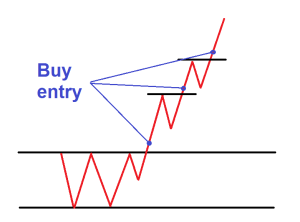
Practice shows that using “Short-term trading” tactics in most cases gives lower returns than “Buy and hold” tactics. At the same time “Short term trading” tactics carries less risk.
Trading Fake Breakout
Just as there are real breakouts, there are also fake breakouts, which occur when the price breaks out of a level but then quickly reverses. Fake breakouts can be difficult to trade, as it can be hard to know whether the breakout is real or not. However, there are a few things that traders can look for to help them identify fake breakouts.
One thing that traders can look for is a false breakout that occurs after a period of consolidation. This can be seen on a chart as a price that breaks out of a range and then quickly reverses. Sometimes, the price will even retrace back into the range it just broke out of. This can be a sign that the breakout was not real and that the price is likely to continue consolidating.
Another thing to look for is a false breakout that occurs with little volume. This can be seen on a chart as a price that breaks out of a level but then quickly reverses and doesn’t move much after the breakout. This can be a sign that there wasn’t much interest in the breakout and that it was likely fake.
Finally, another thing to look for is a false breakout that occurs after a sharp move. This can be seen on a chart as a price that makes a sharp move and then breaks out of a level, but then quickly reverses below the support/resistance levels.
The risk involved with forex trading online shouldn’t be overlooked. There is a chance of losing a significant amount of money if you don’t know what you’re doing. It is crucial to gain a knowledge of the market prior to you even begin investing with money. Keep reading our lessons.