


The difference between major, minor and exotic currency pairs is crucial to anyone looking to trade in the forex. These three categories serve as the foundation of currency trading. Each has its own set of unique characteristics, opportunities, and risks that can shape your strategy.
Whether you are a total beginner learning the forex basics, or are an experienced trader looking to expand your portfolio, understanding the classification of these pairs will consolidate your market knowledge and enhance your judgment.
This guide will explain the criteria on the basis of which a pair is classified as “major,” what role minors play, and the ways in which exotics can offer you opportunities if you are willing to take on the risk. You will develop an understanding of the intended purpose of these classifications and which pairs will enhance your trading possibilities.
What are major, minor and exotic currency pairs in forex trading?
Currency pairs in forex trading are classified into three main categories. These are major pairs, minor pairs, and exotic pairs. As with every other group in trading, these each have unique characteristics, liquidity levels, and trading costs. It is therefore crucial to comprehend each in order to develop a robust strategy.
In terms of the most liquid and heavily traded exchanges in the market, major currency pairs will always include the US Dollar and one of its leading counterparts, for instance the Euro, Japanese Yen, or British Pound. Examples include EUR/USD, USD/JPY, GBP/USD and USD/CHF. These pairs combined make up a substantial volume of forex trading in a day, making them a favorable choice for beginner and professional traders alike.
Minor currency pairs do not include the US Dollar. Instead, they involve other major currencies, the Euro, Pound, or Yen. Examples include EUR/GBP, GBP/JPY, and AUD/NZD. Although minors do have a slightly wider spread than majors, they still offer opportunities for traders looking to diversify beyond USD pairs.
The Seven Major Currency Pairs
The major pairs of currencies have unrivaled junctions to the most liquid and largest economies in the world. Forex trading is dominated by these pairs for the liquidity they hold.
These seven pairs, EUR/USD, USD/JPY, GBP/USD, USD/CHF, AUD/USD, USD/CAD, and NZD/USD together make up almost 90% of transactions done on forex.
Not to mention, these major pairs provide traders with ample opportunities as they can make huge transactions without a large impact on the market price. Traders enjoy these pairs as they also have a tight spread, which cuts down trading costs. With a broker like TIOmarkets, traders can enjoy competitive trading conditions without having to worry about the costs as the conditions help to keep costs low.
Major economies provide ease of access and reliability with the regular stream of economic data, which gives both beginner and seasoned traders an opportunity to operate within a low-risk environment.
EUR/USD
The EURUSD trading pair is the most popular and traded pair worldwide. Almost all economic activity in a given country or region is represented, and the EURUSD is considered a proxy for the world economy. It has lower spreads and more stable price behavior than exotic or minor pairs so is traded much more frequently.
USD/JPY
The USDJPY trading pair is in second place. It centers around interest rate differentials along with other economic factors that the USD has with the other currencies. An increase in the United States interest rate in comparison to that of Japan causes a stronger USD to JPY currency pair. The JPY is considered a ‘safe haven currency,’ meaning that traders tend to acquire the pair due to the prevailing conditions of the global economy, which causes extreme volatility to the pair.
GBP/USD
The volatility of “Cable,” The US and British Pound Currency pair, is attributed to the extreme sensitivity of cross-border and behavioral factors that each country concerns. This sensitivity to both discrete and incremental factors and policies makes it tempting and suitable for traders who profit from volatile pairs as the GBP/USD witnesses sharp swings.
USD/CHF
The US Dollar and Swiss franc forex pair is also known as the “Swissie” and is another pair of focus by traders in times of indecision and turmoil. The reputation of a stable economy, strong banking industry, and political neutrality makes Switzerland a safe haven country. As a result, the CHF becomes a focus of attention as the market turmoil triggers a strength for the USD/CHF pair.
AUD/USD, USD/CAD, and NZD/USD
These three pairs of forex currency constitute, AUD/USD, USD/CAD, and NZD/USD and are known as commodity currencies. Such means is that the currency pairs are directly associated with the prices of gold, natural gas and oil, and dairy products.
Minor Currency Pairs
Besides the crosses that trade portals facilitate between key currencies and the US dollar, the crosses that do not have the US dollar are known as minor currency pairs. They include the Euro, British Pound, Japanese Yen, Swiss Franc and Australian Dollar.
Some well known pairs are:
- EUR/GBP (Euro and British Pound)
- GBP/JPY (British Pound and Japanese Yen)
- EUR/CHF (Euro and Swiss Franc)
Unlike major pairs, minor pairs trade with less volume thus having wider spreads as a result, which is common with many forex brokers. They are not as liquid as USD pairs, but are popular with traders looking to diversify and capitalize on regional economic activity.
Exotic Currency Pairs
Exotic currency pairs are pairs of a major currency and a currency of an emerging market, creating unique and riskier trade opportunities. The real question is, what is an emerging market economy?
An emerging market economy is any developing country with growing industrial output, increasing international trade, and progressing financial markets. Some of these are Turkey, South Africa, Mexico, and Brazil. Their currencies, when combined with a major currency like the Dollar or Euro, create pairs such as USD/TRY, USD/ZAR, and EUR/SGD.
Due to broad spreads and price activity being more sporadic and volatile, liquidity on exotic currency pairs is considered more difficult to and drawn out compared to major forex pairs. The impact of geopolitical activity and a nation’s economic movement on currencies is disproportionate compared to major or minor currencies.
Read Also: Top Best 10 Forex Pairs to Trade and Never Trade
Comparing Major, Minor and Exotic Currency Pairs in Forex
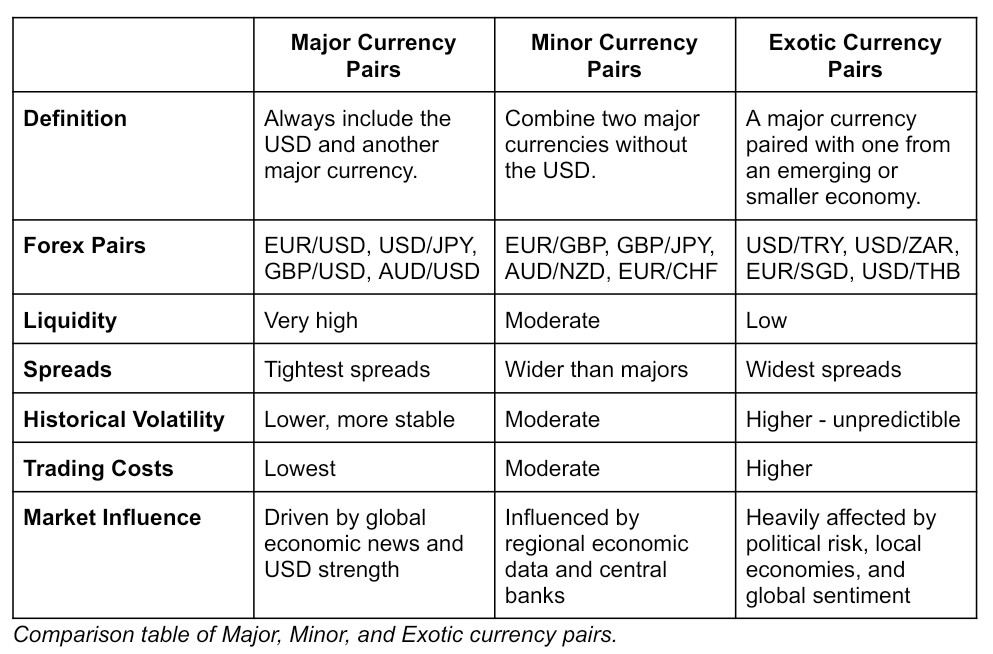
To elucidate on the differences, let’s put side by side comparison of major, minor and exotic currency pairs to show their differences and prominent defining features.
Why is the US Dollar Dominant in the Major Currency Pairs?
The USD’s prominence in major currency pairs is legacy of the US dollar being the allocated currency for the Bretton Woods Agreement of 1944, setting gold at the primary reserve currency for the globe.
Even after the agreement was abandoned in 1971 by President Nixon’s denial of gold convertibility, the Dollar still had strong control over the trade and financing on an international level. Currently, the Dollar is present in approximately 90% of Forex transactions, making it the most traded currency in the world.
Many factors such as the size and steadiness of the US economy, the Dollar’s use in international trade of commodity pricing, its utmost dominance in international trade settlement use, and the overall mass of the US financial markets is what makes it the uppermost currency in the globe.
These factors are what makes international trade prominent and means of settling for pegging the currencies to the Dollar. It is also due to the numerous central banks that keep abundant USD reserves, making the currency a dominant peg in the global financial system.
Because the Dollar is a dominant currency, the major currency pairs will be the most liquid and have the tightest spreads on the forex market. The economic information from the United States, along with the Federal Reserve policy votes, employment figures, and GDP numbers, greatly influence all major pairs. Consequently, US economic analysis is an important part of successful forex trading.
Different strategies for pairs by currency class
Every class of currency pairs requires a unique trading strategy, and this is largely determined by the pair’s characteristics. Major pairs are often traded with a combination of pattern and historical economic event trading.
For forex traders on minor pairs, analysis is based on the major microeconomic and macroeconomic factors of the two concerned currencies. It is necessary to have a sound grasp of global politics and the economic ties between the two countries to form a strategy for minor currency pairs. Because the spreads are wider and the overall liquidity is lower than for major currency pairs, position size may need to be adjusted.
In the case of exotic pairs, it is important for traders to analyze the emerging market period. Exotic traders must examine the exotic pairs including risk of political instability in the relevant countries, commodity prices, and the economic state of the countries in question. Volatility in risk is high and must be managed. These traders, in particular, should focus on risk management techniques such as stop loss and take profit orders.
Conclusion: Mastering Major, Minor and Exotic Currency Pairs in Forex
Constructing a strategy involves knowing the relevant pairs as well as their major, minor, and exotic distinctions.
Everyone can see that major pairs are widely traded for their high standards of liquidity and low spread. Minor pairs, on the other hand, enhance diversity of trading strategies through concentrating on cross currency relations, whilst exotic pairs offer more lucrative opportunities of trading, albeit at a risk of high spreads.
The decision to use major, minor, and exotic pairs depends on one’s trading approach, the level of risk, and the volatility of the particular economy or countries of interest. A trader’s capability of identifying the peculiarities of the indicated categories assists them in formulating major adjustments to their decisions pertaining to currency pairs for trading and their management.