

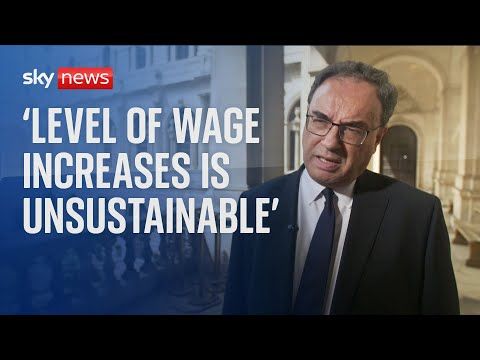
Bank of England governor Andrew Bailey has said it is “absolutely critical” for the British central bank to maintain its inflation rate target at two percent, signaling further rate hikes in the coming months.
Bailey’s remarks came after calls for central banks to raise their inflation targets. Proponents of inflation target change recommend raising the target to three or four percent, saying it will provide central banks more flexibility and “spare some pain” for businesses and consumers.
The two percent inflation target has become a guideline for central banks, including the U.S. Federal Reserve and European Central Bank, across the globe for years. The BoE reasons that if inflation exceeds that target, it will be hard for businesses to set the right prices and people to plan their expenses. Meanwhile, too low inflation can lead to a series of business failures and rising unemployment.
Britain’s headline consumer price index — a major indicator of inflation — stood at 8.7 percent in May, after peaking at 11.1 percent in October last year. At the same time, core price inflation, excluding food and energy, rose to 7.1 percent — the highest over three decades. In his speech at a conference in Aix-en-Provence, France, Bailey acknowledged that inflation in the U.K. was more “stubborn” than in other countries.
The BoE began its monetary tightening campaign in December 2021 to battle inflation. It last raised the key rate by 50 basis points to five percent. Experts, however, have warned that the bank’s aggressive rate hikes can make the economy contract. They point out that the mortgage crisis, resulting from high interest rates, may push the U.K. into a recession.
London-based rating agency Moody’s explained that Britain is vulnerable to a recession because most of its mortgage holders have short-term fixed-rate loans for their properties. British mortgage holders usually lock in fixed interest rates for two or five years, meaning their outstanding mortgages will follow the new base rate.
According to the Institute for Fiscal Studies, soaring mortgages will reduce household disposable income by 7.5 percent. Paired with rising costs, British consumers’ ability to afford goods and services will further decline if central bank policymakers keep raising interest rates.
Besides the mortgage crisis, Vanguard senior economist Shaan Raithatha said the U.K. experienced a labor shortage due to increasing long-term sickness leaves and “energy shock.” Raithatha said the energy shock in the U.K. was more significant than in mainland Europe. According to the economist, the issue might result from Britain’s slower reaction to the energy crisis than its peers.
“There’s an issue here because the economy is very resilient, we know that the transmission towards mortgages is a bit slower and a bit less effective than we’ve had in the past as well, and so clearly the Bank has to do a bit more to get inflation under control,” said Raithatha.
Updates on British financial markets
Britain’s economic outlook has influenced its financial markets. Forex experts say the pound/dollar exchange rate may experience volatility in the third quarter. In mid-June, the currency pair hit a ten-month high of $1.252. Expectations of further monetary tightening by the Fed in the U.S. will likely push the dollar to rally, putting pressure on the British currency in the coming weeks.
Meanwhile, the benchmark FTSE 100 index in the London Stock Exchange is expected to hit a new high this year despite the macroeconomic uncertainty. The index hit its all-time high of 8,047 last February. Analysts explain that share buybacks, dividend growth and earnings increases will fuel the index’s rally this year. On Friday last week, the index closed 0.32 percent lower at 7,256.94.