

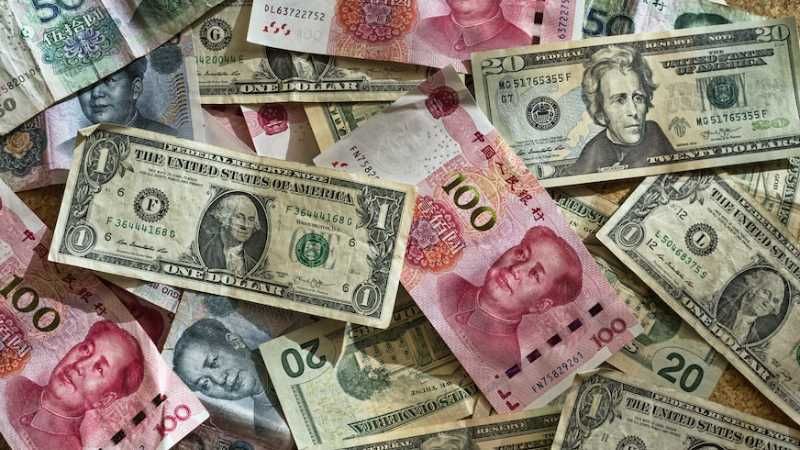
Several anonymous banking sources recently revealed that China’s biggest state banks had decreased their dollar deposit rates for the second time in a month. This decision came as Chinese authorities intensified their efforts to stabilize the declining yuan.
Per a Bloomberg report, several banks, including the four major state-owned lenders, eliminated the spread they had previously provided over the U.S. Secured Overnight Financing Rate (SOFR) for corporate clients.
These sources noted that banks had provided one-year deposits at 5.7 percent, down from six percent around a month ago. As of now, the SOFR stands at 5.09 percent.
Significant cuts in interest rates have also impacted retail investors. State-owned banks recently reduced one-year rates on household deposits from the range of 4.5 percent to five percent to approximately 2.8 percent.
In contrast, one-year yuan deposits offer a rate of 1.65 percent for a similar period. The decrease in deposit rates aims to support the yuan by reducing its appeal for companies and people to convert their cash holdings into dollars.
Traders and analysts have suggested that policymakers are concerned about the long-lasting depreciation of the yuan. They fear that this depreciation may deter foreign investment and trigger capital outflows.
In response, policymakers plan to lower dollar deposit rates. These rates align with offshore rates but will be reduced to match the reduced domestic rates implemented to stimulate the weakening economy.
Due to China’s economic slowdown and widening yield differentials with the U.S., the yuan has experienced a significant decline of nearly five percent against the dollar. It made it one of the poorest-performing Asian currencies of the year.
Ken Cheung, the chief Asian F.X. strategist at Mizuho Bank, explained that this action aims to reduce the “interest rate advantage of the U.S. dollar in onshore markets.”
Cheung added that the objective is to discourage the accumulation of dollars and promote settlements in foreign exchange.
Two sources disclosed that the new rates became effective on July 1. They further noted that certain banks were not providing rates surpassing the 2.8 percent limit for large deposits. It is common for banks to offer higher rates for deposits that exceed $1 million.
Measures to curb yuan’s decline against the dollar
Trading sources have unveiled that the People’s Bank of China (PBOC), the country’s central bank, has taken new measures to slow down the yuan’s decline against the dollar.
These include establishing daily fixings for the currency that are stronger than anticipated. State banks are also observed selling dollars in the onshore and offshore markets.
Reuters sources reported that primary state banks had already lowered these rates by up to 100 basis points from the previous upper limit of 5.3 percent in early June.
Last week, other sources said that the central bank had surveyed foreign banks to gather information about the interest rates they offer for dollar deposits to their clients.
In last Friday’s statement, the PBOC reassured that it would continue to maintain the yuan’s relative stability and mitigate the potential hazards associated with substantial fluctuations in the exchange rate.
Currency traders also noted that decreasing dollar deposit rates would relieve commercial lenders’ net interest margin pressure. Before the recent adjustments, banks’ dollar deposit rates had been higher than lending rates, and these changes seek to address that disparity.
According to data from the central bank, Chinese companies had foreign currency deposits totaling $453 billion by the conclusion of May. Households possessed $125 billion in foreign currency deposits.
Bloomberg suggested that the size of corporate deposits in China could be more significant than what official data reveals. Research conducted by Eurizon SLJ Capital Ltd. indicates that Chinese firms currently have around $912 billion as U.S. currency deposits in the country’s banking system. This amount has grown from $758 billion recorded at the end of 2019.