

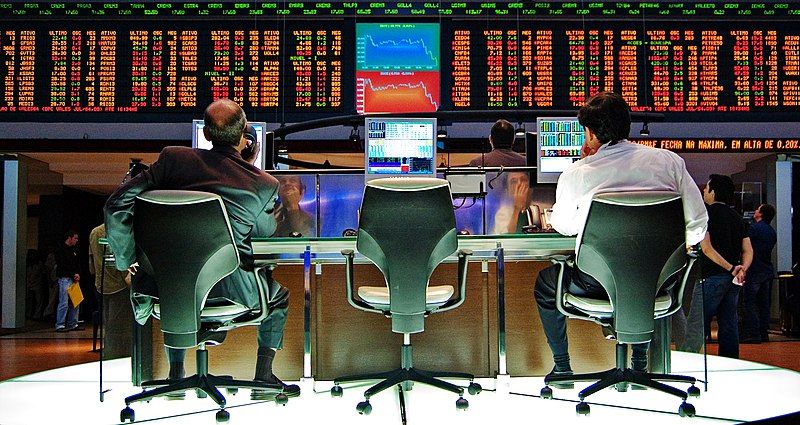
Wall Street gained on Monday as investors expected the U.S. Federal Reserve to not increase the interest rate for the first time since March last year.
The S&P 500 rose by 40.07 points or 0.93 percent to close at 4,338.93, the highest level over a year. As of last week, the index rose by 20 percent from its October 12 low. Analysts said recent gains in the index indicated a start of a bull market.
Meanwhile, the Dow Jones Industrial Average closed at 34,066.33, gaining 189.55 points or 0.56 percent. The Nasdaq Composite concluded the trading session at 13,461.92, rising by 202.78 points or 1.53 percent. The daily percentage gain on Monday was the biggest for Nasdaq since May 26.
NFJ Investment Group portfolio manager Burns McKinney said rate-sensitive growth stocks contributed to Wall Street’s gains on Monday. The technology sector in the S&P 500 closed 2.07 percent higher at 2,991.18. Microsoft strengthened by 1.55 percent, while Apple posted a 1.56 percent gain.
Analysts explained that the expectation of a steady benchmark rate made investors opt for risky assets like equities.
“Investors have been looking forward to a Fed pause in the rate hiking cycle since they started over a year ago,” said McKinney. “They’re trying to get out ahead of that.”
The market forecasts a 75 percent chance of the Fed maintaining the current federal fund rate at 5.00 to 5.25 percent. Investors still consider the possibility that the Fed may hike the interest rate by 25 basis points next month.
Fed buying time
In May, Fed governor Philip Jefferson said the central bank could “skip” hiking rates in the June 13-14 meeting. He argued that keeping the rate steady for a while would provide a better insight into the U.S. economy. Jefferson yet asserted that the skip would not mean the end to the central bank’s tightening campaign.
BofA Global Research economists said the Fed “appears to want additional time” to see the full impact of policy lags and recent banking stress. Analysts say the Fed’s hawkish policy and banking turmoil have reduced credit availability for American consumers and businesses.
“While incoming data point to resilience in activity and stickiness in inflation, the Fed appears to want additional time to monitor policy lags and regional bank stress.”
Economists at BofA Global Research
The U.S. government will publish data for consumer and producer prices on Tuesday and Wednesday, respectively. Economists predict that the data will show inflation slowing in the U.S., but not as quickly as the Fed expects.
In addition to the Fed, the European Central Bank (ECB) and the Bank of Japan (BoJ) will hold their respective policy meetings this week. The market expects the ECB to deliver a 25-basis-point rate hike on Thursday. The eurozone central will likely indicate further interest rate hikes as inflation in the region remains above the target rate, say analysts.
The BoJ, on the other hand, will maintain its “ultra-dovish” monetary policy. Analysts explained that Japanese financial authorities were “wary” of making a policy pivot due to the country’s years-long deflation in the past.
Asian stock markets strengthen
Asian stocks gained on Tuesday local time after the rally on Wall Street. The MSCI Asia Pacific index, excluding Japan, rose by 0.19 percent midday.
Hong Kong’s Hang Seng index added 0.24 percent to 19,450.02. Meanwhile, China’s CSI 300 was at 3,848.12 after gaining 0.096 percent. South Korean Kospi index also rose by 0.33 percent. In Japan, the benchmark Nikkei 225 index traded 1.86 percent higher at 33,037.51.
The S&P/ASX 200 in Australia also rose by 0.19 percent to 7,133.90. New Zealand’s S&P/NZX 50 strengthened by 0.32 percent as well.