

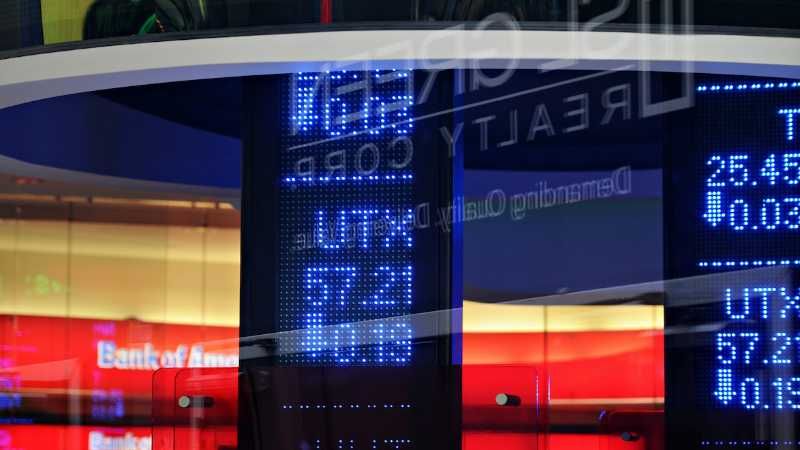
Stocks on Wall Street declined on Tuesday as investors waited for the outcome of the debt ceiling discussions in Washington.
The Dow Jones index finished at 33,012.14, losing 336.46 points or 1.01 percent. The S&P 500 concluded the trading session at 4,109.90, falling by 26.38 points or 0.64 percent. Meanwhile, the Nasdaq Composite index lost 22.16 points or 0.18 percent to close at 12,343.05.
Shares of Horizon Therapeutics plunged 14.17 percent after the Federal Trade Commission said it would file a lawsuit to prevent the acquisition of the biopharmaceutical company by rival Amgen in a deal worth $27.8 billion. Amgen stock finished 2.42 percent lower in the same session. The decline of both companies weighed on the Nasdaq Biotech Index, which posted a three-week low after falling by 2.44 percent.
Home Depot was one of the biggest drags on the Dow Jones and S&P 500, falling by 2.15 percent after the home improvement retailer slashed its annual sales projection and forecasted a sharper-than-anticipated decline in profit. The retailer’s peer, Lowe’s Companies, also saw a 1.16 percent loss in its stock value.
“You can argue that people are tired of spending on the house, they want experiences, they want to go out they want to do other things, they don’t want to fix up the house according to Home Depot, because they had horrendous earnings.”
Ken Polcari, Managing Partner at Kace Capital Advisors
Kace Capital Advisors managing partner Ken Polcari explained that consumers were “tired of spending on the house” because their wages could not keep up with rising costs in various consumer products. The Commerce Department reported that retail sales increased 0.4 percent in April, against the estimates of a 0.8 percent increase.
Capital One stock climbed 2.05 percent after Berkshire Hathaway announced Monday that it had bought a stake in the banking firm. On Tuesday, Berkshire Hathaway closed 0.07 percent higher.
Shares of ONEOK declined by 2.36 percent after the midstream service provider announced a plan to buy pipeline operator Magellan for around $18.8 billion. Meanwhile, Magellan shares declined by 2.49 percent.
Polcari said the ongoing debt ceiling crisis was “causing angst” in investors who were already “a little bit more sensitive” to the Federal Reserve’s prevalent impact in slowing inflation.
President Joe Biden has begun talks with House Speaker Kevin McCarthy to form an agreement to raise the national debt limit. Republicans have asked Biden’s administration to cut spending, while Democrats suggest discussing the budget issue separately.
The U.S. hit the debt limit of $31.4 trillion this January, forcing the Treasury to maneuver the budget to maintain the ability to pay its obligations. Treasury Secretary Janet Yellen warned that the country could default on its debts in June if lawmakers could not form an agreement on time.
Analysts have discussed the potential negative consequences of a U.S. default, which includes a stock sell-off. The impact of a U.S. debt default will also affect other countries as the U.S. remains one of the global economic powerhouses.
Market anticipates Fed’s future policy
In addition to the outcome of debt ceiling talks, investors are anticipating the Fed’s future rate policy. Fed fund futures predict that the central bank will pause the interest rate hike campaign in its next policy meeting. Investors also forecast rate cuts to begin this September.
Several Fed officials have spoken in public ahead of the agency’s upcoming meeting in June. Atlanta Fed President Raphael Bostic said he did not expect the central bank to start cutting rates this year as the inflation rate remained well above the Fed’s two-percent target.
Meanwhile, Richmond Fed President Thomas Barkin said he was “comfortable” with further interest rate hikes if necessary. Barkin, nevertheless, noted that he agreed with the “optionality” implied in the Fed’s latest policy statement in which the Federal Open Market Committee omitted language that indicated additional hikes.