

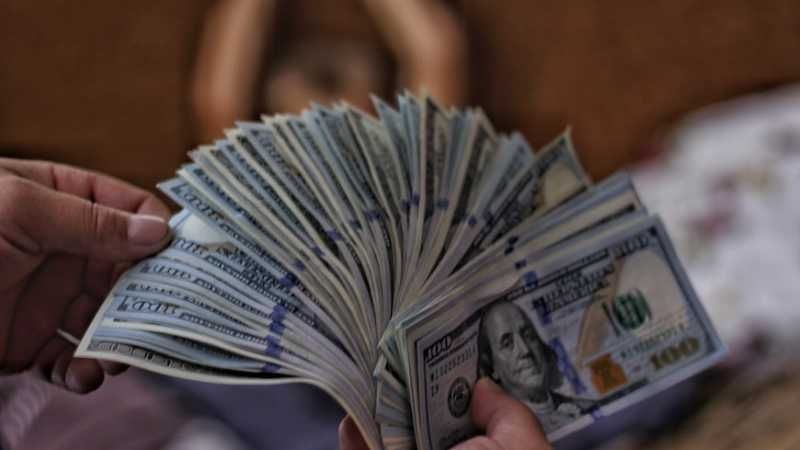
The U.S. dollar weakened in the Asian forex market on Wednesday local time as investors anticipated new consumer price data to acquire a better economic outlook.
The dollar index, which tracks the currency’s value against six major peers, declined by 0.07 percent to 101.55. The euro rose 0.11 percent to $1.0971, while sterling gained 0.1 percent to $1.2634 ahead of the Bank of England’s (BoE) policy meeting. The market expects the BoE to hike the cash rate by 25 basis points on Thursday.
Against the dollar, the Japanese yen strengthened by 0.1 percent to 135.11 per dollar. The Bank of Japan (BoJ) governor Kazuo Ueda said Tuesday that the central bank would end its yield curve control policy and shrink its balance sheet.
Commonwealth Bank of Australia currency strategist Carol Kong said the BoJ’s decision “was not surprising at all” because the market had been anticipating the Japanese central bank to take action soon.
The Australian dollar also traded 0.08 percent higher to $0.67675 versus the U.S. currency after a new report showed that the country had a budget surplus for the first time in 15 years, supported by strong job growth and increasing profits from the mining sector.
Analysts said the incoming U.S. consumer prices data would likely “set the tone” for the market after the stronger-than-anticipated payrolls report last week. The U.S. added 253,000 nonfarm payrolls in April, significantly higher than the initial estimates of 180,000.
Investors expect headline consumer prices growth of 5.2 percent in April, a decline from the six percent posted in March. However, analysts at market research firm Barron’s cautioned that consumer prices data could be “mild” and that the Fed expected a more significant decline in consumer price index year-over-year to pause its monetary tightening campaign.
The Fed raised the country’s benchmark lending rate by a quarter of a percentage point last week, signaling a possible pause in next month’s policy meeting. Fed chairman Jerome Powell said officials would monitor incoming inflation data to determine whether additional hike would be “appropriate.”
Analysts pointed out that the Fed needed to take the recent turmoil in the U.S. banking sector into account when deciding on the rate policy. The central bank’s quarterly survey revealed that credit conditions for U.S. private firms and households continued to tighten since New Year, likely due to the high interest rate, which currently ranges from 5.00 to 5.25 percent.
A series of bank failures followed the high-profile collapse of regional lender Silicon Valley Bank in March. Several regional lenders reported deposit outflows as clients moved their money to bigger lenders. Recently, JPMorgan Chase acquired the majority of First Republic Bank since the San Francisco-based lender encountered a liquidity issue.
U.S. debt ceiling crisis to influence dollar
The U.S. unresolved debt ceiling crisis can further weaken the dollar, as noted by analysts. The country needs to raise its debt ceiling to avoid defaulting on its debts, with analysts forecasting the U.S. to reach its legal cap as early as next month.
“There has been a lot of attention lately on the debt ceiling issues. So that means there could be some more volatility in markets … and I think the dollar could weaken even further, as we have seen in the past.”
Carol Kong, Currency Strategist at Commonwealth Bank of Australia
The debate surrounding the debt ceiling happens because Democrats insist on raising the legal cap without any trade-off while Republicans demand several requirements, including spending cuts, before agreeing to the cause. Democrats reason that spending cuts will prevent the government from realizing some of its programs in the coming years.
Breaching the debt limit will lead to the inability of the federal government to pay its bills, including Social Security checks and Medicare reimbursements. It will also accelerate a recession, which analysts have already predicted to happen within the third quarter.