

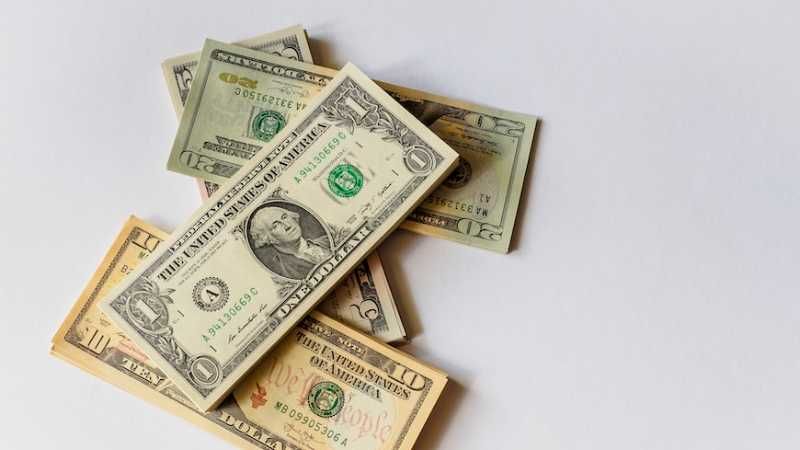
The U.S. dollar declined Wednesday after the Federal Reserve raised the benchmark lending rate by 25 basis points and signaled a possible rate hike pause.
The dollar index, which tracks the greenback’s performance against six major currencies, fell by 0.42 percent at 101.42 after reaching its one-week low of 101.05 earlier in the session. The index also posted a 0.22 percent decline the day before.
Data in the forex market showed that the euro rose by 0.46 percent to trade at $1.1047, just below a 13-month high of $1.1096 achieved last week. Analysts have said that the euro’s recent rally is influenced by the market’s expectation of narrower the interest rate gap between the dollar and the euro.
The dollar also tumbled by 1.02 percent to 135.15 yen. It dropped by around 0.56 percent on Tuesday, allowing the Japanese currency to recoup some losses that followed the Bank of Japan’s decision to maintain its ultra-dovish monetary policy.
The Australian dollar rose by 0.05 percent at $0.6666. The Aussie breached a two-week high of $0.6717 the day before after the Reserve Bank of Australia resumed its monetary tightening campaign after a pause in May, raising the country’s cash rate by 25 basis points to 3.85 percent.
After the policy meeting, Fed chairman Jerome Powell said the central bank would watch incoming economic data to gauge whether more hikes “may be appropriate.” Analysts said the Fed’s implicit signal for a rate hike pause had slightly lifted the dollar off session lows, which it breached immediately after the central bank published the meeting results.
“Some people might have been expecting some sort of explicit pause,” Adam Button, chief currency analyst at market data platform ForexLive, said. “I don’t think that was realistic but this is what a pause sounds like in reality.”
A pause in the Fed’s tightening campaign will give officials time to assess the impact of recent banking stresses, wait on the final decision of political debate regarding the U.S. debt limit and monitor the progress of inflation, said analysts.
“The Fed continues to walk the tight rope, and that is they’re trying to strike a balance between their inflation fighting credibility while trying to engineer a soft landing,”
Michael Arone, Chief Investment Strategist at State Street Global Advisors
State Street Global Advisors chief investment strategist Michael Arone said the Fed continued to “walk the tight rope” by attempting to fight inflation while ensuring that the economy would fall on a soft landing — a state of slowing economic growth but not to the point of contraction.
Analysts have warned the Fed that its consecutive rate hikes will lead to an economic contraction. The inflation rate in the U.S. is too high for the Fed to engineer a soft landing, as noted by analysts. The country’s gross domestic product grew by 1.1 percent in the first quarter, significantly below the earlier estimates of two percent.
According to analysts, a recession in the U.S. will adversely impact global markets, given that the dollar is the world’s dominant reserve currency. Several countries have begun to reduce reliance on the U.S. dollar to protect their economies. ASEAN Plus Three countries recently agreed to enhance its currency swap lines program for emergency liquidity needs.
Incoming economic data
Investors are currently anticipating the April jobs report and the consumer price index (CPI) for guidance on the Fed’s future policy. The U.S. nonfarm sector is expected to add 180,000 jobs in April, a decline from the 236,000 increase the month before. Earlier data showed that private companies hired more employees in April due to strong demand in leisure and hospitality, but wage growth slowed.
The headline CPI will likely show a further decline in price growth, similar to data in March. Analysts, however, said core CPI — which excludes energy and food prices — had remained high in the past year.